The Truth Revealed

Tuesday, November 25, 2008

Yes, vote-buying existed in my time, says Dr M

The Malaysian Insider
By Leslie Lau
Consultant Editor

KUALA LUMPUR, Nov 25 — Tun Dr Mahathir Mohamad continued his campaign today against money politics in Umno by questioning the determination of current party leaders in ridding themselves of the culture of vote-buying.

He admitted that vote-buying also existed in his time as party president, but it was never as openly practised as it is now.

"Incidents of bribery are now widespread and open until the public looks upon Umno politics with disgust. That did not happen before.

"It never came to a point where the party president is accused of money politics. It never happened to such an extent that the disciplinary board receives up to 900 complaints," he wrote in his chedet.com blog today.

Dr Mahathir has grown increasingly vocal over the issue of money politics, or vote-buying, in the current Umno election campaign.

He has openly accused party leaders of using money to secure nominations for top posts, and has threatened to name those he claims are guilty of bribing their way to high office.

The former prime minister has also warned Umno that it stands to lose heavily in the next general election if the practice of vote-buying continues.

He said today that the fact that money politics existed during his time cannot be used to excuse or legitimise the openly corrupt practises under the current party leadership.

"I admit that when I was Umno president and prime minister, there was already money politics," he said in acknowledging accusations that it was under his watch that vote-buying crept in to become part of the party's culture.


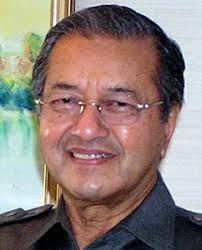
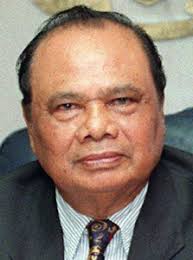
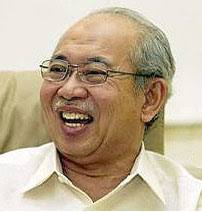
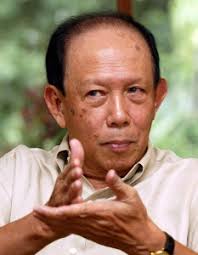
"This was clear when Tun Ghafar Baba (left) and I were challenged," he said referring to his slim victory in the 1986 Umno elections in which the two men defeated by a slim margin Tengku Razaleigh Hamzah (center) and Tun Musa Hitam (right).

He said that was the reason why a new system was introduced in which each nomination for the top posts received bonus votes.

Later on, he said a minimum requirement, or quota, was introduced in which candidates had to receive a certain number of votes before they are allowed to get on the starting block.

He said it is clear that even the current quota system has not been successful in getting rid of vote-buying.

If leaders known for engaging in money politics are elected into office it will lead to Umno's defeat in the next general election.

"The public knows who they are even though it is hard to prove they are paying for votes," he said.

Monday, November 24, 2008

Can Dr Mahathir cure Umno of money politics?

Business Times Singapore
Monday, 24 November 2008 10:06

There is considerable irony is his threat. It was under his 22-year tenure that corruption flourished and took root within the party. Dr Mahathir tried with words to root it out - scolding, cajoling, imploring, begging, even crying on occasion. He would have been better served by coming down hard on offenders, using some of his formidable powers that he amassed when he was premier.

Umno has already nominated the candidates who will contest party elections for every post from the deputy president downwards. Unfortunately, there's more than four months of campaigning before the actual polls itself.

The reason for the delay is Prime Minister Datuk Seri Abdullah Ahmad Badawi. Abdullah has declined nominations for the Umno presidency but he still wants to be Prime Minister until March so the party's supreme council, not without reservations, postponed the polls to that month while allowing nominations to begin in September.

Deputy Prime Minister Datuk Seri Najib Razak is already premier-elect because no one secured enough nominations to challenge him for the presidency. But there are fights everywhere else with three candidates jostling for the deputy presidency; eight for the three vice-presidential posts; and contests for both the head of the Youth and Women's wings - unseen in Umno for a long, long time.

Some might say that this is a healthy development for a political party that claims to champion democracy. But this is Umno - where money politics has been on the rise since the late 1980s. The fear is that a successful candidate may actually have been the best that money can buy and it is a concern that is grounded in not inconsiderable evidence.

Most of the evidence is anecdotal but it is widely believed. Tengku Ahmad Rithauddeen, a former foreign minister and current head of the party's disciplinary committee, has labelled the party "sick" and in need of "strong medication".

Former Prime Minister Tun Dr Mahathir Mohamad thinks that he knows the medication required. Writing in his blog last week, Dr Mahathir threatened to publicly reveal the people whom he alleges are involved in money politics.

There is considerable irony is his threat. It was under his 22-year tenure that corruption flourished and took root within the party. Dr Mahathir tried with words to root it out - scolding, cajoling, imploring, begging, even crying on occasion. He would have been better served by coming down hard on offenders, using some of his formidable powers that he amassed when he was premier.

Be that as it may, Dr Mahathir, 82, is now fed up and thinks that the time is ripe for stern action. He has proposed to do several things. He said that all reports on money politics submitted to him would be forwarded to the Umno disciplinary committee and the Anti-Corruption Agency. "If these two means are futile, I will reveal the names of those involved together with reports in my blog," he wrote.

Dr Mahathir has already endorsed both Najib and International Trade Minister and Umno vice-president Tan Sri Muhyiddin Yassin for Umno president and deputy respectively. But Muhyiddin faces a two-cornered challenge from Malacca Chief Minister Datuk Ali Rustam and Land and Regional Development Minister Tan Sri Muhammad Muhammad Taib. Both are candidates whom Dr Mahathir scornfully described as "jokers" before they received enough nominations to qualify as aspirants to the post of deputy president.

His appraisal of them didn't stop them from receiving quite decent support for a deputy presidential bid. Truth be told, there are no lack of stories about most aspirants - except Najib, who does not have to - judiciously using money to help their causes.

There is only one thing wrong with the former premier's threat. He is an interested party as his youngest son Datuk Mukhriz Mahathir is among three candidates eyeing the Umno Youth chief's post. So he will have to be seen as impartial and come out with everything he knows or risk a backlash with those he named pointing fingers elsewhere.

That could be a disaster for a party that's trying to regroup and re-invent itself for the future. But that's just the talk. There has been no corresponding walk and Umno has shown no desire to change. Who knows? Dr Mahathir's "surgery" may be just what the doctor ordered.

Saturday, November 15, 2008

Dr M: Pak Lah to blame for corruption and cronyism in Umno


By Shannon Teoh

KUALA LUMPUR, Nov 14 - Former Prime Minister Tun Dr Mahathir Mohamed today blamed Prime Minister Datuk Seri Abdullah Badawi for the corruption which he says is rife in Umno.

He said the new Umno leadership would have to work hard to repair what he described as the damages inflicted on the country by Datuk Seri Abdullah Ahmad Badawi's administration.

Dr Mahathir, who has been increasingly vocal in recent weeks, repeated his contention that Barisan Nasional's (BN) current weak position is largely the fault of Abdullah.

Writing in his popular chedet.com blog today, he defended his own administration and leadership, pointing out that even when Umno was extremely unpopular in 1999, BN managed to retain its two-thirds majority in Parliament.

"Umno leaders must now meet as many Umno members and voters as possible to hear their

complaints," he said, naming the economic downturn, inflation, lack of employment and contracts for small contractors as matters that Datuk Seri Najib Razak, as Abdullah's successor, must pay attention to.

He said that cronyism and corruption became rife under Abdullah.

"This was so because even Abdullah was seen to abuse his position and power to help his son and son-in-law's businesses," he stated, referring to such companies as Scomi, in which his son Kamaluddin Abdullah is involved in and ECM Libra, which his son-in-law Khairy Jamaluddin is linked to.

"Everyone knows about the RM200 given to delegates to the Kubang Pasu division so that they did not vote me to be a delegate at the 2006 Umno General Assembly," Mahathir said.

He added also that a Petaling Jaya Selatan leader as well as a veteran leader had reported that Abdullah had given RM 200 and other gifts to branch members and treated them to a stay in a luxury hotel in exchange for support of his 2010 transition plan.

"It is clear that corruption has become part of Umno culture at all levels. This will cause Umno to lose the confidence of the people.

"If Umno under Najib wants the support of voters, it must stamp out corruption. If not, voters will vote whoever pays them off and this includes the opposition," he warned.

Mahathir, who was Prime Minister for 22 years, rebutted any assertion that Abdullah had inherited a damaged Barisan Nasional.

"If so, then why did BN gain two-thirds majority since 1974? BN has never failed to rule Kedah, Perak and Selangor and since Gerakan joined BN, it has never lost Penang," he reasoned.

He further stated that Abdullah had succeeded him in Oct 2003 and in five months, won big at the 11th General Elections with 90 per cent of MPs from the ruling coalition and took back Terengganu as well as nearly regaining Kelantan from Pas.

"This shows that the BN he inherited was very healthy," Mahathir concluded and added that the Permatang Pauh by-election was further proof as "members were afraid to wear the badge and shirts of Umno or BN."

Friday, October 31, 2008

Zaid says racialist social contract a 1980s Umno creation


KUALA LUMPUR, Oct 31 — If at all there was a social contract between the Malays and non-Malays before independence, it was the guarantee of equality and the promise of the rule of law, said former de facto Law Minister Datuk Zaid Ibrahim.

Offering his take on an issue that has been at the core of a roiling debate in the country, he said that the more racialist social contract — which places more emphasis on Malay primacy — was a product of Umno ideologues in the 1980s.

He believed that on the eve of independence, one of the elements which gave Alliance leaders and all Malayans confidence was the knowledge that "a constitutional arrangement that accorded full respect and dignity for each and every Malayan, entrenched the rule of law and established a democratic framework for government had been put in place.''

The Federal Constitution, he noted, was crafted by brilliant jurists who understood the hearts of minds of those who would call this nation their home and whose children would call it their motherland.

"Hundreds of hours of meetings with representatives of all quarters resulted in a unique written constitution that cemented a compact between nine sultanates and former crown territories, '' he said.

This compact honoured the Malay Rulers, Islam, the special status of the Malays, and created an environment for the harmonious and equal coexistence of all communities through the guarantee of freedoms, he noted in a speech at the Lawasia conference today.

This social contract was unilaterally restructured in the 1980s by "a certain segment of the BN leadership that allowed for developments that have resulted in our current state of affairs,'' said Zaid.

"The non-Malay BN component parties were perceived by Umno to be weak and in no position to exert influence. Bandied about by Umno ideologues, the social contract took on a different, more racialist tone. The essence of its reconstructed meaning was this: that Malaya is primarily the home of the Malays, and that the non-Malays should acknowledge that primacy by showing deference to the Malays and Malay issues. Also, Malay interest and consent must be allowed to set the terms for the definition and exercise of non-Malay citizenship and political rights. This marked the advent of Ketuanan Melayu or, in English, Malay Supremacy.

"Affirmative action and special status became a matter of privilege by reference to race rather than of need and questioning of this new status quo was not to be tolerated.

"The new political philosophy in which the primacy of Malay interests was for all purposes and intents the raison d'ĂȘtre of government naturally led to interference with key institutions, '' he said.

He urged the Barisan Nasional government to abandon the reworked concept of the social contract and embrace "a fresh perspective borne out of discussions and agreements made in good faith with all the communities in this country.''

In his speech, Zaid also touched on:

• Democracy, the rule of law and Umno

"Mukhriz Mahathir will probably be the new Umno Youth leader. In saying as he did recently that there is no need for law and judicial reforms as it will not benefit the Malays, he typifies what is perceived as the kind of Umno leader who appeals to the right wing of Malay polity.

"That he may be right is sad as it leads to the ossification of values that will only work against the interests of the party and the nation. This type of thinking may pave the way to a suggestion in the future that we may as well do away with general elections altogether as they may not be good for the Malays. We are a deeply divided nation, adrift for our having abandoned democratic traditions and the rule of law in favour of a political ideology that serves no one save those who rule.''

• The transition to democracy in Indonesia

"The majority of Indonesians have embraced democracy, religious tolerance, and religious pluralism. In addition, a vibrant civil society has initiated public discussions on the nature of democracy, the separation of religion and state, women's rights, and human rights more generally. These developments have contributed to a gradual improvement in conditions for human rights, including religious freedom, over the past few years. Since 2003, Indonesia has also overtaken Malaysia on the Reporters sans Fronteres Press Freedom Index, moving up from 110th place to 100th out of 169 countries covered. Malaysia on the other hand has dropped from 104th place to 124th place in the same period. I am not surprised. In 1999, Indonesia passed a new press law that, in repealing two previous Suharto administration laws, guaranteed free press through the introduction of crucial measures. Progress has not stopped there. On April 3 this year, Indonesia passed its Freedom of Information Act. This latest law allows Indonesia's bureaucracy to be open to public scrutiny and compels government bodies to disclose information.''

• Nation building

"We have failed miserably in dealing with complex issues of society by resorting to a political culture of promoting fear and division amongst the people. The Ketuanan Melayu model has failed. It has resulted in waste of crucial resources, energy and time and has distracted from the real issues confronting the country. The obsession with the Ketuanan Melayu doctrine has in fact destroyed something precious in us. It makes us lose our sense of balance and fairness.”

• Malays and modernity

"Dr Mahathir was right to ask that Malays embrace modernity. He fell short of what we needed by focusing on the physical aspects of modernity. He was mistaken to think all that was needed to change the Malay mindset was science and technology. He should have also promoted the values of freedom, human rights and the respect of the law.”

• The Judiciary

"The courts must act with courage to protect the constitutionally-guaranteed rights of all citizens, even if to do so were to invoke the wrath of the government of the day. In PP vs Koh Wah Kuan (2007), a majority bench of the Federal Court chose to discard the doctrine of separation of powers as underlying the Federal Constitution apparently because the doctrine is not expressly provided for in the Constitution. This conclusion is mystifying as surely the court recognises that power corrupts absolutely and can thus be abused. If the courts are not about to intervene against such excesses who is? Checks and balance are what the separation of powers is about. Surely the apex court is not saying that the courts do not play a vital role in that regard?

"The rule of law has no meaning if judges, especially apex court judges, are not prepared to enter the fray in the struggle for the preservation of human rights and the fundamental liberties. To all our judges I say discard your political leanings and philosophy. Stick to justice in accordance with the law. - The Malaysian Insider

Wednesday, October 22, 2008

The social-contract/constitution equivalency


By Tricia Yeoh
editor@thenutgraph.com

First Conference of Rulers in Kuala Kangsar, 1897 (Public domain)

LAST week, the Conference of Rulers issued a much-publicised statement. The statement reiterated the special position of the Malay rulers, Islam, the Malay language, and the genuine interests of other communities as enshrined in the Federal Constitution. The rulers reminded Malaysians that it is not proper to dispute the provisions of the Federal Constitution.

Many have pondered the significance of the statement's issuance, since it comes immediately following a series of incidents that increasingly tug at Malaysia's inter-ethnic fabric.

There was the decision by the Home Ministry to declare Hindu Rights Action Force (Hindraf) an illegal organisation.

And then there is the continuing showdown between Seputeh Member of Parliament Teresa Kok and Malay-language daily Utusan Malaysia. Both parties are at psychological war with the other, although Kok was never proven guilty over the so-called azan debacle, which started the face-off.

Most recently, the daily published a fictional story about the murder of a Chinese woman politician, a character which many believe alludes to Kok (even though its author has denied any correlation).
Multiple interpretations

The rulers' statement, just as the constitution on which it is based, is likely to be interpreted differently by various quarters. Barisan Nasional leaders welcomed the assurance that all communities in Malaysia are treated fairly.

However, due to the timing of the statement, it could also be interpreted as a convenient legitimisation of the more racist factions within Umno. It could lead to an even more aggressive defence of the ketuanan Melayu (Malay supremacy) discourse.

The statement also comes at a time when Deputy Prime Minister Datuk Seri Najib Razak is almost assured of his ascent as Prime Minister come March 2009, barely five months away. And memories of his 1987 statement, that he would bathe the keris with Chinese blood, are still fresh for many Malaysians. One can only hope he has changed his sentiments in that regard.

On the other hand, the contents of the rulers' statement were not all that surprising, really. Some might say it was a chilling warning sent to all citizens that the social contract should not be challenged. However, the rulers also emphasised that "all provisions in the Federal Constitution" are "known as the social contract". This gives new meaning to the idea of a social contract.

In recent public discussions, politicians have only assumed it to be the exchange of Malay rights for non-Malay citizenship. But according to the rulers' definition, the entire constitution is the contract between state and citizen.

(Mis)understanding history

The debate about the position of the Malays should therefore be interpreted in light of the constitution as a whole. It is true that Article 153 highlights the special position of Malays, natives of Sabah and Sarawak, and the legitimate interests of other communities. However, it should also be read alongside Article 8, which guarantees equality before the law regardless of religion, race, descent, or place of birth.

I also find this sentence in the statement utterly intriguing: "Among the reasons identified for these [misunderstandings] ... is the cursory knowledge of those concerned regarding the historical background as to why these provisions were enshrined in the Federal Constitution, and the influence of their attempts to implicate the principles of impartiality and justice without regard for the historical background and social condition of this country."

It is unclear whether the rulers were chastising those who have questioned the social contract, or "Malay leaders" who have retaliated. Either way, the rulers seem to be ticking off those who misunderstand history, and those who are impeding upon the principles of impartiality and justice.

Therefore, to clarify a point on history, I quote the Constitutional Commission in developing the Constitution (1956):

"[A] common nationality was the basis upon which a unified Malaysian nation was to be created and that under a democratic form of Government it was inherent that all the citizens of Malaya, irrespective of race, creed or culture, should enjoy certain fundamental rights."

A common nationality seems to have been the rightful objective of the Federal Constitution, which the rulers say is synonymous with the social contract.

Hindraf supporters at opposition leader Datuk Seri Anwar Ibrahim's Aidilfitri open house on 12 Oct 2008

Safeguarding legitimate interests

Furthermore, the rulers' statement actually called on the Malays to "be united to safeguard the ... genuine interests of the other communities in Malaysia as enshrined in the Federal Constitution."

That the interests of other communities are well taken care of is emphasised several times in the statement. Indeed, Article 153 is often cited as the legal basis that protects the special rights of Malays. But the article specifies the "special position", which can be argued as socioeconomic position, of three categories: Malays; natives of Sabah and Sarawak; and legitimate interests of other communities. The latter is often a forgotten category, which is clearly stipulated in Article 153.

One could argue that the plight of the marginalised Indian community, as raised by Hindraf, falls perfectly under the purview of Article 153, too.

Due to the politicisation of race in Malaysia, Article 153 has been considered the be-all, end-all license for race-based affirmative action and ketuanan Melayu. Suflan Shamsuddin, in his book Reset, argues that it is not the article itself that people are disputing today, but rather the wrongful application of it.

If, for example, the government of the day were democratically elected, with sufficient checks and balances, the application of Article 153 would not be in such a mess. There would not be blatant misinterpretation, and there would not be misuse and abuse of a legitimate contract. The arbitrary means of handling the special position of certain communities have led to great distress.

Encourage dialogue

I hardly imagine that ordinary citizens would question the position of the Malay rulers, Islam as religion of the state, and Malay as the national language. Instead, it is those policies considered as racist and discriminatory that many have problems with. Unmitigated ketuanan Melayu has little constitutional basis, after all.

In fact, the New Economic Policy (NEP) was introduced in 1971 to correct socioeconomic imbalances among the different ethnic groups. It was quite a fair policy to begin with, and it certainly was not introduced on the basis of Article 153. To claim that the NEP was formulated on the basis of Article 153 is a retroactive attempt to say the NEP has constitutional grounds. This is a misguided afterthought, and a false argument.

The rulers stressed the need for peace, harmony and mutual respect to maintain order in the country. No Malaysian desires violence, instability and disaster. However, in seeking national unity, there must also be efforts at achieving a genuine peace and harmony that is not based on pretence.

The process of achieving this requires some civil discussion and conversation among all Malaysians. And this should be encouraged, especially among the younger generations who were not present during the formulation of the original social contract. Seeking rational dialogue — even regarding the social contract — is a much better solution than concocting political assassinations in short fiction.

Tricia Yeoh is Director of the Centre for Public Policy Studies. She believes that Article 153 of the Federal Constitution is itself not strong enough a basis to argue for racial supremacy or discriminatory policies.

Sunday, October 19, 2008

THE UNDAUNTED PRINCE


Tengku Razaleigh Hamzah is again trying to achieve his dream of becoming Umno president but with a national agenda in mind. Some say he is pushing his luck; he says he is proving a point.

DRIVING into Gua Musang, one is greeted by a huge banner announcing a religious event at Masjid Razaleigh.

The mosque is named after the constituency’s nine-term MP, Tengku Razaleigh Hamzah, who began representing the expanse of jungle and village settlements way back when the area was known as Ulu Kelantan.

And the area is ulu (remote, with the connotation of backwardness). Gua Musang boasts the largest population of orang asli in Kelantan and they revere him. Razaleigh, in turn, attends to their modest needs and supplies them with bicycles so they can get around.

Razaleigh grew up in a wealthy, political family. His father was Kelantan mentri besar before Merdeka but even as a young man, Razaleigh had his sights on the federal capital.

Now, into the second weekend of the Umno polls, the contest for the party leadership looks like a badly listing ship. Razaleigh has not, to date, received a single nomination.

Conversely, the heir apparent Datuk Seri Najib Tun Razak has already received 43 nominations out the 58 (30% of 191 divisions) required to qualify him for the top post.

Razaleigh and Najib are the only contenders for the helm, and Razaleigh actually threw in his hat first. He had offered himself as the alternative to Prime Minister Datuk Seri Abdullah Ahmad Badawi months before the latter announced he was relinquishing the position to his deputy.

At 71, the dignified, soft-spoken Razaleigh is a generation older than his 55-year-old opponent. There is a yawning gap of experience between him and the outspoken, mostly ambitious division chiefs who are at least 20 to 30 years his junior. But he does not see age as an impediment.

“Age is based on our ability to think,” he said with a smile.

Their old family ties make it just a bit awkward for Najib today to stand against his former mentor. When Razaleigh was managing Petronas, Najib’s father, second prime minister Tun Abdul Razak, had asked Razaleigh to take his son, freshly back with an economics degree after several years’ study in the United Kingdom, under his wing. Najib was told to carry Razaleigh’s briefcase and learn everything he could from him.

In keeping with his old school refinement, he has never hinted, not even in a fleeting, private moment, that Najib, or anyone else, “owed him”.

Now Razaleigh wants to make a point. He wants to remind Umno delegates that demo­cracy is very much a party tradition and the quota system — whereby candidates were required to get a certain number of nominations to qualify to run, plus entitling them to bonus points to boot — was alien to the party spirit. Razaleigh’s repeated attempts to abolish the quota system have failed, however.

If “the purpose of any political party is to win elections”, as Kelantan state Opposition Leader from Kok Lanas Datuk Md Alwi Che Ahmad asserted, then the role of politicians is to lead.

Razaleigh is no exception. He has his ambitions, if tempered by national exigencies. Look­ing at the crop of younger aspirants and their naked ambitions has not been reassuring.

“This time I am forced to come forward because no one else has the courage to stand, especially for the Malays who have no choice,” said Razaleigh.

Quietly, he has been traversing the country to remind people that he is still to be counted.

“Next general election, Umno might be rejected. And the Malays will not have a platform. Some say there is PAS. But PAS’ struggle is different.

“I heard that not only the Malays but even Umno members themselves voted the DAP. We were almost wiped out in the Federal Territory. In Permatang Pauh (by-election), there are 20,000 Umno members but Barisan received only 10,000 votes.”

He holds “the collective leadership, not any single individual leader, responsible”, meaning the Cabinet and the Umno supreme council.

Razaleigh is proud to be a lifetime member of Umno and cannot imagine leaving the party “unless they do something really detrimental to the Malays”.

“I want to democratise the party. The leadership should not have too much power. Mem­bers are now afraid of leaders, whereas it should be the other way round.”

If he were to win the president’s post, he proposed giving members, rather than delegates, the right to vote in the party leadership. He would also propose that the president hold office for not more than three terms, while state liaison chiefs be limited to two terms.

In the spirit of democracy, Razaleigh has declined to name a running mate, leaving that choice to party delegates.

Final chance

This is Razaleigh’s final stab at the top party post — and by extension the prime minister’s job. He challenged (Tun) Dr Mahathir Mohamad in 1987 and famously lost by 43 votes. According to sources close to him, Razaleigh had banked on Najib’s support but some time that day, Najib had had a change of heart.

“When I was not chosen, I backed down,” Razaleigh said simply. The quota system was introduced after that divisive party polls.

In 2004, only Gua Musang had nominated him and Razaleigh became ineligible to run for party president.

Razaleigh is an astute, experienced politician. But his palace background limits his combat in action. Uncle to the Sultan and Raja Perempuan of Kelantan, Razaleigh is fasti­dious about maintaining his princely stature.

In fact, it has become second nature to him, even in his short-sleeved cotton-shirted days when as Semangat ‘46 president he had consorted with the opposition in the Barisan Alternatif. Wallowing in the mud fighting for party positions is beneath him.

He admitted, after just a whisper of hesitation “on a Friday, so I can’t lie” to having held discussions with the Pakatan Rakyat “on general matters” without getting into the speci­fics of posts and positions. It was they who had approached him, he said.

“I was happy to talk to them to know their plans and they met me to get my views.”

In the current political whirlwind, Razaleigh has been the only candidate to offer an alternative blueprint for the Barisan Nasional’s continued survival. He suggested a single, expanded multi-racial party to which individuals could directly subscribe.

Just as Abdul Razak had formed a unifying coalition in the Barisan Nasional in 1974, after having suffered at the polls in 1969, so too, he felt, it was time for a fresh direction after the ravages of the March 8 general election.

“We must open doors so individuals can join,” said Razaleigh, although conceding that for now “it’s just a proposal which may not materialise”.

That idea was picked up by Abdullah and announced at the Gerakan assembly. Non-Malays lauded the proposal for direct membership to the coalition and an instant TV3 short-messaging service (SMS) poll showed that more than 70% of respondents supported the idea.

The proposal echoed a similar suggestion by Umno founder Datuk Onn Jaafar in the years before Merdeka. But Umno at that time was not ready.

Apparently, today it still is not prepared to accept such a drastic policy change. A clutch of Umno leaders promptly responded that it was premature and that Umno still had a role to play.

Obviously if Malaysians could subscribe directly to the Barisan, the individual component parties would become irrelevant. On such a level playing field, the Malays in parti­cular would feel threatened that their tacit privileged position in Malaysian politics would be eroded.

With such sentiments gripping Umno in the months leading up to its March party election, the idea dissipated as quickly as it was floated. It was, however, an idea very much in keeping with the country’s current mood, as proven by Anwar’s winning of Malaysian multi-racial hearts.

Anwar has dominated these past few months on the political roller-coaster.

“He called the shots,” said a blogger aligned to the maverick figure.

Abdullah’s untimely departure from the national stage was hastened by Umno’s fears that Anwar was imminently to form an alternative government. Meanwhile, the Umno grassroots were restless and the supreme council was unable to keep their own ambitions in check.

Nevertheless, the blogger does not think that Anwar can now pull it off. “The moment has passed,” he said reflectively of Anwar’s initial deadline to form a new government on Sept 16.

A man to respect

If Razaleigh harbours any personal agenda, apart from wanting to rescue the battered economy, it is just to prove that he can do it.

Before Abdul Razak died, he had called seven people to his bedside, including Dr Mahathir, (Tun) Musa Hitam and Razaleigh, recounted Alwi.

Razak had told them: “My successor will be from among you all. Take turns according to seniority.”

Razaleigh held by that. So after Dr Mahathir, it should have been Razaleigh, then Musa, said Alwi, the Prime Minister’s political secretary.

Now Razaleigh “wants to tell the public Umno is a democratic party where you can challenge anybody if you have the credibility. So he wants to give that option. It is not a question of him winning, getting nominations,” explained Alwi.

To him, Razaleigh’s credibility does not stem from his royal roots — which do count in Kelantan — but from his experience and stature.

“He has the stature of Dr Mahathir and Musa. He is of that generation, not ours. We cannot reach his level of thinking. That’s why we must think of him as a statesman and don’t fight him, (but) listen to his advice,” Alwi said.

The theoretically logical solution earlier mooted by some that Razaleigh become president and Najib his deputy, at least for a term until things cooled down politically, has received lukewarm response.

“Of course, he’s out of place. Out of time, out of place. But you can use his talent, his stature to strengthen Umno. Razaleigh is such a personality. He must be respected,” said Alwi.

Those who have given up on Razaleigh’s prospects must understand that generational factor, he added.

“As Pak Lah said: Umno doesn’t understand Pak Lah; Umno doesn’t understand Razaleigh. They come from that first generation. And Umno now is not that generation.”

Thursday, October 16, 2008

Idris Jala Receives Excellence In Leadership Award From Frost & Sullivan


KUALA LUMPUR, Oct 16 (Bernama) -- MAS managing director and chief executive officer Datuk Seri Idris Jala has been honoured with "Excellence in Leadership Award by Frost & Sullivan, a leading strategic market consulting and training services provider.

"I am honoured to receive this award. However, this award belongs to the entire team at Malaysia Airlines. Without their support and cooperation, I would not have been able to achieve the successful turnaround of Malaysia Airlines," he said in a statement.

Idris was the sole recipient from the aviation industry to receive an award at the Frost & Sullivan awards ceremony at Mandarin Oriental Hotel Wednesday.

MAS Chairman Tan Sri Dr Munir Majid said the award recognises Idris as an individual who has made significant impact through his excellence in leadership, innovation in decision-making, implementation of strategies and accomplishments in driving the turnaround of Malaysia Airlines.

"His compelling and inspirational leadership have won the respect of all of us within the company, industry and the general public. We are proud of him and he has our whole-hearted and continued support of his leadership as we march forward with our Business Transformation Plan," he added.

Idris was appointed managing director and chief executive officer in December 2005 in the aftermath of the national carrier's biggest financial loss in its corporate history.

In February 2006, he announced the airline’s Business Turnaround Plan (BTP).

From a nine-month loss of RM1.3 billion in 2005, he managed to turnaround the airline in less than two years.

The airline registered a record RM851 million in net profit in 2007.

Building upon its successful BTP, Idris announced Malaysia Airlines' five-year Business Transformation Plan Two in January aimed at achieving RM1.5 billion annual profit by 2012. -- BERNAMA

MIER says growth to fall from 5.3% in 2008 to 3.4% next year


KUALA LUMPUR, Oct 16 — While optimistically predicting Malaysia's economic to grow 5.3 percent for 2008, the Malaysian Institute of Economic Research (MIER) today forecasted the Gross Domestic Product (GDP) growth will contract to 3.4 percent in 2009 due to a gloomy global outlook.

MIER executive director Datuk Dr Mohamed Arif Abdul Kareem said it adjusted the GDP growth from 4.6 percent to 5.3 percent for 2008 due to the higher-than-expected domestic growth during the first half of this year and the resilient US economy earlier this year

However, Bernama reported that he cautioned it was likely that growth would deteriorate late this year as the Malaysian economy was taking a hit from the knock-on effects of a flagging global economy.

He added that the United States had managed to post a good performance in the second quarter of 2008, delaying a severe slowdown thanks to tax rebates, a stronger dollar and cut in interest rates.

According to him, Malaysia may experience a technical recession in 2009 or two consecutive contractions, “probably in the second and third quarter”. Mohamed Arif said indications also pointed to the Malaysian economy facing a “strong headwind” in the coming years.

“It is not something that we saw in 1997/98 Asian financial crisis where it saw sharp contractions and sharp recovery,” he said, adding MIER had revised the 2009 outlook to 3.4 percent from 5.0 percent earlier.

“The effect will be milder this time but it's going to last longer. We will not experience a growth contraction of 7.4 percent this time around,” he added.

Mohamed Arif said the economy should be back on track to growth trajectory in 2011 and until then “we will see sluggish growth as we have to wait others to recover as well”.

However, he said that Malaysia's fundamentals were generally good except the budget deficit.

“Budget deficit this year will exceed five percent of GDP and exceed four percent next year,” he said, adding that the expected widening of deficit was due to lower government revenue as crude oil prices came down to US$70 per barrel.

He also said that the 2009 Budget had envisaged the oil price at US$125 per barrel with the oil earnings contributing about 40 percent to the government revenue.

According to Mohamed Arif, the Malaysian economy is also one of the better ones in the region.

“It is in the sense that macroeconomy has been good, the financial sector is fairly stable and we continue to record current account surpluses. We are in a better position to weather the storm compared to others but we cannot take things for granted,” he said.

On the ringgit, MIER was of the view that the local unit was still undervalued though in weakening mode.

“The ringgit is weakening partly because the US dollar is strengthening. Ironically, the dollar is strengthening amid a weak economy. One salient explanation is that the US is continuing its borrowings. Capital is still flowing from the US, thus pushing up demand for the dollar,” Mohamed Arif said.

“We dont think the ringgit will go back to the three ringgit to a dollar as we have forecast earlier. The ringgit will strengthen as the dollar adjusts downwards. It may hit its low of 3.6 and settle around 3.3 or 3.4 next year,” he said.

On the interest rate, Mohamed Arif said that MIER did not rule out the possibility of the government revising downward the rate early next year.

“It is not going to be large. It could be 25 basis points. It is likely to happen in line with moderate inflation,” he said.

Regarding the political scene, Mohamed Arif said long-term investors were not disturbed by the current political development amid slower economic growth though “one may coincide the other and compound the difficulties”.

“They said we are heading in the right direction, political speaking. Malaysia is more mature, going for the dual party system. It is music to the ears because it can ensure good governance, transparency and accountability,” he said.

According to Mohamed Arif, MIER is worried about the secondary impact of the US recession as China's economy is not immune.

“There are already indications that China is beginning to feel the pinch.

If China doesnt export as much as before, our exports will also be affected. We cannot take this lightly,” he said.

He also said that the global rescue package would only provide some relief but it could not really prevent a recession. - Bernama

Bank Of America


Illustrations: The Art of David Dees

Tuesday, September 30, 2008

ZAID CALLS FOR REPEAL OF ISA IN OPEN LETTER TO PM


DATUK MOHD ZAID IBRAHIM

29 September 2008

YAB Dato’ Seri Abdullah Badawi
Prime Minister of Malaysia
5th Floor, East Wing
Perdana Putra Building
Putrajaya
Malaysia

Dear Mr Prime Minister

IN our proclamation of independence, our first prime minister gave voice to the lofty aspirations and dreams of the people of Malaya: that Malaya was founded on the principles of liberty and justice, and the promise that collectively we would always strive to improve the welfare and happiness of its people.

Many years have passed since that momentous occasion and those aspirations and dreams remain true and are as relevant to us today as they were then. This was made possible by a strong grasp of fundamentals in the early period of this nation.

The federal constitution and the laws made pursuant to it were well founded; they embodied the key elements of a democracy built on the rule of law. The Malaysian judiciary once commanded great respect from Malaysians and was hailed as a beacon for other nations.

Our earlier prime ministers, Tunku Abdul Rahman, Tun Razak and Tun Hussein Onn were truly leaders of integrity, patriots in their own right and most importantly, men of humility. They believed in and built this nation on the principles and values enunciated in our constitution.

Even when they had to enact the Internal Security Act (ISA) 1960, they were very cautious and apologetic about it. Tunku stated clearly that the Act was passed to deal with the communist threat.

"My cabinet colleagues and I gave a solemn promise to Parliament and the nation that the immense powers given to the government under the ISA would never be used to stifle legitimate opposition and silence lawful dissent," was what the Tunku said.

Our third prime minister, Tun Hussein Onn, reinforced this position by saying that the ISA was not intended to repress lawful political opposition and democratic activity on the part of the citizenry.

The events of the last three weeks have compelled me to review the way in which the ISA has been used. This exercise has sadly led me to the conclusion that the government has time and time again failed the people of this country in repeatedly reneging on that solemn promise made by Tunku Abdul Rahman.

This has been made possible because the government and the law have mistakenly allowed the minister of home affairs to detain anyone for whatever reason he thinks fit. This subjective discretion has been abused to further certain political interests.

History is the great teacher and speaks volumes in this regard. Even a cursory examination of the manner in which the ISA has been used almost from its inception would reveal the extent to which its intended purpose has been subjugated to the politics of the day.

Regrettably, Tunku Abdul Rahman himself reneged on his promise. In 1965, his administration detained Burhanuddin Helmi, the truly towering Malay intellectual, a nationalist who happened to be a PAS leader. He was kept in detention until his death in 1969. Helmi was a political opponent and could by no stretch of the imagination be considered to have been involved in the armed rebellion or communism that the ISA was designed to deal with.

This detention was an aberration, a regrettable moment where politics had been permitted to trump the rule of law. It unfortunately appears to have set a precedent and many detentions of persons viewed as having been threatening to the incumbent administration followed through the years.

Even our literary giant, ‘sasterawan negara’ the late Tan Sri A Samad Ismail was subjected to the ISA in 1976. How could he have been a threat to national security?

I need not remind you of the terrible impact of the 1987 'Operasi Lalang.' Its spectre haunts the government as much as it does the peace-loving people of this nation, casting a gloom over all of us. There were and still are many unanswered questions about those dark hours when more than a hundred persons were detained for purportedly being threats to national security. Why they were detained has never been made clear to Malaysians.

Similarly, no explanation has been forthcoming as to why they were never charged in court. Those detainees included amongst their numbers senior opposition members of parliament who are still active in Parliament today.

The only thing that is certain about that period was that Umno was facing a leadership crisis. Isn’t it coincidental that the recent spate of ISA arrests has occurred when Umno is again having a leadership crisis?

In 2001, Keadilan ‘reformasi’ activists were detained in an exercise that the Federal Court declared was in bad faith and unlawful. The continued detention of those that were not released earlier in the Kamunting detention facility was made possible only by the fact that the ISA had been questionably amended in 1988 to preclude judicial review of the minister’s order to detain.

Malaysians were told that these detainees had been attempting to overthrow the government via militant means and violent demonstrations. Seven years have gone and yet no evidence in support of this assertion has been presented. Compounding the confusion even further, one of these so-called militants, Ezam Mohamad Noor, recently rejoined Umno to great fanfare, as a prized catch it would seem.

At around the same time, members of PAS were also detained for purportedly being militant and allegedly having links to international terrorist networks. Those detained included Nik Adli, the son of Tuan Guru Nik Abdul Aziz Nik Mat, the Menteri Besar of Kelantan. Malaysians were made a promise by the government that evidence of the alleged terrorist activities and links of these detainees would be disclosed. To date no such evidence has been produced.

The same formula was used in late 2007 when the Hindraf 5 were detained. Malaysians were told once again that these individuals were involved in efforts to overthrow the government and had links with the militant Liberation Tiger of Tamil Eelam of Sri Lanka. To date no concrete evidence have been presented to support this assertion.

It would seem therefore that the five were detained for their involvement in efforts that led to a mobilisation of Indian Malaysians to express, through peaceful means; their frustration against the way in which their community had been allowed to be marginalised. This cause has since been recognised as a legitimate one. The Hindraf demonstration is nothing extraordinary as such assemblies are universally recognised as being a legitimate means of expression.

In the same vein, the grounds advanced in support of the most recent detentions of Tan Hoon Cheng, Teresa Kok and Raja Petra Kamarudin leave much to be desired. The explanation that Tan Hoon Cheng was detained for her own safety was farcical. The suggestion that Teresa Kok had been inciting religious sentiments was unfounded as was evidenced by her subsequent release.

As for Raja Petra Kamarudin, the prominent critic of the government, a perusal of his writings would show that he might have been insulting of the government and certain individuals within it.

However, being critical and insulting could not in any way amount to a threat to national security. If his writings are viewed as being insulting of Islam, Muslims or the Holy Prophet, he should instead be charged under the Penal Code and not under the ISA.

In any event, he had already been charged for sedition and criminal defamation in respect of some of his statements. He had claimed trial, indicating as such his readiness and ability to defend himself. Justice would best be served by allowing him his day in court more so where, in the minds of the public, the government is in a position of conflict for having been the target of his strident criticism.

The instances cited above strongly suggest that the government is undemocratic. It is this perspective that has over the last 25 plus years led to the government seemingly arbitrarily detaining political opponents, civil society and consumer advocates, writers, businessmen, students, journalists whose crime, if it could be called that, was to have been critical of the government.

How it is these individuals can be perceived as being threats to national security is beyond my comprehension. The self-evident reality is that legitimate dissent was and is quashed through the heavy-handed use of the ISA.

There are those who support and advocate this carte-blanche reading of the ISA. They will seek to persuade you that the interests of the country demand that such power be retained, that Malaysians owe their peace and stability to laws such as the ISA. This overlooks the simple truth that Malaysians of all races cherish peace. We lived together harmoniously for the last 400 years, not because of these laws but in spite of them.

I believe the people of this country are mature and intelligent enough to distinguish actions that constitute a ‘real’ threat to the country from those that threaten political interests. Malaysians have come know that the ISA is used against political opponents and, it would seem, when the leadership is under challenge either from within the ruling party or from external elements.

Malaysians today want to see a government that is committed to the court process to determine guilt or innocence even for alleged acts of incitement of racial or religious sentiment. They are less willing to believe, as they once did, that a single individual, namely the minister of home affairs; knows best about matters of national security.

They value freedom and the protection of civil liberties and this is true of people of other nations too.

Mr Prime Minister, the results of the last general election are clear indication that the people of Malaysia are demanding a reinstatement of the rule of law. I was appointed as your, albeit short-lived, minister in charge of legal affairs and judicial reform.

In that capacity, I came to understand more keenly how many of us want reform, not for the sake of it, but for the extent to which our institutions have been undermined by events and the impact this has had on society.

With your blessing, I attempted to push for reform. High on my list of priorities was a reinstatement of the inherent right of judicial review that could be enabled through a reversion of the key constitutional provision to its form prior to the controversial amendment in 1988.

I need not remind you that that constitutional amendment was prompted by the same series of events that led not only to Operasi Lalang but the sacking of the then Lord President and two supreme court justices.

Chief amongst my concerns was the way in which the jurisdiction and the power of the courts to grant remedy against unconstitutional and arbitrary action of the executive had been removed by Parliament and the extent to which this had permitted an erosion of the civil liberties of Malaysians.

It was this constitutional amendment that paved the way for the ouster provision in the ISA that virtually immunises the minister from judicial review, a provision which exemplifies the injustice the constitutional amendment of 1988 has lent itself.

I also sought to introduce means by which steps could be taken to assist the judiciary to regain the reputation for independence and competence it once had. Unfortunately, this was viewed as undesirable by some since an independent judiciary would mean that the executive would be less ‘influential’.

I attempted to do these things and more because of the realisation that Malaysia’s democratic traditions and the rule of law are under siege. Anyway, there is nothing wrong with giving everyone an independent judiciary and the opportunity to a fair trial.

This is consistent with the universal norms of human rights as it is with the tenets of Islam, the religion of the federation. Unchecked power to detain at the whim of one man is oppressiveness at its highest. Even in Israel, a nation that is perpetually at war the power to detain is not vested in one man and detention orders require endorsement from a judge.

If there are national security considerations, then these can be approached without jettisoning the safeguards intended to protect individual citizens from being penalised wrongfully. In other jurisdictions involved in armed conflicts, trials are held in camera to allow for judicial scrutiny of evidence considered too sensitive for public disclosure so as to satisfy the ends of justice.

If this can be done in these jurisdictions, why not here where the last armed struggle we saw, the very one that precipitated the need for the ISA, came to an end in the 1980s?

Any doubts as to the continued relevance of the ISA in its present form should have been put to rest by the recommendation by the Human Rights Commission (Suhakam) that the ISA be repealed and an anti-terror legislation suited to the times enacted in its place. Containing as it did a sunset clause in its original times, the ISA was never intended to be a permanent feature on the Malaysian legal landscape.

Through its continued use in the manner described above and in the face of public sentiment, it is only natural that the ISA has become in the mind of the people an instrument of oppression and the government is one that lends itself to oppressiveness.

Its continued use does not bode well for a society that is struggling to find its place in the global arena. It does not bode well for the democracy that is so vital for us to develop sustainably.

Mr Prime Minister, I remember very clearly what you once said; that if one has the opportunity to do what is good and right for the country, then he must take on the task. I respect you deeply for that and if I were confident that I would have been able to do some good for Malaysia, I would have remained on your team.

Sir, you are still the Prime Minister and you still have the opportunity to leave your footprint in Malaysian history. I urge you to do so by repealing the ISA once and for all.

Let us attempt to fulfil that solemn promise made by our beloved first prime minister to the people of this country.

Yours sincerely,

ZAID IBRAHIM

Kuala Lumpur

Wednesday, September 24, 2008

Fund manager 'took Wall Street's largest one-day payday'


23/09/2008 - 17:42:38

The man taking multi-million euro bets against UK banks is believed to have earned the largest one-year payday in Wall Street history.

New York hedge fund manager John Paulson saw the warning signs of a troubled US housing market more than three years ago and set out to “take as much advantage” as possible.

Last year, two funds set up by his firm Paulson & Co were up $15bn, about 600%, and he entered the Forbes list of billionaires after taking an estimated $3.5bn in fees.

The US business magazine said the windfall was “believed to be (the) largest one-year payday in Wall Street history”.

In early 2007, his net worth was estimated at $300m, but last month, as the 78th richest American, his bets increased it to $4.5bn, Forbes said.

His major breakthrough came in 2005, when he was convinced the US economy would soon fail and asked his employees to find a “bubble” to short.

In mid-2006, when few people expected a crisis in the housing market, Mr Paulson believed aggressive lending was widespread and set up a hedge fund solely to bet against risky mortgages.

He took advantage of the market by finding a way to make complex debt trades pay off if mortgages lost value.

The “exuberance in the credit markets and the massive liquidity was severely mispricing these securities”, he told Pensions and Investments magazine.

While housing remained strong, Mr Paulson remained convinced of its imminent crash, despite his funds losing money, and said it was “just a matter of waiting”.

He added to his investments.

“I’ve never been involved in a trade that had such unlimited upside with a very limited downside,” he told the Wall Street Journal.

He said his former boss had told him to “watch the downside, the upside will take care of itself”.

His hedge funds bought “credit-default swaps” – designed for buyers who wanted to insure against the debt going bad – that he thought had been priced too low.

He also took “short” positions in risky “collateralised debt obligations” - repackaged mortgage securities.

So when the sub-prime mortgage crisis and the credit crunch hit, Mr Paulson saw the value of his funds soar 600%.

Born on December 14, 1955, John Alfred Paulson studied finance at New York University’s College of Business and Public Administration, where he graduated first in his class.

He went on to receive an MBA from Harvard Business School and was awarded the designation of Baker Scholar, the school’s top academic honour, for graduating in the top 5%.

He joined Bear Stearns in 1984 as a member of its mergers and acquisitions team before moving to Gruss and Co four years later.

He launched his own business in 1994.

Aware that he was benefiting from others’ misfortunes, the married father-of-two has kept a low profile, saying he was reluctant to celebrate while so many Americans faced losing their homes in the crisis.

According to the Wall Street Journal, he even used software to stop his clients forwarding his emails and spreading his tactics.

Thursday, September 18, 2008

BREAKING NEWS!!

Anwar Ibrahim's Press Conference at 14.20 Hrs.

Siaran Langsung Sidang Media Datuk Seri Anwar Ibrahim

Tempat : PKR HQ, Tropicana
Tarikh : 18 September 2008
Masa : 2 P.M

At the just concluded press conference the Pakatan Rakyat leader Dato Seri Anwar Ibrahim said they had sent a letter to the Prime Minister Abdullah this afternoon, to request him to instruct the Speaker of the Dewan Rakyat to convene an emergency sitting of Parliament on Tuesday 23 September 2008. The sitting is specifically to allow the Pakatan Rakyat to put forward a 'Motion of No Confidence' in the Prime Minister and the Government. According to Anwar, Pakatan has the majority MPs on thier side, but decline to give the numbers for security reason on members involved.


Picture courtesy of The Malaysian Insider

Tuesday, September 2, 2008

IT'S IN THE ARITHMETIC, STUPID

Malaysia Today
Posted by Super Admin
Tuesday, 02 September 2008 14:32


This is not just about kicking Barisan Nasional out. This is not just about forming a new Pakatan Rakyat federal government. This is also about maintaining the peace, stability and harmony between the many races and about denying Umno the opportunity to turn this whole thing into a race issue.

THE CORRIDORS OF POWER

by Raja Petra Kamarudin

Soon after the 8 March 2008 general election, Malaysia Today mooted the possibility that Pakatan Rakyat could form the new federal government if at least 30 Barisan Nasional Members of Parliament crossed over. Another idea that Malaysia Today mooted was the formation of the ‘Unity Government’ and the eventual emergence of a two-party system in Malaysia.

The two-party system was accepted with no problems but the crossovers and Unity Government proposals were whacked to kingdom come. Some even commented that I had ‘changed’ since the election and no longer speak the way I used to. They were beginning to wonder what had happened to me and whether I was suffering from ‘battle fatigue’ and should in fact take a long rest before continuing to write again.

The ‘ailment’ I was suffering from was merely a case of realpolitik or pragmatism. Let’s face it: what can Pakatan Rakyat do with a mere 82 seats in Parliament? It does not even have enough clout to stop the federal government from sabotaging the five states under Pakatan Rakyat control. And this can be done easily enough by squeezing the five states of development money (like how they did to Terengganu in 1999) whereby, come the next election, these states will fall back into Barisan Nasional’s hands (like what happened to Terengganu in 2004).

It’s all about money. If the states get squeezed of money, then the people will re-evaluate the logic of keeping these states under Pakatan Rakyat control. See what the 2009 Budget was all about. It was about pouring money into states like Sabah and Sarawak that may be the source of the crossovers. Umno knew that Sabah and Sarawak were the most possible targets of the crossovers. So they are promising billions to these two states just to ensure that they remain in Barisan Nasional.

Barisan Nasional has 140 seats in Parliament against Pakatan Rakyat’s 82 -- which is 31 for PKR, 28 for DAP and 23 for PAS. But that is for the whole country. In Peninsular Malaysia, Pakatan Rakyat has 80 seats against Barisan Nasional’s 86. Yes, that’s right. In Peninsular Malaysia, Barisan Nasional has only six seats more than Pakatan Rakyat. If just three Barisan Nasional Members of Parliament from Peninsular Malaysia cross over, Pakatan Rakyat would have 83 seats against Barisan Nasional’s 83.

The ‘main players’ in Barisan Nasional are Umno (79 seats), MCA (15 seats), MIC (3 seats) and Gerakan (2 seats). But 13 of Umno’s seats are in Sabah. Therefore, in Peninsular Malaysia, Umno has only 66 seats against MCA’s, MIC’s and Gerakan’s 20 (Total 86 for Barisan Nasional versus Pakatan Rakyat’s 80).

Sabah and Sarawak are definitely the Kingmakers. And the fact that, by law, 25% of the Parliament seats must come from Sabah and Sarawak means they shall always be the Kingmakers. And this is even more so now since, in Peninsular Malaysia, Barisan Nasional’s and Pakatan Rakyat’s seats are almost split 50:50. In fact, in Peninsular Malaysia, Pakatan Rakyat garnered more votes than Barisan Nasional (51% versus 49%). Only when you add the votes from Sabah and Sarawak are the percentages reversed.

The King of Kings would be PBB, Taib Mahmud’s party in Sarawak, which has 14 seats. This is followed by Umno in Sabah, which has 13 seats. SUPP and PRS, both in Sarawak, have six seats each. UPKO in Sabah and SPDP in Sarawak have four seats each -- followed by PBS in Sabah (3 seats), SAPP in Sabah (2 seats) and PBRS and LDP, both in Sabah, with one seat each.

The bottom line is, there are 56 Parliament seats in Sabah and Sarawak. Umno controls 13 and the opposition (DAP) two. The balance 41 are controlled by the component members of Barisan Nasional East Malaysia. If you regard the 13 Umno Sabah seats as ‘component member’ seats, then the total ‘hostile’ seats in East Malaysia (within Barisan Nasional) would be 54. Add the 20 from MCA, MIC and Gerakan, then Pakatan Rakyat would now have 74 seats to fish from.

And 30 seats are all Pakatan Rakyat needs. So 74 are plenty. And that is assuming the 66 Umno seats in Peninsular Malaysia remain with Barisan Nasional and do not cross over.

But there would be a problem if none of the 79 Umno Members of Parliament cross over. Pakatan Rakyat has 43 Malay Members of Parliament opposed to 39 non-Malays. That is okay because then Umno can’t say that the non-Malays control the opposition. But if 30 non-Malay Members of Parliament cross over to Pakatan Rakyat, and they get to form the new federal government, then it would be 69 non-Malays opposed to only 43 Malays.

Herein lies the problem and that is why there is a delay in Pakatan Rakyat forming the new federal government. Anwar Ibrahim does have his 30. In fact, it is more than 30. But Anwar has to be very careful in maintaining the ‘balance’. He can’t afford to form the new federal government with 69 or more non-Malay Members of Parliament and only 43 Malays. Umno would go to town with this and it will ‘prove’ what Umno has been saying these last many months: that the non-Malays have grabbed political power and the Malays have lost political power.

Yes, this is the song Umno has been singing since the 8 March 2008 general election. Malay political power had eroded, argues Umno. And once the 30 or more non-Malay Members of Parliament cross over and Pakatan Rakyat forms the new federal government, the Malays will lose political power.

In an Umno Johor Convention a couple of months ago, they spoke about how they regret giving citizenship to the immigrants on 31 August 1957. Now that these immigrants have been granted citizenship, they have demonstrated ingratitude by voting for the opposition. These immigrants should never have been given citizenship, argued speaker after speaker. And Tun Dr Mahathir Mohamad and Tengku Razaleigh Hamzah were guests of honour in this Convention.

You could see Tengku Razaleigh cringe, as if in great pain, on hearing this. He knew that Barisan Nasional suffered its most humiliating performance on 8 March 2008 because of exactly this. Such statements are not going to help. It will just make matters worse.

Umno played the race card to the hilt in the run-up to the recent general election. And it is still doing so until now, as the Umno Bukit Bendera Division Chief has shown. They still refer to Malaysian-born Chinese and Indians as immigrants. They still call the Chinese and Indians ungrateful squatters. They still ask the Chinese and Indians to go back to China and India, though all these people were born in Malaysia and not in any other country.

In a PPP Convention in Melaka, held before the 8 March 2008 general election, the Umno Vice-President and Chief Minister told the 1,000 or so Indians that Umno does not need the non-Malays. They do not even need Sabah and Sarawak, said Ali Rustam. Umno has ruled Malaysia for 50 years without the non-Malays, or the people from Sabah and Sarawak, and they can continue to do so another 50.

Ali Rustam was not asked to apologise. Neither was the Umno Bukit Bendera Umno Chief, who Abdullah Badawi said did not really mean what he said. But if I were to say something like that, the police would be in front of my house the very next day and I would be hauled into court and charged for sedition within 24 hours. That would be how swift the police would act in the event I said even 10% of what the Umno leaders say.

And this will be what will trigger the crossovers. The Barisan Nasional Members of Parliament will join Pakatan Rakyat to form the new federal government because of such talk. Umno has no respect for the non-Malays. Umno thinks all it needs to do is to bribe Sabah and Sarawak with more development funds and they will remain the loyal running dogs of Barisan Nasional. Umno knows that the Parliament seats in Peninsular Malaysia are split almost 50:50. So all they need to do is to bribe Sabah and Sarawak and the 54 seats in East Malaysia will remain in Barisan Nasional and Umno will subsequently remain in power.

Umno also knows that by just getting at least 30 Members of Parliament from Sabah and Sarawak, or even the 20 from MCA, MIC and Gerakan, to cross over is not enough. That would give Pakatan Rakyat a 43-Malay versus 69-non-Malay federal government. This will be exactly what Umno wants. Then they can play up the ‘Malays have lost political power’ race card. And then the May 13 Version 2 would become a reality.

There are many impatient people. They want Anwar to take over and form the new federal government today. They want at least 30 Members of Parliament from Sabah and Sarawak to cross over now. They want Anwar to tell Umno to go to hell. But he can’t do that. He needs Umno. Well, at least he needs some of those from Umno. He needs at least 15 to 20 Umno Members of Parliament to join another 15 to 20 non-Malay Members of Parliament to cross over so that he can form the new federal government with the right racial balance. Then Umno can’t say that the Malays have lost political power. And Umno also can’t use this to fan the sentiments of the Malays and trigger another race riot the likes of what happened on 13 May 1969.

This is not just about kicking Barisan Nasional out. This is not just about forming a new Pakatan Rakyat federal government. This is also about maintaining the peace, stability and harmony between the many races and about denying Umno the opportunity to turn this whole thing into a race issue.

And Anwar, of all people, knows this. And that is why he is taking his time about it and is covering all the bases before making his move. We want Malaysia to move forward into 2009. We do not want to return to 1969. This is the crux of the matter.

Monday, September 1, 2008

Ambiga Up To Mischief Again

Ambiga Up To Mischief Again - The Report of the Panel of the So-called Eminent Persons To Review the 1988 Judicial Crisis In Malaysia: A Pathetic Attempt At Revisionism By A Panel of Kangaroos

FUTURE FASTFORWARD
Matthias Chang
Sunday, 31 August 2008 05:58


Introduction

When I first read the report on page 22 of the New Straits Times on the 30th August 2008, with the face of Ambiga prominently displayed in the accompanying picture, my first reaction was, when will this woman stop making a fool of herself and her stupid theatrics!

I called a former President of the Bar Council and enquired whether he was aware of such a panel to review into the so-called judicial crisis. He replied that he came to know about the report just as I did, in the newspaper. Next, I called another senior member of the Bar who had intimate knowledge of the issues pertaining to the Tribunal and his response was the same – from reading the newspaper. He had no prior knowledge!

I stand to be corrected, but I am sure that the majority of the lawyers in Malaysia are unaware of this Panel of Eminent Persons.

Why the secrecy?

There seems to be a trend in organizing surprises.

First there was the dinner organized by the Bar Council, but paid for by the government. Not all lawyers were invited to the event. It was a pathetic attempt to boost Badawi’s image by the payment of some monies to the judges found guilty of misconduct. Zaid Ibrahim, the de facto Law Minister responsible for orchestrating the event with Ambiga, was found guilty of corruption (“Money Politics”) when contesting for a post in the ruling party. This first effort at revisionism backfired!

Just a few weeks ago, the War Criminal Blair was invited to speak on the Rule of Law by the University of Malaya as the guest speaker for the Sultan Azlan Shah Lectures. But surprisingly, the invitation cards, unlike previous years made no mention that the mass murderer was the guest speaker. Again, the conspirators were plotting in secret.

Now, we discover that the so-called eminent persons were appointed in 2007 unknown to the vast majority of the members of the Malaysian Bar. Why the secrecy? It is apparent that the Report was a rush job to achieve a certain agenda within a certain time-table. If the report was published as a diversion for Badawi after the humiliating defeat by the Opposition in the recently concluded by-election of Permatang Pauh, it will be a futile effort. The deep-seated anger against the Badawi regime is such that no amount of diversion will dampen the spirit of the rakyat against a corrupt regime.

Like The Thief In The Night

Before I proceed in exposing the sinister designs of this so-called Panel of Eminent Persons, I would like to issue a challenge to Mr. Verma to a public debate. In the event of his refusal, I will only be too happy to debate with Ambiga and her side-kicks in this sordid affair – Mah Weng Kwai, Richard Yeoh and Haji Sulaiman Abdullah – to a public debate entitled:

“Is the deliberation of the so-called Panel of Eminent Persons transparent and in accordance with the Rules of Natural Justice?”

They have a week to respond, and if they fail to do so, I shall call them hypocrites and cowards, and unfit to discharge their duties respectively as President, Malaysian Bar, President, Lawasia, Executive Director, Transparency International (Malaysia) and Representative, International Bar Association.

Why do I say that the conduct of the members of the panel is like the thief in the night in pursuit of a sinister venture?

Consider the following:

1) The Two Tribunals which investigated into the misconduct of Tun Salleh and five other judges were sanctioned by the Yang Di-Pertuan Agong in accordance with the Constitution and had the requisite jurisdiction and competence to adjudicate on the issues before them.

2) Tun Salleh and his Counsels refused to submit to the jurisdiction of the Tribunal, one that was sanctioned by the Agong whom Tun Salleh professed his loyalty and obedience. The rationale for writing the offensive letter to the Agong was that he was appointed by the Agong. Yet, he refused to submit to the jurisdiction of the said tribunal.

In contrast:

1) As stated in page 3 of the Report, and following a lengthy Preamble,

“It is now decided that the Malaysian Bar Council, the International Bar Association, Lawasia and Transparency International-Malaysia do establish a Panel of Eminent Persons (the “Panel”) to study, investigate, review and report on:

a. the events leading up to and surrounding the appointment of the 1st and 2nd Tribunals;
b. the composition and deliberations of the 1st and 2nd Tribunals;
c. the findings of the 1st and 2nd Tribunals;
d. the effect that these events have had on the administration of justice in Malaysia; and
e. any other matters related or incidental to the above.”

It is so typical of Ambiga and her side-kicks that they have the audacity to arrogate to themselves the authority to challenge the findings of Tribunals duly authorized and convened pursuant to our Constitution and in full conformity with the request of the Agong who demanded that Tun Salleh be removed for misconduct!

Ambiga may suffer under the grand illusion that she, as President of the Malaysian Bar, is the Almighty but ordinary folks applying common sense know better and will see her for what she is – a mouth-piece for the Badawi regime.

It goes without saying that the members of the Panel suffer from the same disease of misplaced arrogance and conceit.

Mr. J.S. Verma, former Chief Justice of India, is a disgrace to his profession for he was part of the political and judicial system that continue to oppress 90% of the population of India, the landless peasants who continue to live in squalor on less than US$1 a day.

The two Pakistani members of the Panel likewise have no standing whatsoever as they have condoned a political system in their country which is no more than a surrogate for the United States imperial agenda. Their country is a bloody mess and it would serve humanity better if they devote more efforts in liberating their fellow countrymen and women from the clutches of the US-financed fascist regime!

In so far as Gordon Hughes is concerned, when he has exhausted his efforts in bringing the former Australian Prime Minister John Howard to the International Criminal Court to answer for war crimes charges, then and only then may he be considered worthy to adjudicate on other legal matters.

I have no wish to comment on the Malaysian members of the Panel. Suffice to say, they played no part at the material time when Tun Salleh was justly and correctly removed from office for gross judicial misconduct. They are now the champions for Tun Salleh. How convenient! Ambiga at the material was neither seen nor heard in the defence of Tun Salleh, if she was minded to do so.

These are the so-called “eminent persons” (two former Judges and four lawyers who are hardly known internationally) appointed by Ambiga to review the findings of the constitutionally appointed tribunals and duly sanctioned by the Agong. Ambiga must have been scrapping the bottom of the barrel!

Yet, they have the audacity to question the composition of the members of the two tribunals comprising of eminent judges. In the circumstances, I challenge the hypocrite Ambiga to name the judges of the two tribunals which in her conceited view, are incompetent to adjudicate on the issues before them and as authorized by the Agong in accordance with the express provisions of the Constitution.

The Panel held three meetings, one on the 21st-22nd September 2007 to finalise the Terms of Reference, the second on the 11th-12th April 2008 wherein “issues were discussed threadbare and relevant material scrutinized” and the third was to “finalise, sign and present” the report to the Joint Committee.

Arrogating power unto themselves, these “eminent persons” deliberated in secret, away from the glare of public scrutiny. Two days were sufficient to discuss the issues and relevant material.

This is transparency by the lofty standards of Transparency International!

This is in conformity with the Rules of Natural Justice by the standards of the Bar Council, Lawasia and the International Bar Association!

The Singular Failure Sufficient to Destroy the Validity of the Report

The members of the panel are lawyers by profession. One would expect that at the minimum, they would pretend to behave as one, for justice must not be only done, but seen to be done.

There are five Terms of Reference as stated in page 3 of the Report.

I need only draw the public’s attention to the Fourth Term of Reference to demolish the entire Report of the Panel and expose their dastardly deeds as a shameful attempt to subvert the findings of the two lawfully constituted tribunals which found Tun Salleh and two other judges guilty of judicial misconduct.

The Fourth Term of Reference provides:

“To adopt all necessary measures, including interviewing witnesses and other relevant persons, examining documents and seeking further information for the purposes of arriving at a proper conclusion.”

I have read the report several times, and I have yet to come across a page of the report where there are references to witnesses’ testimony.

The report contains several assumptions but no mention is made as to how these assumptions were made, whether from witnesses’ testimony or otherwise. Anyone reading the report would have no clue as to who assisted in the investigation and or the gathering of “further information”.

In fact, a large portion of the report seems to me to be a regurgitation of the self-serving book “May Day for Justice” written by Tun Salleh. Be that as it may, and if the Panel is indeed as TRANSPARENT as Transparency International projects itself to be, may we have answers to the following queries:

1) Were witnesses called to testify before the Panel?

2) If there were none, why not?

3) If yes, who were the witnesses?

4) Specifically, did Tun Salleh and or Datuk George Seah testify before the Panel?

5) Specifically, did Raja Aziz Addruse and or Param Cumarasamy testify before the Panel?

6) What further information and or materials were sought in relation to the review of the findings of the two tribunals?

7) Was the report drafted collectively by the members of the Panel?

8) If yes, who was the member who had the main responsibility for the first draft report?

9) Were any lawyers, not members of the Panel involved in the drafting of the report?

10) What was the basis for the finding in paragraph 2.5 of the report wherein it is stated: “It appears that this decision may have angered Dr. Mahathir …” Did the panel seek the views of Tun Dr. Mahathir Mohamad when preparing the report? If not, why not? Why did they rely merely on a news report?

11) What was the basis for stating in paragraph 2.6 that “the remarks very likely were not well received by the executive”? Who in the executive were they referring to?

12) In paragraph 2.35, is the Panel accusing the Agong of mala fides?

13) Who provided the finance and amenities for the members of the Panel and were these finances duly authorized?

I have at least another 100 questions. But it will suffice for the Panel to answer the above questions.

If the above queries are sufficient to indicate that the Panel was conducting its proceedings in contravention of its own terms of reference, and rushing to submit the report to the Joint Committee before the 20th Anniversary (see paragraph 1.2 of the Introduction to the report at page 4) then my case is established that the Panel is nothing but a Kangaroo Court, convened by Ambiga and her side-kicks to serve the political agenda of the Badawi regime.

Additionally, in paragraphs 2.50 to 2.52, the Panel expressly acknowledged that pursuant to the advice of the Conference of Rulers, Tun Salleh had in fact agreed to apologise to the Agong for his misconduct, and did proceed to meet the Agong in Johor on the 27th June 1988. However, the Agong refused to accept the apology and maintained his demand that the Tribunal proceed to investigate into the matter.

The fact that Tun Salleh was willing to apologise is sufficient to dispose and bury forever the misplaced notion that Tun Salleh was innocent of the charges!

Food For Thought

Why would Ambiga, who is a vociferous opponent of the Shariah law and who has forcefully denied the reality that for all intent and purposes Malaysia is an Islamic state (inter-alia by reason that Malaysia is a member of the O.I.C.), support Tun Salleh at this juncture when as Lord President, Tun Salleh had confessed in a speech that while our civil law is based on English Common Law, he said that:

“In this situation, not only is the judiciary bound by Islamic law as propounded by jurisconsult (Muftis who give legal rulings on particular matters), but Parliament and the Executive too are certainly bound by these rulings …”

No responsible government can allow the postulation of such views by the Head of the Judiciary without causing fear and consternation among its non-Muslim population. This was in fact one of the charges against Tun Salleh for which Tun Salleh has refused to rebut.

To avoid any misunderstanding, I have no objections to Shariah law, if that is the wish of the people, but for Ambiga to conduct and portray herself in the way that she has been doing is sheer hypocrisy!

Ambiga is up to mischief again!