The Truth Revealed

Wednesday, September 25, 2013

Chin Peng's Last Laugh On Malaysia Day (September 16)

NONE 
During World War II, Chin Peng and the British Army (Force 136) joined forces in 1941, to fight the Japanese invaders. Chin Peng’s outfit was called the Malayan People’s Anti-Japanese Army (MPAJA) and after the war, he was decorated for his heroism with the Order of the British Empire (OBE) by His Majesty King George VI.


by Mariam Mokhtar @http://www.malaysiakini.com
chinpeng01The Malaysian government intended to deliver a humiliating blow and final insult to Chin Peng, the late former Secretary-General of the Communist Party of Malaya (CPM), by denying his dying wish.
Despite the sabre rattling by Premier Najib Abdul Razak and extremist groups like Perkasa, it is Chin Peng who has won the psychological battle and more importantly, is having the last laugh from beyond the grave, leaving Najib with egg on his face.
Najib may wish to diminish Chin Peng’s role in our history, perhaps even airbrush him out of the struggle for Independence, but the irony is that his death on September 16, will mean that the Malaysia Day celebrations, will now also commemorate Chin Peng’s memory.
Chin Peng has been praised for being a wily operator and the brains behind the guerrilla warfare of the Emergency (1948-1960). Even he could not have planned it better. His death on Malaysia Day was the ultimate accolade for a man who was denied his right to return to the country of his birth and denied a fair hearing in the Court of Appeal. What poetic justice!
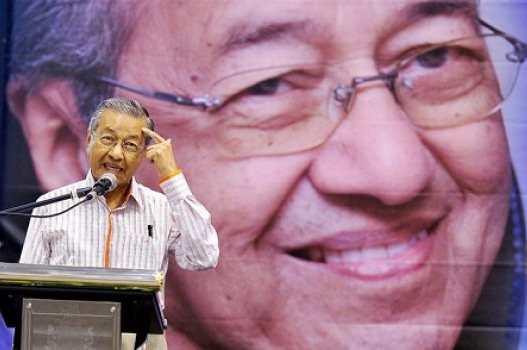
The Malaysian government reneged on the terms of the three-way Peace Treaty Dr Mwhich it signed with Thailand and the CPM leaders, in Hadyai in 1989. The PM at the time was (Tun) Dr Mahathir Mohamad (right).
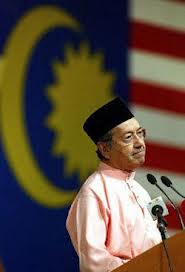
In life, the government rejected Chin Peng’s application to live in Malaysia. In death, they refused to allow his remains be interred in his family burial plot near Lumut. This prolonged revenge-fuelled retribution by UMNO Baru will unwittingly give Chin Peng, the oxygen of publicity. If the young and uninformed did not know of Chin Peng, they do now.
When Najib ordered that government forces be placed on red alert at border checkpoints, people scoffed at his idea.
If two jet engines can be smuggled out of Malaysia, then it would be child’s play to smuggle an urn into the country. This is a pointless exercise especially as resources and manpower should be deployed to better use, to deter crime.
Fighting and living in the shadows were Chin Peng’s speciality. It would have been easy for him to sneak across the border, assume an alias, and live anywhere in the country, like the former Bosnian Serb leader, Radovan Karadic, the architect of the Srebrenica massacre who escaped arrest for 12 years, practising as a doctor in Belgrade. Chin Peng may have been the leader of a disbanded guerrilla army, but he was a man of honour.
The unprecedented furore and lack of compassion, to allow an old man his dying wish, is prompted by the upcoming UMNO-Baru elections. Najib will milk Chin Peng’s death for political mileage to show his ultra-Malay credentials.
Many people are probably unaware that the struggle for Malaya’s Independence was fought on several fronts.
When the Japanese invaded Malaya in 1941, the Malays and Indians were given better treatment than the Chinese. Sino-Japanese relations had deteriorated after the Nanking Massacre (The Rape of Nanking) in 1937.
When the tide turned against the Japanese in 1943, the Japanese started to encourage Malay nationalism by arranging conferences, demonstrations, language courses and education. They even whipped up anti-Chinese sentiment by using paramilitary groups of, mainly, Malay men, to fight Chinese resistance groups.
Without the CPM ...
In the chaos immediately after the war, the MPAJA being the most organised and well-armed group within Malaya was given tacit approval by the British to restore law and order, at least until the British administrators returned in force.
The MPAJA used this opportunity to exact retribution on their old enemies and Japanese collaborators. As the Malays had been given preferential treatment by the Japanese during WWII, the MPAJA punished them severely.
The clashes were interpreted as racial conflict. The Malays retaliated by forming groups to fight what they saw as the “Chinese MPAJA/CPM”. Internecine clashes between these two groups, continue to this day and to increase the distrust between the Malays and Chinese, UMNO Baru will conveniently use the bogey, ”Chinese communists” or “May 13”, whenever it suits them.
After WWII, Chin Peng continued his armed struggle for Independence, but this time, he fought against the British because he wanted Malaya to be free from colonial rule. He renamed his outfit, the Malayan Races Liberation Army (MRLA). His ideology was to have an egalitarian society with the wealth redistributed among the people equitably through the labour movement under communism.
The civilian side of the MRLA was the Min Yuen (Masses Movement) which provided the guerrillas with food, information, and new recruits. Civilians who did not cooperate were tortured by the MRLA, whilst those caught cooperating, were imprisoned by the British.
The guerrillas would disrupt labour relations on the rubber estates and their sympathisers would demand military protection. The idea was to sabotage the economy but also to keep the British troops out of the jungle. The communists later changed this strategy when civilians began to blame the communists for their hardships.
Najib said that returning Chin Peng’s ashes would upset the Malays because the CPM had committed atrocities against them. Malaya was on a war footing. Atrocities were committed on both sides.
japan occupation of malaysia world war 2 060508The Japanese killed several hundred thousand Malayans during the Japanese Occupation; the Batang Kali massacre was blamed on rogue elements in the British Army; and yet, the worse treatment has been reserved for Chin Peng, whose forces were responsible for 10,000 deaths.
No one is condoning Chin Peng’s guerrilla warfare but Malaysians must realise that without the CPM, the Japanese in Malaya would not have been defeated.
Without the Min Yuen, we would not have the current identity card system and Chinese squatters living on the jungle verges would not have been resettled into new villages, much to the irritation of Malay villagers who complained that these settlements had electricity and running water.
Without the CPM, we would not have had the Internal Security Act or a return to the authoritarian regime of Gen. Sir Gerald Templer, the High Commissioner who introduced local elections and village councils as his objective was the formation of a united Malayan nation. The Chinese were urbanised by the British to reduce the influence of the CPM.
UMNO Baru and the Malays are in their exalted position because of Chin Peng. Without the armed conflict of the CPM, the British would not have agreed to give Independence to Malaya, nor the privileges that the Malays now enjoy.
Tunku A RahmanTunku Abdul Rahman (left) acknowledged that Chin Peng’s challenge to him, at the Baling talks in 1955,  immediately led to Merdeka. Perhaps, it is fitting that divine intervention has made it possible for UMNO Baru to honour Chin Peng every year on September 16.
The British used the divide-and-rule strategy to conquer the locals, the Japanese in WWII deployed the same tactic. Today, UMNO-Baru continues this method of control.
Chin Peng may be gone but his legacy continues. Malaysians are still striving to establish a just and equal society.
Get your FREE website here --->http://www.pluginprofitsite.com/main-37067
 photo PLS-33431480.jpg

Chin Peng's Farewell: A Letter to Comrades and Compatriots

Chin Peng’s Farewell: A Letter to Comrades and Compatriots

by dinobeano
September 21, 2013
MY COMMENT: My views on the status of the late Chin Peng are well DM latest3known. I think his remains should be brought home and his wish to be interred with his parents should be granted. It is not being magnanimous but about honouring our treaty obligations. I therefore compliment the former Inspector-General of Police Tan Sri Rahim Noor for standing up for the rights of Chin Peng under the 1989 Hatyai Peace Agreement between the Malaysian Government and the Communist Party of Malaya (CPM).
Now that he is dead, his cremated remains should be brought home to be buried beside his parents. This is not about politics. It is the most honorable and decent thing to do. We must also learn to accept our history, and recognise that Chin Peng fought the Japanese and British imperialists, although we may not accept his ideology and methods. When our government signed that peace treaty, we accepted him and his comrades as non-combatants and partners in peace.
Yes, many lives were lost during the Emergency (1948-1960). Armed conflicts cost lives. The American lost 55,000 soldiers and the Vietnamese many times more.But once the Americans and the Vietnamese signed the Paris Peace agreement,  they began the process of rebuilding their relations and today both combatants are working together to advance common interests. Reconciliation is possible only if we can come to terms with our past and learn the lessons of our history.--Din Merican

Chin Peng's Farewell: A Letter to Comrades and Compatriots

September 21, 2013
Latest Update: September 21, 2013 05:12 pm
 My dear comrades, my dear compatriots,
 CP's BookWhen you read this letter, I am no more in this world.It was my original intention to pass away quietly and let my relatives handle the funeral matters in private. However, the repercussions of erroneous media reports of me in critical condition during October 2011, had persuaded me that leaving behind such a letter is desirable.
 Ever since I joined the Communist Party of Malaya and eventually became its secretary-general, I have given both my spiritual and physical self in the service of the cause that my party represented, that is, to fight for a fairer and better society based on socialist ideals. Now with my passing away, it is time that my body be returned to my family.
 I draw immense comfort in the fact that my two children are willing to take care of me, a father who could not give them family love, warmth and protection ever since their birth. I could only return my love to them after I had relinquished my political and public duties, ironically only at a time when I have no more life left to give to them as a father.
 It was regrettable that I had to be introduced to them well advanced in their adulthood as a stranger. I have no right to ask them to understand, nor to forgive. They have no choice but to face this harsh reality. Like families of many martyrs and comrades, they too have to endure hardship and suffering not out of their own doing, but out of a consequence of our decision to challenge the cruel forces in the society which we sought to change.
 It is most unfortunate that I couldn't, after all, pay my last respects to my parents buried in hometown of Sitiawan (in Perak), nor could I set foot on the beloved motherland that my comrades and I had fought so hard for against the aggressors and colonialists.
chinpeng01 My comrades and I had dedicated our lives to a political cause that we believed in and had to pay whatever price there was as a result. Whatever consequences on ourselves, our family and the society, we would accept with serenity.
 In the final analysis, I wish to be remembered simply as a good man who could tell the world that he had dared to spend his entire life in pursuit of his own ideals to create a better world for his people.
It is irrelevant whether I succeeded or failed, at least I did what I did. Hopefully the path I had walked on would be followed and improved upon by the young after me. It is my conviction that the flames of social justice and humanity will never die. – September 21, 2013.
 * Chin Peng died at hospital in Bangkok on Malaysia Day, September 16, 2013 at the age of 89. This is his final letter to his comrades and compatriots published in his memorial booklet.
 * This is the personal opinion of the writer or publication and does not necessarily represent the views of The Malaysian Insider.

Chin Peng: A Left Wing Nationalist

Chin Peng should be remembered in Malaysian history as an ardent freedom fighter whose party – despite its failures in succeeding in its guerilla warfare against the British and the Malaysian state – sowed the seeds for labour organisation and resistance. 
P. Ramasamy is Deputy Chief Minister of the State of Penang, Malaysia
 
CP's BookThe former Secretary General of the Malaysian Communist Party (MCP), Chin Peng alias Ong Boon Hua died at the age of 88 in a private hospital in Bangkok on September 16, the day Malaysians celebrated their national day. It was on this same day, the Minister Mentor of Singapore, Lee Kuan Yew, celebrated his 90th birthday.
According to his aide, Chin Peng will be cremated at Bangkok's Wat That Throng temple in a week's time. The news of Chin Peng’s death was carried in all the media in the country as well as abroad. Yet in Chin Peng’s own hometown of Sitiawan in the state of Perak, the people could only merely whisper about the passing away of this legend. Even though the MCP is gone, folks here are reluctant to talk openly about Chin Peng.
Like Vietnam, Indonesia and Cambodia, Malaya had its share of anti-imperialist/anti-colonial struggles in the 1940s and 1950s. In Vietnam it was led by the guerilla freedom fighter and communist Ho Chih Minh; in Indonesia it was led by (later President) Sukarno; and in Malaya it was under the leadership of Chin Peng. The MCP formed in the early 1930s first fought the Japanese and later the British. It is well known and acknowledged that without the contribution of the MCP, the British would have delayed the granting of political Independence in 1957.
Today in Malaysia, the mention of Chin Peng's name brings about mixed feelings. While his foes think that he was a traitor and a murderer responsible for so many deaths during the civil war, others regard him as a freedom fighter, a patriot and a nationalist.
Chin Peng’s -  who fought the Japanese, British and later the Malayan/Malaysian authorities -  last wish was to have his ashes buried near the graves of his parents. The Malaysian government turned down this request that came from the relatives who were there to attend the funeral. In fact, before his death, Chin Peng always harboured the desire to return to his hometown to pay his last respects to his deceased parents. His parents and his family members are buried at the Kong Hock Kong Lumut Pundut burial ground.
The caretaker when interviewed said that Chin Peng's brother and relatives would come and pay their respects every Qing Ming (All Souls Day).  But the government, apprehensive about reactions from rightist Malay organisations and former servicemen associations, refused his entry. Chin Peng even took the matter to court but he was unsuccessful because he could not produce evidence of his birth in Sitiawan. Even an international campaign that was launched to garner support for his return failed to materialise.
Chin Peng and the MCP
Chin Peng was born in 1924 in Sitiawan, Perak. His parents had a shop that sold bicycles and spare parts. He was educated in Chinese in Nan Hwa High School before continuing his education in English at Anglo-Chinese School. The MCP had an organsed presence even before Chin Peng joined the party. Under the influence of the Chinese Communist Party (CCP), cells were established in Malaya to get the support of the overseas Chinese for the communist cause in China.
Before the invasion of the Japanese, the MCP supported the cause of the Chinese revolution and at the same time laid the grounds for the eventual communist takeover of Malaya. In doing so, the party carefully created and sustained networks especially among the urban poor, plantation and port workers. It was only a matter of time, before a considerable section of the urban working class came to be sympathetic towards the cause of the MCP and its affiliates.
Sitiawan, the birth place of Chin Peng, is not a very impressive town. In the early days, it was surrounded by rubber and coconut plantations and small-holdings. Later, rubber was replaced by oil-palm. Only with the establishment of a naval base in nearby Lumut port in the 1970s that there was urban development in Sitiawan. The interesting thing about the state of Perak  is that it had produced a number of prominent individuals who had played a role in the MCP and left-wing organizations.
ChinPeng and Comrades
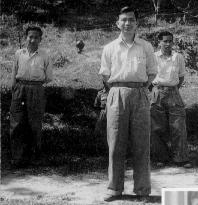
Chin Peng and Comrades
Apart from Chin Peng, Rashid Mydin and CD Abdullah were prominent Malay MCP leaders from places such as Parit and Ipoh. During the Emergency, in Sungei Siput, another town in Perak, a Tamil by the name of Perumal organised plantation workers very often defying and challenging European planters. In the town of Slim River, R.G. Balan was the main labour organiser who later was promoted to be the vice-chairman of the MCP. One Panjang (tall) leader Muniandy who died some years back was a prominent MCP commander in the Sitiawan area.
I also come from a village called Kampung Baru, a few kilometers away from Sitiawan town. My father who migrated from South India had rubber and coconut small-holdings. Chin Peng's father was known to my father. In the mid-1950s, I was around six years old; he took me to Sitiawan town and purchased a small bicycle for my use from the bicycle shop owned by Chin Peng's family. This episode is still vivid in my memory!
It was the Japanese invasion that provided the opportunity for Chin Peng to rise in the hierarchy of the party. The British withdrawal from Malaya provided an opportunity for the MCP to enter into close collaboration with the former. The withdrawing British agreed to assist the MCP and its anti-Japanese front, the Malayan Peoples' Anti-Japanese Army (MPAJA) during the course of the occupation. Apparently, the British also agreed to recognise the MCP as a legitimate political organization on the withdrawal of the Japanese from Malaya. Much later, after the failure of the Baling Peace Talks, Chin Peng criticised the British for not honouring their commitment to the party!
With the end of World War II and just before the British arrived to re-occupy Malaya, the MCP was not certain as to what exact strategy it should adopt towards the British. Lai Tek, the party's secretary general, later to be executed for being an agent of both the British and the Japanese, formulated a policy of limited agitation and cooperation with the British. This explains the reason why the British were able re-enter Malaya with relative ease and without resistance from the MCP. Some historians have lamented that just before the arrival of the British, the MCP was the most powerful organization in the country but it was not prepared to take power. Before the MCP could act against Lai Tek for his betrayal, he fled the country, first to Thailand and later to Hong Kong.
With the exit of Lai Tek, Chin Peng was elevated to the post of secretary general of the MCP. With his rise, the MCP abandoned its earlier strategy of limited agitation and cooperation and decided to adopt a more aggressive posture towards the British. With the support of his affiliates, the MCP decided that the time had come to evict the British from Malaya once and for all. Directives were given to his affiliates and trade unions to launch massive strikes and demonstrations against the British. With the assassination of three European planters in Perak, the British launched an all out attack against the MCP and its affiliates.
In 1948 the British declared an Emergency and brought in Australian, New Zealand and Gurkha troops  to engage the communists in a long and protracted struggle. After 12 years of armed struggle, the MCP, unable to put up an effective resistance withdrew its troops to southern Thailand.  Emergency rule was effectively ended in 1960. However, guerrilla struggle waged by the MCP was not totally over. In states like Perak and Pahang, the traditional strongholds of the MCP, occasional guerrilla warfare was undertaken. The Malaysian government introduced selective emergency measures to root out the remnants of communists even during the early 1980s.
The Decline of the MCP
The British counter-insurgency measures comprised of force, administrative procedures and psychological tactics considerably weakened the MCP. By the 1970s and 1980s, a number of international developments dented the relevance of the MCP. For instance nationalist rivalry in communist camps, the animosity between USSR and China, the tensions between China and Vietnam and the pragmatic thrust of Deng Hsiao Ping's economic policies led to the weakening of the ideological basis of the left. At the domestic level, one of the greatest weaknesses of the MCP was the lack of Malay/Muslim support. Furthermore, the party's close identification with the Chinese community and its outward orientation towards the Chinese Communist Party were factors that did not endear the party to the local population.
Given the impossibility of launching  a communist revolution in Malaysia underChin Peng 4 changed international circumstances, Chin Peng decided to end the armed struggle. On December 2, 1989, at the Haadyai Peace Talks in Southern Thailand with both the Thai and Malaysian governments, the party decided to lay down its arms and to disband its armed units. In return, both the governments agreed to provide financial assistance for their respective nationals for re-settlement in accordance with their laws and regulations.
The Malaysian government also promised that Chin Peng would be allowed to come into the country just like his comrades Rashid Mydin, CD Abdullah, Shamsiah Fakeh and many others. However, Chin Peng was in for a rude shock. Following the Haadyai Peace Accord, the Malaysian government broke its promise and refused to allow Chin Peng into the country.
Chin Peng has died. Although his role in Malaysian politics is a controversial one, it must be remembered that without the MCP, the British would not have quickened the pace of Malaysia securing Independence. In India, without the impact of the Indian National Army (INA) under Subhas Chandra Bose, it is unlikely that Independence would have been granted in 1947.
Political, social and economic developments in post-war Malaysia would make no sense without any reference to the MCP. The formation of trade unions amongst urban and plantation workers was largely initiated by the MCP. The fight against plantation capital for the improvement of the lives of Tamil workforce was directly inspired by trade unions that came under the influence of the MCP. It was the MCP which  promoted and respected Indian leaders. R.G. Balan of Perak became the vice-chairman of the MCP. It also gave recognition to Malay leaders. The famous Malay Regiment in Pahang operated was under the control of the MCP.
For the Indian community in Malaysia, especially those who had involved in trade unions activities both during the British colonial days and the post-independence period, the MCP had a clear positive impact. After the INA’s debacle at Imphal, many Indians returned and joined trade unions that were affiliated to the MCP. Since they could not liberate India from the British, joining the left-wing trade unions meant not only getting back at their oppressor--the British--but also improving their socio-economic lot. It was the tremendous sacrifice of the left-wing trade unions that emboldened Indians in the plantations and urban areas. Indians labourers especially Tamils described by the British capitalists as "meek" and "docile" were organised, trained and mobilised by the MCP affiliated unions to emerge as a force to assist the MCP in its war against the oppressors.
Chin Peng might not have succeeded in organising the communist revolution in Malaysia. Malaysians might not have convinced that communism was the real solution to the myriad problems of the society. But the fact remains that he was less a communist than a left-wing nationalist. In fact, those who joined the party were not inspired so much by the lofty ideals of Marxism-Leninism, but practical necessity to change the oppressive nature of the political and economic system. During his times, it was the British colonialism and its naked oppression of the masses that was something that that any decent human being could not tolerate. Tamil plantation workers joined the MCP led trade unions not for any abstract ideological reasons, but to end the exploitative nature of the merchant capitalism in plantations.
Many Malays joined left-wing nationalist organisations that came to be affiliated to the MCP not because of their love for communism, but for the sheer necessity to end the system that was oppressive and feudal in nature. Poor Chinese villagers and workers joined the movement for reasons of economic justice and for the simple reason that MCP was the only fighting force against the Japanese imperialists who massacred members of the Chinese community. For the Chinese, Malays and Indians who readily participated in the activities of the left, the MCP provided a vision for the future.
Note:
The Economic and Political Weekly, published from Mumbai, is an Indian institution which enjoys a global reputation for excellence in independent scholarship and critical inquiry.
 First published in 1949 as the Economic Weekly and since 1966 as the Economic and Political Weekly, EPW, as the journal is popularly known, occupies a special place in the intellectual history of independent India. For more than five decades EPW has remained a unique forum that week after week has brought together academics, researchers, policy makers, independent thinkers, members of non-governmental organisations and political activists for debates straddling economics, politics, sociology, culture, the environment and numerous other disciplines.
 EPW is also unique because it is the one forum where there is an exchange of ideas across the social science disciplines - political scientists debate with economists, sociologists read what political scientists have to say, historians study what economists have to say and so on.

Chin Peng, Britian's Most Trusted Guerrilla dies

PURE Leverage ------>  http://www.sociallever.com/?id=JEJelani
 Chin Peng, a wily and fanatical communist guerrilla who was decorated by the British for helping expel Japanese invaders from Southeast Asia during World War II and then led a brutal 12-year insurgency against the English colonial rulers in his native Malaya, died Sept. 16 in a Bangkok hospital.
He was reported to be 88, but his age could not immediately be confirmed. The cause was cancer, his former lawyer, Darshan Singh Khaira, told the Associated Press.
The Malayan “emergency,” as it was called by the British, lasted from 1948 to 1960. The violence killed more than 10,000 people, including many civilians. Chin Peng, a onetime secretary-general of the Communist Party of Malaya, kept up his ruthless fight even after the former colonial protectorate of Malaya gained independence in 1957 and after the new country became part of Malaysia in 1963.
Rufus Phillips, a scholar of guerrilla warfare and author of “Why Vietnam Matters,” said in an interview that Chin Peng was the figure who “really spearheaded the whole emergency.”
Chin Peng’s guerrilla fighters burned villages, attacked Police stations and orchestrated assassinations before an overwhelming military force supplied by the British Commonwealth nations pushed his movement deep into the jungle. His indiscriminate attacks robbed him of much of his popular support, and British promises of Malayan independence sapped the rest.
At its height, the Malaya crisis was an international battleground in the fervid conflict between nationalism and anti-colonialism. In time, the fight there was overshadowed by the burgeoning war in Vietnam. Once a formidable outlaw, Chin Peng gradually faded into “irrelevance,” Phillips said, especially as Malaysia’s economic might grew in the 1970s.
Prime Minister Najib Razak told the Malaysian newspaper the Star that Chin Peng “will be remembered in Malaysia as a terrorist leader of a group that waged war against the nation and caused immeasurable cruelty to the people and attacking our security forces.”
Chin Peng — a name he took as his nom de guerre — did not officially surrender until 1989, making him one of the world’s longest-surviving communist guerrilla leaders. “I fought a liberation war,” he wrote in his 2003 memoir, “My Side of History.” “To ask whether I would do it again is idle talk. . . . You can tell me I was wrong. You can tell me I failed. But I can also tell you how it was and how I tried.”
The son of a bicycle dealer who had emigrated from China, he was born Ong Boon Hua in the northern Malay state of Perak. The reported years of his birth range from 1920 to 1924.
He joined the Communist Party of Malaya in his teens, inspired after reading Mao Zedong’s manifesto “On Protracted War.” He was described as studious, learning four Chinese dialects as well as Malayan and English, and was deeply offended by what he perceived as the economic exploitation of the country’s Chinese and Indian ethnic minorities.
The Malay Peninsula was one of the British Empire’s most important economic engines, providing a steady supply of tin and rubber until the Japanese drove out most of the Anglo colonists in 1942, during World War II.
An elite group of British military and intelligence forces stayed behind, partnering with the Malayan People’s Anti-Japanese Army (MPAJA). Chin Peng became one of the communist-backed organization’s most seasoned and fiercest members and an essential liaison between the MPAJA and Britain’s special operations unit known as Force 136.
“I used the trunk roads and then the estate roads to avoid being spotted,” he told a Singaporean newspaper in 2009, describing how he’d meet the British operatives arriving by submarine. “I cycled everywhere.”
F. Spencer Chapman, a British army officer highly decorated for his military record in Malaya, once called Chin Peng “Britain’s most trusted guerrilla representative.”
In 1945, he participated in a victory parade in London and was honored with an appointment to Officer of the Order of the British Empire. The distinction was later withdrawn when he began a merciless terror campaign to evict the colonial powers who had bestowed it on him.
“The British were desperate and found us useful,” Chin Peng wrote in his memoir. “Conveniently, we both wanted to defeat the Japanese. The fact of a common enemy, however, brought no change to Britain’s long-term aim — a return to the colonial status quo ante. Neither did this common enemy change our agenda which looked to independence from colonial domination and the founding of a Democratic Republic of Malaya.”
The Communist Party of Malaya, which passed a resolution in 1948 advocating “the capture of power by the peasants and workers by any means,” drew thousands of followers with Chin Peng as its leader. Many were ethnic Chinese who had been denied legal and political protections long granted to the dominant ethnic Malays.
The communists led crippling labor strikes and then turned to violent methods. They used mostly British weapons left over from arms caches dropped by airplane and hidden in the jungle during World War II.
On the morning of June 16, 1948, communist guerrillas slaughtered three British rubber planters, leading to months of chaos. Forces loyal to Chin Peng ambushed and assassinated the British High Commissioner for Malaya, Henry Gurney, in 1951.
The British began making preparations for a full-scale combat operation to wipe out the insurgency. The colonial government declared not a war but rather a “state of emergency,” a word choice that allowed plantation owners to be compensated for any losses in insurgent attacks.
The Korean War, meanwhile, led to a surge in prices for Malaya’s rubber, rice and tin, and the British government used the windfall to fund its counterinsurgency efforts. About 70,000 Commonwealth troops fought against an estimated 10,000 guerrillas.
Chin Peng’s increasingly desperate followers retreated far into the jungle, where they threatened and killed villagers as they sought food, money and supplies.
At the same time, the British engaged in a massive effort to isolate and protect more than 400,000 ethnic Chinese — Chin Peng’s presumed base of support for sustenance and intelligence. Most were uprooted from their farms and rural outposts and resettled in well-guarded compounds known as “new villages,” which supplied vastly improved access to sanitation, health care and education.
The British offered a $42,000 bounty for Chin Peng’s corpse and almost double the amount to anyone who could capture him alive. The guerrilla leader refused offers of amnesty by the British and later leaders of independent Malaya.
“The amnesty means surrender,” hedeclared in 1955. “Surrender means humiliation. We will not accept surrender at any time. We will carry on the struggle to the last man.”
Chin Peng’s ragtag group — holed up near the Thai border — continued to strike at what it considered a lapdog post-colonial government. Malaya declared an end to the “emergency” in 1960.
Chin Peng moved to China and reportedly continued to extort money from businesses to sustain his dwindling band of followers. He gradually lost the support of his former Chinese patrons and reached a peace accord with Malaysian authorities in 1989, after which he lived in obscurity in Thailand.
Chin Peng was reportedly married and had at least two children, but information about survivors could not be independently confirmed.
About a decade ago, Chin Peng filed a lawsuit to return to his homeland, where he remained persona non grata. The country’s top court ruled in 2009 that he needed birth and citizen certificates to reenter. Both had been seized by the British in the late 1940s.

Money Politics in UMNO: Dead or Very Much Alive

Get your FREE website here ---> http://www.pluginprofitsite.com/main-37067 
 
mmocol-syednazri-new-150x150
It does not appear so and the possibilities look endless though there has been no complaint as yet. Some party members, in denial as always, would in fact be angry at the suggestion that money politics and vote-buying would still reign.
The sum above is among the numerous estimates put up by many people who are not convinced that money politics could be fully eradicated even with a revamped system that has a wider voting base compared with just 2,500 previously.
In fact, the RM13 million figure needed for vice-presidency came from no Datuk Nur Jazlan Mohamedless than Pulai Division Chief Datuk Nur Jazlan Mohamed when he wrote in a news portal the other day.
“It is an estimate. But the UMNO divisions play a crucial role,” he said last week when I asked him where he was coming from with that write-up.Yes, it is all about the divisions holding the key as always, and by extension, the division heads having great influence in the outcome.
Overall there are some 20,000 branches in 191 divisions. The 146,000 delegates will be picked from these but the point to note is that their votes would not be aggregated in determining the outcomes. Rather their votes would only be tallied at the respective divisions and in the end only count as one, representing that division.
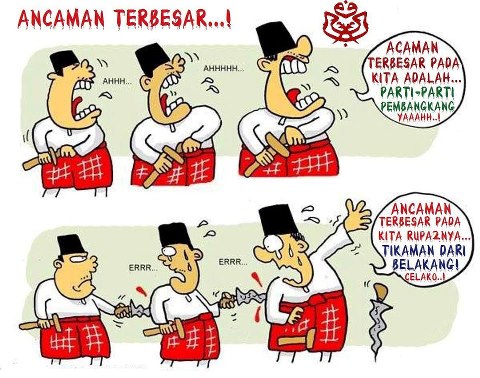
umno-tikam-belakang
Example: 800 delegates in Jelutong division cast their votes for Vice-President (each is allowed to pick three) — 600 votes for Candidate A, 500 for B, 300 for C, 300 for D, 150 for E and 150 for F. It means Candidate A is the pick from this division but it will not carry 600 votes — only one vote, that is representing Jelutong. This is where the maths comes in since it is all about winning over the respective division, not individual delegates.
And Nur jazlan was told of the calculations: “If there are six candidates contesting for three vice-president’s slots, a candidate only needs to secure support from just 64 of the 191 divisions (one third) to be assured of a win.
“If a candidate goes out to seek assistance from a particular division leader to get that one vote from his division and forks out an investment of, say, RM200,000 for one division,  the candidate only needs to invest slightly less than RM13 million to win (RM200,000 x 64).”
If the same formula is used for Supreme Council, an aspirant needs solid backing from just seven or eight divisions to secure one of the 25 elected places in the panel. (RM200,000 x 8 = RM1.6 million).
Prime Minister Datuk Seri Najib Razak who has been returned unopposed as party president, gave a stern reminder on Saturday when he told party members not to resort to three things in this election — abuse of power, personal attacks and money politics. But knowing the stakes, people can be very resourceful nowadays.
It must be remembered that a place as UMNO Vice-President puts a person in a comfortable position for the next level should anything happen to anyone of the top two.Hence, the assumption that some investment is needed to secure it.
Records show that money politics is quite entrenched in Umno. In the last party election alone we saw prominent candidates being forced to pull out due to the menace. The deep pockets of some candidates as well as affluent connections among many have given rise to the deep-rooted patronage system in the party.
mahathir-in-tearsFormer UMNO President Tun Dr Mahathir Mohamad did everything, including shed tears on stage, to coax members out of the habit but it never really died. Nur Jazlan in his posting noted: “I remember my late father Tan Sri Mohamed Rahmat as party Secretary-General at one time revealed that in the 1993 UMNO elections, the then rising star Datuk Seri Anwar Ibrahim invested RM1 million each to 90 division leaders in his bid to become Depuy President of the party and also to put him in line for No 1 and Prime Minister.”
Yes, we remember the Wawasan Team and the start of serious money politics. So, UMNO members who may be upset at suggestions that money politics could be alive still, don’t be angry at me or this paper. Just deal with it.
* This is the personal opinion of the columnist.

Monday, September 16, 2013

INSANE.. here is why...

Hi,

My very good friend Joel Therien just released a
Facebook Marketing course and well ... he has gone

INSANE.. here is why... http://sociallever.com/?id=JEJelani

He asked me to promote the course, he told me he was
originally going to sell it at $197.00.. but then he decided
to sell it at $2.95 cents!!!

Ah... I said to him, what's the catch, what is the upsell?

Then this is when I knew he was insane...

He said to me "There is no catch, no upsell, no forced
continuity.. there is NO CATCH at all!"

Then Joel went on to say...

"Most brand new marketers turn to facebook for leads..
and well.. most brand new marketers have very little money to
spend...

So that's why I am selling it for $2.95 with NO CATCH, I have
been new, I have been broke, this will set people on the right path
without spending a dime!

So ummm, before Joel gains consciousness, go get your copy now
for just $2.95 cents!!!!!

>>>> http://sociallever.com/?id=JEJelani
If you are looking for...

- High quality leads..
- Something simple to grasp?
- An easy way to get noticed and recognized?
- Maybe great new ways in generating leads, traffic and sales?

Then this new Facebook package will guild you through, and set you
up on a solid foundation, showing you with confidence and comfort
on how to use Facebook to explode your business in a way you have
never used it before!

- Pull in traffic
- Collect those likes and followers
- Generate leads
- Build that know, like and trust to create customers
- Increase your profits
- Explode your business and organization!

You can grab your copy here for just $2.95

>>>>> http://sociallever.com/?id=JEJelani
But hurry... as I said I think Joel has gone a bit insane so
go grab it now... as the price WILL increase for sure!

-- Joel Therien
Founder and CEO
GVO | Pureleverage

IT'S ALWAYS FREE

Start a Second Income™
with the company that's first
with Internet entrepreneurs!

  • Now in our 15th successful year
  • Millions of dollars paid out to our affiliates
  • 93000+ commissionable products & services
  • In over 190 countries worldwide
  • World-class 24/7 support & training
  • Bronze Member of Better Business Bureau
  • Can do everything from your computer, tablet, or smartphone
  • Start earning money within minutes and it's ALWAYS FREE
CLICK HERE -----> http://www.sfi4.com/10845324

Sunday, September 15, 2013

Sabah Illegal ICs: The Buck Stops with Mahathir

Kee TCBy Kee Thuan Chye
Former Prime Minister Mahathir Mohamad drew considerable laughter last Wednesday when he gave testimony at the Royal Commission of Inquiry (RCI) on illegal immigrants in Sabah. One hopes the laughter was laced with irony and scepticism.
buckstopsherefrontsmall
US President Harry S. Truman on Accountability
 Irony and scepticism because it seems unlikely, going by reports of the proceedings, that anyone listening to some of the things he said could find them acceptable.
The most unacceptable was his saying that he had not heard about Project IC or Project M (for Mahathir) until only recently, and that the Government could not be held responsible for the issuance of illegal identity cards (ICs) to immigrants who had entered Sabah illegally.
“These illegal immigrants may have been issued the identity cards erroneously or it may have been the wrongdoing of certain low-ranking civil servants,” he said, expressly passing the blame on to others.
Well, if it were a matter of only a few hundred ICs, we might say these civil servants acted corruptly on their own and out of their personal greed, but a key witness has earlier testified at the RCI that in 1993 alone, about 100,000 ICs were issued to immigrants in Sabah. One hundred thousand in one year is a staggering number. How likely is that to have been a private enterprise undertaken by “low-ranking civil servants”?
It is a requisite of leadership that the leader is accountable for what his underlings do. Especially when it is something serious – in fact, treasonous. We’re not talking here about giving out free food vouchers or concert tickets. We’re talking about giving out citizenships illegally. Mahathir’s disavowal of knowledge about its happening does not exonerate him. He was the CEO of Malaysia. Ignorance is no defence. He has to take responsibility.
Besides, it’s extremely unlikely that he was not aware of it at the time when so many ICs were given out, under what was apparently an organised programme, and leaders of Sabah political parties were making a hue and cry about it. The Prime Minister does not live in a cocoon, much as Mahathir would want us to believe.
We can also bet our bottom ringgit that he could not have found out about Project IC or Project M only recently when the issue has been out in the media for years, with specific naming of the project. A man like Mahathir who is so well-informed of developments must surely have heard of Project IC or Project M way before “recently”.
In fact, people were detained under the Internal Security Act (ISA) for alleged involvement in the issuance of identity cards to foreigners, like Hassnar Ebrahim (who was arrested in 1988), Akjan Ali Mohamad (in 1995), Ramli Kamaruddin (in 1995), Mohd Nasir Sugip (in 1995),  Kee Dzulkifly Kee Abdul Jalil (in 1995) and Abdul Rauf Sani (in 1996).
Most of them have testified at the RCI and admitted issuing tens of thousands of ICs illegally. Some have also alleged that they received instructions to do this from then Deputy Home Minister Megat Junid Megat Ayub. They have also claimed that they carried out their operations in the Kampung Pandan home of Aziz Shamsuddin, Mahathir’s then political secretary.
They were detained when Mahathir, apart being from the Premier, was also Minister of Home Affairs. He held the portfolio from 1986 to 1999. In that capacity, he would have known about the arrests and the reasons for them. He probably signed the detention orders himself.
So how could he say to the RCI, “Hassnar? I have never heard of him. I am also not aware that he had been arrested under the Internal Security Act.”?
He also said something outrageous when he said it could have been the decision of the National Security Council (NSC) to detain Hassnar. Who was he trying to fool? Since 1971, the function of the NSC has been that of coordinating policies related to national safety. It does not detain people under the ISA. Surely, Mahathir knows this since the NSC is part of the Prime Minister’s Department and chaired by the Prime Minister.
Would he claim “I don’t remember” to something like this? As he did numerous times when he testified at the RCI on the V.K. Lingam case in 2007 involving the fixing of judges? As he has also done now at the Sabah RCI in claiming that he didn’t remember giving specific instructions to former Sabah chief minister Mustapha Harun when the latter allegedly sought his approval to issue ICs to illegal immigrants?
mahathir baru
Project M: Saya  tak tahu, tanya Anwar
Mahathir’s performance at the RCI was expected. From the media reports, his characteristic arrogance came through. He toyed with the questioners. He played to the gallery, cracking jokes and making light of the serious proceedings. He avoided giving meaningful answers by making jokes.
When the RCI Chairman, (Justice) Steve Shim Lip Kiong, asked him why Joseph Pairin Kitingan was not made chairman of the State Security Council when by convention he should have been as he was the Chief Minister, Mahathir said, “I don’t know the exact reason, but there were many reasons.” What kind of an answer is that?
Mahathir was, however, unequivocal in his sympathy for the immigrants. “We are very considerate about their plight and try to help them as much as possible,” he said. “Our neighbours don’t want to accept these people. We can’t just throw them into the sea. This was my view when I was the prime minister.”
This is a real surprise coming from the man who when he was Deputy Prime Minister said in 1979 that if Vietnamese illegal immigrants tried to land on Malaysian shores, the Government would shoot them. However, the next day, the Government had to deny it, because of an international outcry. And Mahathir – adopting the habit we are now so familiar with – blamed foreign correspondents for misinterpreting his statement. But he didn’t say how he had been misinterpreted.
The E,ections BULL SHITWell, over the decades, Mahathir has shown that he is never wrong. That he has never made a mistake. Not even once during his premiership. As far as Mahathir Mohamad is concerned, Mahathir Mohamad is perfect. When have we ever heard him admit a mistake? When have we ever heard him apologise for anything?
But even so, much as he would deny responsibility for the IC disaster in Sabah, much as he would claim that he was not responsible for everything Megat Junid had allegedly done in that regard, the fact remains that he is. The buck stops with the Prime Minister. That’s the crux. And it’s about time he admitted that.
 

* Kee Thuan Chye is the author of the new book The Elections Bullshit, now available in bookstores.

Mahathir, RCI Sabah and Project IC: Lies.Lies, Nothing but Lies

by Mariam Mokhtar (09-13-13) @ http://www.freemalaysiatoday.com
Mahathir is evil because we encourage him...Are we going to continue to accept his lies and half-truths time and time again? Or are we going to pressure the Judiciary and the few men of integrity left in this institution, to punish those who are guilty of treason? It is our responsibility to change our destiny.--Mariam Mokhtar
drmProject IC: Saya Dah Lupa, Tanya Anwar La
Former Prime minister Dr Mahathir Mohamad’s lack of contrition, is breathtaking but not totally unexpected. We have lost all trust in our politicians, because of him. He stultified our minds, with 40 years of brainwashing.
During his tenure, money greased the wheels of government. Knowledge, or the acquisition of knowledge was restricted, so that in time, he could become master of a compliant rakyat. This is what we have been reduced to, a nation of yes-men who are powerless to act, in the face of mounting recalcitrance.
Mahathir’s 90 minute performance at the Royal Commission of Inquiry (RCI) into Sabah’s illegal immigrant problem, is testimony of his arrogance. He believes that he is invincible. As the 209th witness at the RCI, he behaved like an arrogant buffoon. He showed his contempt for the proceedings, the court and the rakyat.
He denied any knowledge of Project IC and instead blamed low-ranking officers for issuing identity cards to foreigners. A weak leader is one who blames everyone else, including society, for things that went wrong. Should Mahathir be jailed for contempt of court and perjury?
Why has the head of the Civil Service kept quiet? Why is the union which represents the civil servants, not publicly defended the good name of its members?
More often than not, UMNO Baru politicians use and abuse the civil servants to further their political agendas but when Mahathir insults the civil servants, not one UMNO Baru politician has dared to protect them.
What of the junior civil servants themselves? Have they protested their innocence? Is it any wonder politicians like Mahathir have nothing but contempt for people who keep quiet when bullies ravage their reputations.
The day after his testimony, Mahathir insinuated that Anwar Ibrahim, his one-time Deputy, was responsible for Project IC. Mahathir said, “He was in the government, he knew the government’s policy. If that was the government’s policy, why didn’t he stop it?”
As some people get older, they enter their second childhood. Mahathir’s childish response is perhaps, a manifestation of this second childhood. He is like the spoilt child who wants to be the centre of attraction. At times, he acts like the neglected child craving affection, by playing guessing games.
When asked by reporters if he was referring to Anwar, Mahathir sneered, “Maybe”. Is giving a direct answer beyond Mahathir’s comprehension? His supercilious response is like the child who is privy to a secret and feels superior to everyone else.
Mahathir’s legacy
Any member of the rakyat who goes to a government department is aware that no decision is made without the approval of a civil servant with authority. Senior staff await orders from the top.
Mahathir claimed not to know anything about Project IC. What sort of PM was he, who did not know what was happening in his country? Hundreds of thousands, were given MyKads.
This mammoth operation needed clearance from the highest authority in the land. Mahathir must try harder if he thinks he can continue to pull the wool over our eyes.
By the same token, the rakyat must try harder to remove all traces of Mahathir and his legacy, if this country is to move forwards without the politics of division and mistrust.
UMNOUMNO Baru
In 1987, Tengku Razaleigh Hamzah challenged Mahathir in the UMNO party elections, but believing the outcome to be tainted, took his fight to the courts. The old UMNO party was declared illegal as it had not registered some of its branches.
Ku Li started his own party Semangat 46, whilst Mahathir formed UMNO Baru. The vindictive Mahathir dismissed the Lord President of the Supreme Court and castrated the judiciary with a rusty knife. Ku Li is now back in the UMNO Baru fold. Situation normal then?
Anwar launched an attack on Mahathir when he wanted the government to adopt an austerity package and he opposed a number of Mahathir’s fiscal measures in the 1997 Asian Financial Crisis.
Mahathir threw Anwar in jail on trumped-up charges of sodomy, insubordination and corruption, but he was freed and later cleared of these charges, when Abdullah Ahmad Badawi became PM.
In 2013, the Opposition won the popular vote, but massive cheating returned UMNO Baru to power. Handouts like BR1M and other petty cash bribes are enough to dull the average Malaysian mind.
Now that UMNO Baru has broken all the promises it made before GE13, some who voted for UMNO Baru have finally realised their mistake. What about the rest? Are they still in denial?
A few years ago, Mahathir claimed that he had opposed Operation Lalang, the sweep to imprison his critics in 1987. He said that it was instigated by the Police, a charge confirmed by Hanif Omar, the IGP during Mahathir’s tenure. Close buddies will come to each other’s aid.
Similarly, Mahathir denied that he had a hand in the Memali massacre of 1985 and blamed Musa Hitam, his Deputy. The trend is that Mahathir ‘disappears’, when something nasty happens.
Changing our destiny
Mahathir denied that there was any corruption in the Port Klang Free Zone (PKFZ) project when billions of ringgits were lost.Mahathir claimed not to remember his role in the VK Lingam scandal, where judges who were aligned to him were selected for higher office.
People who testified in the Sabah RCI, claimed that Mahathir gave the nod to open the flood gates and allow Filipinos and Indonesians who were Muslims, to be given ICs.
Mahathir betrayed the rakyat and altered the face, culture and genetic pool of our country. He poisoned our trust in politicians.
Mahathir has consistently lied in other RCIs, despite the evidence that was presented in court. Mahathir equates himself with Umno Baru, which in turn, identifies itself with the Malays, who have this notion that Malaysia belongs to them.
It does not! Malaysia belongs to rightful Malaysians.The problem is not Mahathir. The problem is us. Mahathir is evil because we encourage him.
Are we going to continue to accept his lies and half-truths time and time again? Or are we going to pressure the judiciary and the few men of integrity left in this institution, to punish those who are guilty of treason? It is our responsibility to change our destiny.
Mariam Mokhtar is a FMT columnist.

Tuesday, September 10, 2013

Woman steals $5,000 from her boyfriend and hides money in her rectum

7:11 AM EDT
9/5/2013 by Amir Shaw
christieblack
The desire for money can influence people to do strange things. According to a report by Daily Mail, Christie Black of Tennessee attempted to steal $5,000 from her boyfriend by hiding the money in her rectum.

Black’s boyfriend suspected that she was stealing money from him. So he set a trap in his apartment by placing two envelopes with $4,000 and $1,000 in a bag. After he later discovered the money was missing, he confronted Black.

She then confessed that she wrapped the money up and shoved it up her rectum. When her boyfriend demanded the money, Black used a toilet brush and thong and attempted to pull the money out of her rectum. However, she experienced severe impaction and was rushed to the hospital.

Doctors were able to remove a wad of cash from her rectum, and she remains in fair condition.
Black could also face theft charges.

African businessman dies after being raped by his 5 wives

7:07 AM EDT
9/6/2013 by Amir Shaw
Uroko
A businessman in Nigeria died after being raped by five of six wives. According to the Daily Mail, Uroko Onoja partied at a bar in Ugbugbu, Nigeria until the wee hours of the morning in July.

When he returned home, he decided to have sex with his youngest wife. However, his five other wives became jealous and barged into his master bedroom. The women were armed with knives and sticks and began attacking Onoja. They eventually forced Onoja to have sex with them as well.

He had sex with four of his wives in a row. But once the fifth wife approached to have sex with Onoja, he stopped breathing and eventually died. The five wives who forced Onoja to have sex ran into the woods.

Two of the women have been arrested and charged with murder and rape. Onoja was a prominent member of the Ugbugbu community.