The Truth Revealed

Tuesday, March 25, 2008

Ku Li: PM Abdullah is wrong

PETALING JAYA (March 24, 2008): Former Finance Minister Tengku Razaleigh Hamzah said today Prime Minister Abdullah Ahmad Badawi's statement yesterday that "the appointment of anyone but Datuk Seri Idris Jusoh as Terengganu Mentri Besar is unconstitutional" is wrong.

"The Sultan acted within his powers in appointing the person who, in his judgment, is likely to command the confidence of the majority of the members of the State Assembly," said Razaleigh.

"Ahmad Said's appointment is effective and he is now the Mentri Besar of Terengganu," he said, adding that the situation in Terengganu is a crisis of government, not of the Constitution.

"Petitions, threats, coercion and declarations of support for the Prime Minister and his candidate have no bearing on the legality of the Sultan of Terengganu's appointment of his own Mentri Besar," said Razaleigh.

"Perhaps we have forgotten what it is like to conduct ourselves with good manners and due respect for the Constitution and the sovereignty of the Ruler," said Razaleigh, adding however that it is up to the properly convened State Assembly to test Ahmad with a vote of confidence in due course.

"After 50 years of independence, I am sure we should be capable of resolving our issues in a efficient and respectful manner."

"The storm in Terengganu is just the latest in a series of crises brought on by an apparent failure to understand how State powers work relative to Federal ones," said Razaleigh, adding that in the recent crisis in Perlis, "the Prime Minister’s actions suggest stunning ineptness in managing fundamental relationships and straightforward functions of government".

"This is alarming because the Barisan Nasional (BN) government now has five Opposition-controlled states to contend with out of the nine in Peninsular Malaysia.

"The mis-handling of chief ministerial appointments in Perlis, and now in Terengganu, mean that our leadership in two other states is now in jeopardy," he added.

Constitutional law expert Prof Dr Abdul Aziz Bari of the International Islamic University said matters had reached such a stage that there is nothing that can be legally done to force an immediate reversal of the Regency Council's decision to appoint Ahmad at this point. The appointment letter was given to Ahmad yesterday morning.

"The only thing that can be done now is to abide by the Regency Council's decision and wait for the State Assembly to be convened to pass a vote of no confidence. This would put the ball back in the Palace's court to decide afresh," said Abdul Aziz.

He said the Regency Council has the means to get the "best information", as it has the power to call up assemblymen and speak to them in private to gauge personal support.

He cited the 1986 case of Tun Mustapha Datu Harun, whose appointment as Chief Minister of Sabah by the Yang di-Pertua Negri was held to be in mistake.

In that case, the High Court ruled that the pressure applied on the Yang di-Pertua was invalid because the powers of the Head of State to appoint a Mentri Besar are discretionary and subjective, and therefore a Head of State should be allowed to exercise his discretion without pressure.

Abdul Aziz said besides the vote of no confidence move, another way to resolve the matter is for the State Assembly to be dissolved, and fresh elections called.

"Under the Federal and State Constitutions, a ruler may dissolve the State Assembly, and this is a situation where this can be used, and the people should be allowed once and for all to decide who governs the state", he said.

Meanwhile, he said Ahmad has time to negotiate support for himself as Mentri Besar by negotiating support from 17 assemblymen for a simple majority, before the State Assembly, which according to the Terengganu State Constitution, must convene within 120 days of dissolution.

"He can try to persuade his Umno colleagues to join him, and approach the eight PAS assemblymen, to give him a legal platform for the Regency Council to appoint him," said Abdul Aziz.

Twenty-three of the 24 Terengganu assemblyman had pledged support for Idris as Mentri Besar.

Asked whether Article 150 of the Federal Constitution, which gives the federal government the power to declare an emergency in a state, could be used in Terengganu, as was used in Sabah in 1966 to remove Stephen Kalong Ningkan as Chief Minister, Abdul Aziz called it a politically disadvantageous act.

"Use of Article 150 would be politically and economically disadvantageous. Times have changed," he said.

Umno deputy president Datuk Seri Najib Abdul Razak has said Ahmad's status, and whether he breached party discipline by accepting the appointment as Mentri Besar, would be decided by the Umno Supreme Council in its meeting on Thursday (March 27). - THE SUN

Tuesday, March 18, 2008

MALAYSIAN CABINET LINE-UP 2008

Below is the new Cabinet line-up announced by the Prime Minister at noon today which was broadcasted live nationwide. The names are followed in brackets by their party, state and parliament seat.

The Prime Minister after announcing the cabinet line-up.

Prime Minister: Datuk Seri Abdullah Ahmad Badawi

Deputy Prime Minister: Datuk Seri Mohd Najib Abdul Razak

1. Prime Minister's Department

Ministers
i. Tan Sri Bernard Giluk Dompok (UPKO Sabah Penampang)
ii. Datuk Ahmad Zahid Hamidi: (Umno Perak Bagan Datuk)
iii. (Sen) Datuk Mohd Zaid Ibrahim: Justice & Judiciary Reforms (Umno Kelantan Ex-Kota Baru)
iv. (Sen) Datuk Amirsham Aziz: Economic Planning Unit (Maybank CEO)
v. Datuk Seri Nazri Abdul Aziz: Parliament (Umno Perak Padang Rengas)

Deputy Ministers
i. Datuk Johari Baharum (Umno Kedah Kubang Pasu)
ii. (Sen) Datuk Dr Mashitah Ibrahim (Umno Kedah Ex-Baling)
iii. S. K. Devamany (MIC Pahang Cameron Highlands)
iv. Datuk Hasan Malek (Umno Negri Sembilan Kuala Pilah)

2. Ministry of Agriculture & Agro-Based Industry
Minister: Datuk Mustapa Mohamed (Umno Kelantan Jeli)
Deputy: Datuk Rohani Abdul Karim (PBB Sarawak Batang Lupar)

3. Ministry of Unity, Arts & Culture
Minister: Datuk Mohd Shafie Apdal (Umno Sabah Semporna)
Deputy: Teng Boon Soon (MCA Johor Tebrau)

4. Ministry of Defence
Minister: Datuk Seri Mohd Najib Abdul Razak (Umno Pahang Pekan)
Deputy: Datuk Wira Abu Seman Yusop (Umno Malacca Masjid Tanah)

5. Ministry of Domestic Trade & Consumer Affairs
Minister: Datuk Shahrir Abdul Samad (Umno Johor Johor Baru)
Deputy: Jelaing Mersat (SPDP Sarawak Saratok)

6. Ministry of Education
Minister: Datuk Hishammuddin Hussein (Umno Johor Sembrong)
Deputy: Datuk Wee Ka Siong (MCA Johor Air Hitam)
Deputy: Datuk Razali Ismail (Umno Terengganu Kuala Terengganu)

7. Ministry of Energy, Water & Communications
Minister: Datuk Shaziman Abu Mansor (Umno Negri Sembilan Tampin)
Deputy: Datuk Joseph Salang Gandum (PRS Sarawak Julau)

8. Ministry of Entrepreneur & Co-operative Development
Minister: Datuk Noh Omar (Selangor Umno Tanjung Karang)
Deputy: Saifuddin Abdullah (Umno Pahang Temerloh)

9. Ministry of Federal Territories
Minister: Datuk Zulhasnan Rafique (Umno FT Setiawangsa )
Deputy: Datuk M. Saravanan (MIC Perak Tapah)

10. Ministry of Finance
Minister: Datuk Seri Abdullah Ahmad Badawi (Umno Penang Kepala Batas)
2nd Minister: Tan Sri Nor Mohamed Yakcop (Umno Penang Tasek Gelugor)
Deputy: Datuk Ahmad Husni Mohamad Hanadzlah (Umno Perak Tambun)
Deputy: Datuk Kong Cho Ha (MCA Perak Lumut)

11. Ministry of Foreign Affairs
Minister: Datuk Seri Rais Yatim (Umno Negri Sembilan Jelebu)
Deputy: Datuk Seri Tengku Azlan Sultan Abu Bakar (Umno Pahang Jerantut)

12. Ministry of Health
Minister: Datuk Liow Tiong Lai (MCA Pahang Bentong)
Deputy: Datuk Dr Abdul Latiff Ahmad (Umno Johor Mersing)

13. Ministry of Higher Education
Minister: Datuk Khaled Nordin (Umno Johor Pasir Gudang)
Deputy: Hou Kok Chung (MCA Johor Kluang)
Deputy: Datuk Idris Harun (Umno Malacca Tanjung Batu)

14. Ministry of Housing & Local Government
Minister: Datuk Ong Ka Chuan (MCA Perak Tanjung Malim)
Deputy: Datuk Robert Lau (SUPP Sarawak Sibu)
Deputy: Datuk Hamzah Zainudin (Umno Perak Larut)

15. Ministry of Human Resources
Minister: Datuk S. Subramaniam (MIC Johor Segamat)
Deputy: Datuk Noraini Ahmad (Umno Johor Parit Sulong)

16. Ministry of Information
Minister: Datuk Ahmad Shabery Cheek (Umno Terengganu Kemaman)
Deputy: Datuk Tan Lian Hoe (Gerakan Perak Grik)

17. Ministry of Internal Security & Home Affairs
Minister: Datuk Seri Syed Hamid Albar (Umno Johor Kota Tinggi)
Deputy: Datuk Chor Chee Heung (MCA Kedah Alor Star)
Deputy: (Sen) Datuk Wan Ahmad Farid Wan Salleh (Umno Terengganu)

18. Ministry of International Trade & Industry
Minister: Tan Sri Muhyiddin Yassin (Umno Johor Pagoh)
Deputy: Datuk Liew Vui Keong (LDP Sabah Sandakan)
Deputy: Datuk Jacob Dungau Sagan (SPDP Baram Sarawak )

19. Ministry of Natural Resources & Environment
Minister: Datuk Douglas Uggah Embas (PBB Sarawak Betong)
Deputy: Datuk Seri Abdul Ghapur Salleh (Umno Sabah Kalabakan)

20. Ministry of Plantation Industries & Commodities
Minister: Datuk Peter Chin Fah Kui (SUPP Sarawak Miri)
Deputy: (Sen) A. Kohilan Pillay (Gerakan Selangor)

21. Ministry of Rural & Regional Development
Minister: (Sen) Tan Sri Muhammad Mohd Taib (Umno Selangor)
Deputy: Tan Sri Joseph Kurup (PBRS Sabah Pensiangan)
Deputy: Joseph Entulu (PRS Sarawak Selangau)

22. Ministry of Science, Technology & Innovations
Minister: Datuk Dr Maximus Ongkili (PBS Sabah Kota Marudu)
Deputy: Datuk Fadillah Yusof (PBB Sarawak Petra Jaya)

23. Ministry of Tourism
Minister: Datuk Azalina Othman Said (Umno Johor Senggarang)
Deputy: Datuk Seri Sulaiman Abdul Rahman Taib (PBB Sarawak Kota Samarahan)

24. Ministry of Transport
Minister: Datuk Ong Tee Keat (MCA Selangor Pandan)
Deputy: Datuk Anifah Aman (Umno Sabah Kimanis)

25. Ministry of Women, Family & Community Development
Minister: Datuk Dr Ng Yen Yen (MCA Pahang Raub)
Deputy: Senator Noriah Kasnon (Umno Selangor)

26. Ministry of Works
Minister: Datuk Mohd Zin Mohamed (Umno Selangor Sepang)
Deputy: Datuk Yong Khoon Seng (SUPP Sarawak Stampin)

27. Ministry of Youth & Sports
Minister: Datuk Ismail Sabri Yaakob (Umno Pahang Bera)
Deputy: Wee Jeck Seng (MCA Johor Tanjung Piai)

Friday, March 14, 2008

Pro-Malay Malaise

By MARY KISSEL
The Wall Street Journal, March 10, 2008
KUALA LUMPUR, Malaysia

"We live side by side, not together." That's how one Malaysian described the fallout from decades of race-based affirmative action policies to me last week. Malaysians, she said, are fed up.

It shows. In federal and state elections here Saturday, voters of all ethnicities turned to opposition parties in larger numbers than ever before -- a rebuke to Prime Minister Abdullah Badawi and his National Front coalition's pro-Malay platform. Opposition parties won 82 of 222 seats in the national parliament, up from only 19. The biggest gainer, the People's Justice Party, emphasized equality of opportunity for all ethnic groups.

This represents a huge shift in thinking for Malaysians, and a welcome and overdue one at that. While around 60% of the country is Malay, another one-third are Chinese and Indians, with other ethnic groups making up the rest. But since the introduction of the New Economic Policy in 1970s, Malaysia hasn't been governed for the whole of its citizenry; it's been governed mostly for Malays.

Call it affirmative action gone wild. When the NEP was launched, its goals were twofold: to eradicate poverty "irrespective of race" and to restructure the economy away from race-based economic roles for the various ethnic groups. For a country escaping the legacies of colonial British rule, recovering from violent, anti-Chinese race riots and facing extreme poverty among Malays, those goals are easy to understand. Social stability through government-directed outcomes seemed the best balm political leaders could deliver at the time.

The NEP was supposed to last only two decades. In any case, surely Malaysia's elites didn't envision the scope of the pro-bumiputra, or indigenous Malay, bent that evolved. Consider just a few of the discriminatory policies that are now on the books. On the corporate front, foreign and domestic non-manufacturing firms have to take on bumi partners who hold at least 30% of the share capital. Firms that want to list on the Kuala Lumpur stock exchange are required to reserve 30% of their equity for bumi shareholders. Bumis get preferential housing loans and easier access to business licenses and government contracts. Department stores and supermarkets have to reserve 30% of their shelf space for bumi products -- regardless of consumer preferences. Little wonder Wal-Mart isn't here.

Then there's the education system. Before the NEP, Malaysia's public schools were mostly racially integrated. Now they're largely segregated, as Chinese and Indian parents opt to send their children to schools where they feel they won't be discriminated against or exposed to Islamic teachings. More than 80% of government scholarships to study abroad go to Malays. Business leaders tell me they have a hard time sourcing good local talent, across a range of industries -- largely because they're required to have 30% bumiputras on their staff.

These policies have, if anything, become more entrenched over time. While the original NEP called for Malays to get 30% of the country's wealth -- whatever that means -- subsequent economic plans inserted vague language calling for more "wealth creation" for bumiputras. As for encouraging racial tolerance, that hope was put to bed in 2006, when the party conference of the United Malays National Organization was broadcast live and Malay representatives said they'd defend pro-Malay policies to "the last drop of blood." After the prime minister concluded his remarks, shouts of "Long live the Malays!" filled the chamber. Needless to say, the 2007 conference wasn't televised.

This bumi bonanza has slowed investment in Malaysia, and the ruling coalition knows it, even if officials won't say so publicly. At a time when foreign investment has poured into Vietnam, China and India, Malaysia has seen a much smaller sliver of that pie. It's fallen from America's 10th largest trading partner to its 16th largest in little over a year. Malaysia has lost automobile plants to Thailand and electronics plants to China. Motorola, a major electronics employer, threatened to pull out of Penang late last year but decided to stay when the local government awarded the company a major contract. (On Saturday, voters there voted in the opposition Democratic Action Party.)

In this weekend's election, ethnic Chinese swung heavily to the opposition Democratic Action Party, as the victory in Penang showed. Ethnic Indians, too, plumped largely for opposition candidates. But the Malay swing vote -- the core of the National Front coalition -- contributed to the surge. The first indication of the swing came in the capital, where the daughter of opposition leader Anwar Ibrahim beat the National Front candidate. (Mr. Anwar, a former deputy prime minister, was barred from running.) Then opposition parties took the states of Kelantan and Kedah -- an unprecedented victory in a rural Malay-dominated belt.

It's never easy to shed affirmative action policies; as the American experience shows, once preferential treatment is given to a specific ethnic group, it's a hard habit to break. But if Saturday's opposition gains show anything, it's that even Malays are starting to figure out that pro-Malay policies are hurting the country. That is, at least, a start.

Ms. Kissel is editor of The Wall Street Journal Asia's editorial page.

Write to Mary Kissel at mary.kissel@wsj.com

Tuesday, March 4, 2008

Group hands Pak Lah special gift

A group of disgruntled young Malaysians today symbolically handed a 'gift' to Prime Minister Abdullah Ahmad Badawi to express theirdisappointment with his administration.

Full report at Malaysiakini.com


Anak nelayan boleh jadi MB

Sementara itu, Awang Adek berkata, beliau terharu akan dipilih sebagai menteri besar Kelantan jika BN menang dalam pilihanraya umum kelak.

"Saya telah merasai kesusahan dan kerana itu saya akan membantu orang susah, orang yang tiada rumah.

"Percayalah, saya berjanji akan membantu rakyat Kelantan menjadi rakyat yang berjaya," katanya.


Tuesday, February 12, 2008

Borneo activist 'possibly murdered'


Sarawak's indigenous people have faced off with timber companies over customary land rights


Police have said there are no suspects in the case of a tribal chief who mysteriously died in the jungles of Sarawak, but left open the possibility that he could have been murdered for defying the timber industry.

Kelesau Naan, 70, disappeared on October 23 while hunting alone near the remote village of Long Kerong in the east Malaysian state.

International human rights activists demanded an investigation into his death after villagers found his skeletal remains and belongings near a river in December.

On Monday Sumarno Lamundi, a police inspector, said officials have not ruled out the possibility that Naan was killed because he spearheaded anti-logging efforts by his Penan tribal community.

"We are still investigating what happened, but there are no suspects so far," he said. "Everything is still under consideration. We have not rejected any possibility."

Lamundi however refused to say whether authorities have found any evidence of murder or how long the investigations are expected to take.

Naan was on the forefront of the Penan's fight against the state's timber trade, which tribals blame for destroying their ancestral lands and snatching away of customary rights over forests.

Sarawak state authorities and timber companies reject the charges.

Key witness

Naan's death came ahead of what some villagers believe are plans by timber companies to resume logging, which has stalled in recent years in areas surrounding Long Kerong, the village that Naan led.

He was also was an initiator and key witness in an unresolved Penan land rights court case.

Local media have speculated that the Penan chief might have died in an accident, but anti-logging activists suspect that foul play was involved.

Last month Micheal Ipa, Naan's nephew, said some Penans "believe he has been killed by people involved in logging".

The Observatory for the Protection of Human Rights Defenders based in Geneva voiced "deep concern" about Naan's death, saying it "might be the result of his human rights activities in favour of indigenous issues".

Friday, February 8, 2008

PM: I work hard to fulfil duties

Prime Minister Datuk Seri Abdullah Ahmad Badawi said Malaysians were aware that he works hard to fulfil his responsibilities for them.

"Some of you can say that I'm not good, you can say whatever. But don't say that I don't work. I work very hard. I really mean it and you know it. It is God’s will that I become the Prime Minister of Malaysia and I am very conscious that I have to serve the people although I personally do not benefit even one bit because of this," he said.

Boastful arrogance

''I have not benefited one sen from anyone for what I have done. Some people want to give me money, but I do not need it. The government takes good care of its Prime Minister - The Sleeping Prime Minister."

Pictures speak louder than words.


Wednesday, February 6, 2008

ON THE MENU: RAT-A-CHEWY

A 58-year-old Taiwan eatery offers rat meat as winter tonics to welcome the Year of Rat.

Rat meat, also eaten in China, became popular in rural Taiwan in the 1940s and 1950s among people who could not afford chicken or pork. Ho-la, a rural eatery at Taiwan's Chiayi county, serves 10 rat-themed dishes, including rat soup, black pepper-dipped and deep-fried rat. The diner goes through around 18 kg (40 lb) of rat meat per day.


"GONG XI FA CAI" TO ALL THE CHINESE VISITORS TO THIS BLOG


Saturday, February 2, 2008

The dumbest ever quiz answers

LONDON (Reuters): By Paul Majendie

Carol Cheng (C), presenter of the Hong Kong version of the quiz show "The Weakest
Link" stands with contestants before filming in Hong Kong August 18, 2001.

Question: What was Gandhi's first name?
Contestant's answer: Goosey Goosey.

Warning to all those know-alls who shout at the television screen when contestants offer dumb answers to blindingly obvious questions -- one day that could be you.

From regional radio shows to "Who Wants To be a Millionaire?" and "University Challenge," people make fools of themselves -- as internet site www.jumpingjacksbar.com found in collating some of the worst howlers.

Here are leading contenders for the "Dumb Down" gold medal:

Presenter: What happened in Dallas on November 22,1963?
Contestant: I don't know, I wasn't watching it then

Presenter: Which American actor is married to Nicole Kidman?
Contestant: Forrest Gump

Presenter: In which country is Mount Everest?
Contestant: Er, it's not in Scotland is it?

Presenter: Name a film starring Bob Hoskins that is also the name of a famous painting by Leonardo da Vinci
Contestant: Who Framed Roger Rabbit?

Presenter: In which European city was the first opera house opened in 1637?
Contestant: Sydney

Presenter: How long did the Six-Day War between Egypt and Israel last?
Contestant: (after long pause) Fourteen days

Presenter: Where did the D-Day landings take place?
Contestant: (after pause) Pearl Harbor?

Presenter: What is the currency in India
Contestant: Ramadan

Presenter: Johnny Weissmuller died on this day. Which jungle-swinging character clad only in a loin cloth did he play?
Contestant: Jesus

Sunday, January 13, 2008

MALAYSIA: INDEX OF ECONOMIC FREEDOM

MALAYSIA
Rank: 48
Regional Rank: 8 of 30


Malaysia's economy is 65.8 percent free, according to our 2007 assessment, which makes it the world's 48th freest economy. Its overall score is 2.1 percentage points higher than last year, partially reflecting new methodological detail. Malaysia is ranked 8th freest out of 30 countries in the Asia–Pacific region, and its overall score is higher than the regional average.

Malaysia enjoys high levels of fiscal freedom, monetary freedom, trade freedom, and labor freedom. Both the top income tax rate and the top corporate tax rate are moderate, and overall tax revenue is relatively low as a percentage of GDP. Inflation is minor, and the government does not widely distort market prices with direct subsidies. The tariff rate is fairly low, and the government has been working to eliminate some of the non-tariff barriers that impede trade. A highly flexible labor sector with simple employment procedures and no minimum wage helps businesses to stay competitive.

Malaysia suffers from weak investment freedom and weak financial freedom. Despite efforts to liberalize procedures, foreign investment is deterred by such impediments as limited voting shares in companies, enforced hiring of ethnic Malays, and case-by-case government preinvestment approval. Malaysia's financial sector is fairly well developed, but it is also subject to significant government interference and some restrictions on foreign involvement.

Background:

Malaysia's ruling political party, the United Malays National Organization, has held power in a 14-party coalition called Barisan National since 1957. Prime Minister Abdullah Badawi is expected to remain in power until the next election in 2009. Services and industry are the mainstays of the economy and provide the vast majority of employment opportunities. The Office of the U.S. Trade Representative announced on March 8, 2006, that it would initiate negotiations with Malaysia for a free trade agreement. Negotiating a comprehensive agreement is expected to be challenging for both sides.

Business Freedom - 68.6%

Starting a business takes an average of 30 days, compared to the world average of 48 days. Entrepreneurship should be easier for maximum job creation. Obtaining a business license can be difficult, but closing a business is relatively easy. The overall freedom to start, operate, and close a business is relatively well protected by the national regulatory environment.

Trade Freedom - 71.8%

Malaysia's weighted average tariff rate was 4.1 percent in 2003. The government has made progress in liberalizing the trade regime, but non-automatic import licensing, import bans, burdensome regulations and standards, export licensing, non-transparent import tax rules, export subsidies, weak protection of intellectual property rights, restrictive government procurement rules, and services market access barriers add to the cost of trade. Consequently, an additional 20 percent is deducted from Malaysia's trade freedom score to account for these non-tariff barriers.

Fiscal Freedom - 87.8%

Malaysia has moderate tax rates. Both the top income tax rate and the top corporate tax rate are 28 percent. The government has announced that it will reduce individual and corporate tax rates when introducing a value-added tax (VAT). Other taxes include a capital gains tax and a vehicle tax. In the most recent year, overall tax revenue as a percentage of GDP was 16 percent.

Freedom from Government - 79.8%

Total government expenditures in Malaysia, including consumption and transfer payments, are moderate. In the most recent year, government spending equaled 26.5 percent of GDP, and the government received 11.5 percent of its revenues from state-owned enterprises and government ownership of property.

Monetary Freedom - 80.0%

Inflation in Malaysia is relatively low, averaging 2.5 percent between 2003 and 2005. Relatively low and stable prices explain most of the monetary freedom score. Most prices are determined in the market, but the government influences certain prices through state-owned enterprises; controls the prices of petroleum products, steel, cement, wheat flour, sugar, milk, bread, and chicken meat; and usually sets ceiling prices for an extended list of essential foods during major holidays. Consequently, an additional 10 percent is deducted from Malaysia's monetary freedom score to account for these policies.

Investment Freedom - 40.0%

Foreign investment rules have been eased over the years, but foreign investors still face such restrictions as limited voting shares, prior approval, and mandatory hiring of ethnic Malays. In September 2005, the government eased restrictions for domestic residents to buy foreign-listed securities and for foreigners to sell shares in the domestic market. Residents and non-residents may hold foreign exchange accounts, but government approval is required in many cases. Nearly all capital transactions are prohibited, are subject to restrictions, or require government approval.

Financial Freedom - 40.0%

Malaysia's financial sector is relatively well developed but subject to extensive government intervention. Of the 29 commercial banks operating as of September 2005, 10 were domestically owned and 13 were foreign-owned. Six Islamic banks (five domestic and one foreign) account for over 10 percent of baking assets. The government owns a majority of Malaysia's two largest local commercial banks. Foreign equity in banks is restricted, with participation in commercial banking limited to a maximum of 30 percent. The government influences the allocation of credit. There are several offshore banks, insurance companies, and other financial institutions. Numerous restrictions apply to the insurance industry, including restrictions on expatriate employment and foreign equity. Foreigners may trade in securities and derivatives, but foreign participation in stockbrokerages and trust management companies is restricted.

Property Rights - 50.0%

Private property is protected in Malaysia, but the judiciary is subject to political influence. Corporate lawsuits take over a year to file. Cases are generally handled in a satisfactory manner, although many firms include a mandatory arbitration clause in their contracts.

Freedom from Corruption - 51.0%

Corruption is perceived as present. Malaysia ranks 39th out of 158 countries in Transparency International's Corruption Perceptions Index for 2005.

Labor Freedom - 89.5%

The labor market operates under flexible employment regulations that enhance employment and productivity growth. The non-salary cost of employing a worker is moderate, and dismissing a redundant employee is not difficult. The government restricts the number of expatriates that foreign and domestic firms may hire. Malaysia does not have a national minimum wage.


Quick Facts
  • Population: 24.9 million
  • GDP (PPP): $255.8 billion; 7.1% growth in 2004; 5.2% 5-yr. comp. ann. growth; $10,276 per capita
  • Unemployment: 3.6%
  • Inflation (CPI): 1.5%
  • FDI (net inflow): $2.6 billion
  • Official Development Assistance: $447 million (0.2% from the U.S.)
  • External Debt: $52.1 billion
  • Exports: $118.6 billion
    Primarily electronic equipment, petroleum, liquefied natural gas, wood, wood products, palm oil, rubber, textiles, chemicals
  • Imports: $96.8 billion
    Primarily electronics, machinery, petroleum products, plastics, vehicles, iron and steel products, chemicals

Cossiga: US, Mossad behind 9/11

Sun, 13 Jan 2008 01:16:55


Although Osama bin Laden has confessed to launching the attacks, now all the European and American intelligence services are well aware that the attacks were planned by the CIA and the Zionists' Mossad, Cossiga told Corriere della Sera.

The disastrous attack was aimed to put the Muslim world under powerful accusations and drum up support for the war in Iraq and Afghanistan, the former Italian president added.

Cossiga first expressed doubts about 9/11 in 2001, and is quoted in Webster Tarpley's book titled 9/11 Synthetic Terror Made in the USA as stating that, "The mastermind of the attack must have been a sophisticated mind, provided with ample means not only to recruit fanatic kamikazes, but also highly specialized personnel.

He went on to add that the attack could not have been accomplished without penetration into the ranks of radar and flight security personnel.

Frost over the World - Ali Zadari and Ruth Lea

With the election now postponed until February Asif Ali Zadari, Bhutto's husband, joins Sir David to discuss what the future holds for Pakistan and the grieving for his late wife.

Ruth Lea, economist, analyses the implications of oil reaching the $100 per barrel mark.

Tuesday, January 1, 2008

CONFIRMED, IT WAS MALAYSIA HEALTH MINISTER PORNO DVD

BERNAMA, January 01, 2008 17:34 PM

Chua Soi Lek Says He's The Man In Sex Video

LABIS, Jan 1 (Bernama) -- "I am the man in the tape," said Datuk Seri Dr Chua Soi Lek, the Health Minister and MCA vice-president, as he admitted to be the person captured on a videotape while engaging in sexual acts with a woman friend.

But despite his admission of guilt over the matter, Dr Chua stressed that he would not resign from his government and party positions.

"I serve at the pleasure of the prime minister," he said. "I will not allow (other) people to jeopardise or obstruct my duties.

"Reading from a prepared statement at a press conference at the Labis MCA office here, the minister said he had met Datuk Seri Abdullah Ahmad Badawi in Putrajaya yesterday to explain the matter and personally apologise to the prime minister.

Dr Chua, one of the six vice-presidents in the MCA, said he had also met Deputy Prime Minister Datuk Seri Najib Tun Razak and MCA president Datuk Seri Ong Ka Ting over the matter.

He described the woman involved as a personal friend.

Copies of the pornographic videotape were widely distributed in Johor in DVD format over the last few days.

"What's most important is that my family, wife and children have accepted my apology," he told the packed news conference, which was also attended by his supporters.

He appealed to the press to allow some space for his family to deal with this difficult time.

Stressing that he did not make the recordings himself, Dr Chua said that who were behind it were not important but their reasons for doing it were obvious.

However, he declined to elaborate.

Dr Chua extended his apology to his colleagues, supporters and fellow Malaysians.

"I would also like to thank them for their concern and support through phone calls and SMSes," he said.

When asked by reporters on his next course of action, Dr Chua said he would leave it to the police to investigate.

"I leave it to the police to investigate. I'm considering the possibility of making a police report but the police have started their own investigation," he said.

Dr Chua said he came to know about the recordings on Sunday when a friend gave him a copy of the video disc.

The minister said it would be business as usual for him and he would continue to perform his duties as a Cabinet minister and in the MCA.

Dr Chua, who appeared calm and composed throughout the press conference, attended a function at the Segamat Hospital prior to meeting the media. He then headed for a meeting with the Indian community in Labis. At the end of the news conference, Labis MCA chairman Tan Kok Hong said members of the division would continue to support Dr Chua as Labis Member of Parliament.

"We'll continue to support him as the (Barisan Nasional) candidate for Labis (in the general election)," he said.

Dr Chua, who is also Johor MCA chairman, won the Labis parliamentary seat for the BN in the 2004 general election, beating DAP's Tee Gey Yan by a 10,729-vote majority.

Dr Chua garnered 16,469 votes against Tee's 5,740. The Labis parliamentary seat was previously held by former MCA president Tun Dr Ling Liong Sik. -- BERNAMA

Tuesday, December 25, 2007

MERRY CHRISTMAS! EVERYONE

"...Do not be afraid. I bring you good news of great joy that will be for all the people. Today in the town of David a Savior has been born to you; He is Christ the Lord." Luke 2:10,11

Believe! This is the week of Christmas — and it is so important that we believe God and receive Christ.

When the angel Gabriel spoke to the virgin Mary over 2,000 years ago and said she would have a Son even though she was a virgin, she did not doubt — she believed. She said “How will this be, since I am a virgin?” Mary believed God — and she received God’s promise, the Christ child.

When you celebrate Christmas this year, focus on Christ — the wonderful son of God who came to earth to be our Savior. Believe in Him as the Son of God; receive Him in to your heart if you have not done so already. And let’s pray that:
  • Millions of people across the whole world will believe in God and in Jesus Christ as the Son of God
  • People everywhere will receive Christ as their Savior and Lord
  • Your own friends and family will all welcome Christ as their personal Savior

When Christ came to be born on earth, people had a simple choice — would they believe in Him as Savior?

Would they receive Him into their lives?

Would they welcome Him?

Our choice is the same today.

Let us celebrate the birth of Christ into the world — and into our hearts. Merry Christmas!

Please pray for all the people who are lonely this Christmas.

For many people, Christmas is a time of great joy.

Other people may be alone, and afraid, and not have anyone to spend the holidays with.

Please pray that others would come around them and show them love.

MERRY CHRISTMAS!

Saturday, December 15, 2007

A TRUE WARRIOR OF MALAYSIA: “Heroes and High Achievers”

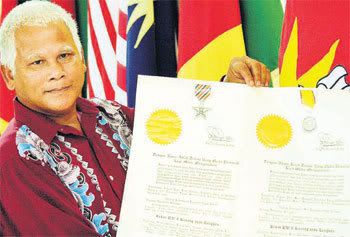
SERI PAHLAWAN GAGAH PERKASA KANANG ANAK LANGKAU
A living legend, an IBAN WARRIOR who's the most deserving to be awarded the title TUN.

TUN KANANG ANAK LANGKAU

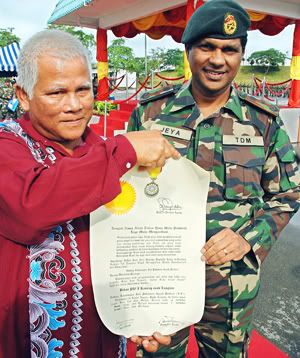
IBAN WARRIOR KANANG ANAK LANGKAU is the only living recipient of the Seri Pahlawan Gagah Perkasa (SP) medal and the Pingat Gagah Berani (PGB), the two highest gallantry awards, and the only soldier to have received both awards.

He received a letter of commendation from the Yang di-Pertuan Agong yesterday for his service and bravery in the army.

In terms of protocol, one of his awards ranks above a Tun's. But the nation's two highest awards for gallantry rest lightly on retired Warrant Officer (I) Kanang Langkau's shoulders.

According to Colonel (Rtd) Fabian Wong, no award was higher than the SP but it did not carry any title.

“It’s not listed in the federal list of importance,” said Wong, who had received the State gallantry award, ‘Pingat Keberanian Sarawak’ (PK).

He hoped Sarawak would accord protocol and importance to SP holders, adding that SP holders should be recognised as “heroes and high achievers” because its (SP) standing is higher than the ‘Tun’.

Stressing that the SP is ranked first in the federal list of awards, Wong said, the ‘Darjah Kerabat Diraja Malaysia’ is second while ‘Darjah Utama Seri Mahkota’ (third), ‘Seri Maharaja Mangku Negara’ (fourth) and Seri Setia Mahkota (fifth).

The second and third awards were only accorded to deserving members of the royal family while the fourth and fifth award - both of which carry the title ‘Tun’ - are for any other Malaysians, he said, adding that all those information could be obtained from the relevant website.


In 1961 he joined the British 42nd Royal Marines Commandos as an Iban tracker, and was later absorbed into the 8th Ranger Battalion.

"I served my country during my army days. I've sacrificed the quality time I should have had with my family. I didn't get to see my children grow up. Now that I'm retired, I spend most of my time with my grandchildren.

"That alone makes me feel like I'm the richest man in the world. A normal civilian life in peacetime is priceless," said the 67-year-old after the 3rd Army Infantry Brigade's 48th anniversary celebration in Semenggo Camp yesterday.

On June 1, 1976, Kanang and his 8th Ranger Intelligence task force were part of Operation Gerakan Setia in the Korbu Forest Reserve, Perak. They stormed the communist terrorist headquarters, killing three terrorists and disrupted the enemy supply route.

For his bravery in that operation he was awarded the PGB on June 4, 1980.

Another fierce encounter that earned him the SP was during Operation Gerakan Pukat in Tanah Hitam, Perak, on Feb 20, 1980. Kanang's platoon was ambushed while hunting a communist unit in Ladang Kending, Sungai Siput, Perak.

Despite serious gunshot wounds in the chest and stomach, as platoon sergeant, he organised a counter attack before passing out.

For his bravery that day, he received the highest award from the king on June 3, 1981.

"I never regretted joining the army. It's the best job anyone could have. And no one can beat the army in terms of welfare.

"Deep in my heart, I will remain a soldier till the day I die," said Kanang.


Kanang terima watikah PGB, SP

KUCHING 14 Dis. – Pegawai Waran Satu, Kanang Anak Langkau, (gambar) yang dikagumi atas keberaniannya menentang pengganas di Sungai Siput, Perak pada tahun 1980, hari ini menerima sijil Watikah Pingat Darjah Keberanian Tertinggi Negara, Seri Pahlawan Gagah Perkasa (SP) dan sijil Watikah Pingat Gagah Berani (PGB).

Anugerah itu disampaikan oleh Panglima 3 Briged, Brigadier Jeneral Jeyabalan S. sempena ulang tahun 3 Briged yang ke-48 di Kem Briged Kuching.

Kanang, 62, kekal menjadi ‘mentor’ dalam kerjaya Angkatan Tentera Malaysia lebih tiga dekad di atas keberaniannya itu.

Pada 3 Jun 1981, beliau diperkenan oleh Yang di-Pertuan Agong untuk menerima Darjah Keberanian Tertinggi Negara, Seri Pahlawan Gagah Perkasa (SP) iaitu lebih tinggi daripada penerima Darjah Seri Maharaja Mangku Negara (SMN) yang membawa gelaran Tun.

Sebelum itu pada 4 Jun 1980, Kanang juga pernah menerima anugerah Pingat Gagah Berani Yang di-Pertuan Agong iaitu darjah keberanian kedua tertinggi negara.

“Sejak darah dari badan saya menitis ke bumi ketika bertempur dengan musuh negara, semangat perwira masih lagi kekal dalam jiwa saya sampai bila-bila pun, saya masih seorang askar,” kata Kanang kepada pemberita di sini.

Kanang berkata, beliau tidak pernah menyesal menjadi tentera walaupun ketika zaman mudanya beliau tidak menyimpan cita-cita untuk menjadi askar.

Ketika ditanya apakah pekerjaannya setelah 21 tahun meninggalkan kerjaya sebagai ‘soldadu’, Kanang berkata, beliau mahu berehat dan menghabiskan masa bersama cucunya yang masih kecil.

– Bernama

Wednesday, December 12, 2007

Indonesia unveils giant Jesus statue

December 12, 2007 - 10:37AM

Muslim-majority Indonesia has unveiled one of Asia's tallest Jesus Christ statues in the mainly Christian town of Manado on North Sulawesi island, the company behind it said today.

Indonesian real estate developer Ciputra built the 30-metre-high statue in its CitraLand residential estate, hoping it will lure tourists and become a religious icon, the company's marketing manager Sonya Lasut said. "It looks like the Jesus is flying to bless people," she added.

The giant Jesus Christ statue in the mainly Christian town of Manado, Indonesia.
Photo: AFP

The white monument - which shows a robed Christ with his arms and palms outstretched above his head - took nearly three years to complete and cost five billion rupiah (about $A611,000). It also consisted of 25 tonnes of metal fibre and 35 tonnes of steel, Lasut added.

She said the Indonesian Museum of Records had certified the statue as Asia's tallest Jesus - overtaking the 27-metre tall Cristo Rei in East Timor's capital Dili - during a ceremony on December 2.

However, Vietnam's state-run tourism agency SaigonTourist says on its website that the southern coastal resort city of Vung Tau is home to a 32-metre-tall Jesus Christ statue. A museum official said he did not have a record of the Vietnamese statue.


AFP

Thursday, December 6, 2007

Who was Altantuya Shaariibuu?

John Berthelsen
Asia Sentinel, 05 December 2007

A murdered woman fades into a caricature as the trial of her accused killers in Malaysia drags on into obscurity

On October 18, 2006, a pretty young Mongolian translator named Altantuya Shaariibuu was brutally murdered at the age of 28. Her mutilated body was found in a jungle clearing near the Kuala Lumpur suburb of Sha Alam. Her reputation has been brutalized as well. The pictures printed here may give some of her back to the world.

After her remains were found about a month after the murder, Altantuya’s accused killers, Abdul Razak Baginda, her former lover and the head of a politically well-connected think tank, and two bodyguards for Deputy Prime Minister Najib Tun Razak, were arrested almost immediately in a blaze of newspaper headlines that all but convicted them.

She had also worked as Abdul Razak’s translator on a shady deal he was brokering for the Malaysian government to buy submarines from France. The pair seem to have travelled to Paris together. A letter found after she was killed appeared to be a demand for money from him for the care of her child, which he may have fathered. She was last seen by eyewitnesses getting into a car outside Abdul Razak’s house with the two elite bodyguards. Abdul Razak had requested help in dealing with her vocal demands for money and presence at the house.

The trial has now been underway for six months while prosecutors wade through a tangle of jurisdictional disputes and take testimony from a tedious list of tangential witnesses. Both prosecution and defense seem intent on keeping the obvious political ramifications of the trial out of the courtroom. It almost seems as if the trial is being delayed just to lessen the impact of a mistrial or even the acquittal of the politically prominent defendants.

In the meantime, Altantuya’s name has been dragged through the mud for so long that she almost has ceased to exist as a person. After being identified by local newspapers following the murder, she was first characterized as a part-time model (code language for a high-priced call girl). She also has been reviled for being an unwed mother, and for jet-setting to Europe with Abdul Razak. She has been described as a bitter, spurned lover demanding money from her rich boyfriend. Her family, meanwhile, has said she worked hard and was just trying to find her way in life.

In a letter found after her death (spelling corrected), she sounds like any jilted young woman: “To see your lover is nothing criminal right? Yes (I) was in shock. I wrote some stupid letters to him where I said I kill myself I want help. Yes I try to blackmail him. Maybe it’s my fault but no I really understand he doesn’t love me anymore and I need to stop that I asked money from him to go back how he promised to me. He lied to me to help and ruin my life. I came to KL to see him to face to face and ask why acting like that. Maybe rich person and he got family doing this. But when I come I did some thing stupid I write letter where I said I will kill myself and thing like that.”

And, she adds: “They say Malaysia is different from Mongolia and said they know people in police so can easy put me to jail. If in Malaysia law goes like that I can’t complain. But true is I did nothing to him. I’m just normal girl trying to meet my lover who lied to me and promised many things but now wants to put me in jail or kill.”

From a series of pictures made available to Asia Sentinel by Syed Abdul Rahman AlHabshi, the honorary Mongolian Consul General in Malaysia, Altantuya looks like nothing more than an attractive young woman off on the trip of her life to Europe. AlHabshi declined a request to say where the pictures came from but they are believed to have been found among her possessions after she was killed. She looks happy. Perhaps she was with her lover when these were taken. Her family has declined to elaborate on the circumstances of the pictures.

According to trial testimony by Burmaa Oyunchimeg, Altantuya’s cousin, who accompanied the victim to Kuala Lumpur to attempt to get Abdul Razak to give her money, there was one more picture. It depicted Altantuya having dinner with Abdul Razak and Deputy Prime Minister Najib. The picture was not in her possession when her decomposed body was found last October. The court has made no attempt to find the picture and Najib has not been called as a witness by either side.

The final picture here is perhaps the most disheartening. It is the three urns in which her bones sit while the trial drones on.

View picture Here