MalaysiaKini.com Video footage
Click Video Link


Saturday, September 22, 2007


Friday, September 21, 2007
RIO TINTO: ENVIRONMENTAL DESTRUCTION
Aluminium project safe. "Similajau aluminium smelting plant will use leading practice environmental standards", said Rinto Tino boss. Is he telling the truth? Let us analyse what they have been practising in other country where they operate. ....read on
The Bougainville People
Me’ekamui, the ‘Sacred Island’ of Bougainville is seen by its people as a natural, God-given inheritance to be willfully preserved from generation to generation. These indigenous people flourished here for thousands of years—thriving on the island’s rich resources of rain forested land and teeming rivers. Generations of Bougainvilleans built their culture into a productive self-sufficient economy.
Since time immemorial, land on Bougainville has been owned on a clan basis, being passed down from mother to daughter. Land boundaries are well known, and have been respected for thousands of years. According to custom, clans hold the rights to the land, the sky above and the earth below. Disrespecting this longtime custom, corporate greed bloodied the heart and soul of Bougainville with the construction of the Panguana mine.
Desperate Survival
Once Rio Tinto set foot on their land in 1960, the villagers witnessed almost an immediate sense of loss. Their health, environmental resources and livelihood were forsaken for corporate gain.
Almost immediately, the Bougainvilleans fell sick from exposure to the mine’s toxins, chemicals and air pollutants. Upper respiratory infections such as Asthma and TB became more common, and even killed people. Children became ill with coughs, colds and chronic ear infections. Many women even died giving birth, because of the lack of basic medicine and care.
As Rio Tinto ravaged the island mining for copper, the company dumped waste rock and tailings, turning the river valleys into a virtual wasteland. Fish and whole forests died, depleting the villagers of their major food source, and eliminating their cash cropping systems. The villagers lost their property due to ongoing environmental contamination. Their water became non-potable, and they were forced to come up with other resources for survival.
Unable to live this way, the people pleaded to Rio Tinto to give them control of their own land surrounding the mine. When Rio Tinto ignored their request, the Bougainvilleans united in the name of their culture and fought for their right to their inherent resources.
The Bougainvilleans’ fight for their rights left many people dead and many more injured. Three entire principal villages were relocated, and many life-long inhabitants were forced to flee the island.
With the blockade, the Bougainvilleans were completely severed from their power of electricity. They were forced to create power from what little they had. They built an electrical repair shop where townspeople turned abandoned electrical pieces into two-way radios and generators. They turned solar energy into power for electricity. Anything that wasn’t nailed down was salvaged into resources for their survival.
With rain forests razed, and hillsides sluiced, the people had no other place to look, but to each other. Together they learned new skills and found new ways to utilize the resources they still did have. Coconuts became the most valuable resource on the island. People looked past this obvious food source, and developed a new process to separate the coconut oil from the pulp so that they could uses it as a car fuel and heating resource.
Their will to survive led the Bougainvilleans to seek justice against the individuals who threatened their livelihood. Only now can they properly reclaim what is rightfully theirs.
Thursday, September 20, 2007
Yes, we are embroiled in a Constitutional Crisis
THE CORRIDORS OF POWER
Raja Petra Kamarudin
Raja Petra Kamarudin
Seri Paduka Baginda Yang di-Pertuan Agong Tuanku Mizan ibni Al-Marhum Sultan Mahmud Al Muktafi Billah Shah has already been unofficially informed that Malaysia Today is garnering online signatures to support a ten-point Peoples’ Petition (Petisyen Rakyat) appealing for Tuanku to intervene and rectify the very troubling and extremely alarming state of affairs in this country. And Tuanku has also been told that thus far we have obtained about 10,000 signatures, to which Tuanku sighed and retorted that this is going to be another responsibility he has to take care of.
We are due to officially submit the petition to Tuanku a week or so before Hari Raya. Nevertheless, since Istana Negara comes under the Prime Minister’s Department, the powers-that-be can of course deny us access to The Agong. That, in fact, happened back in November 1999.
Soon after Parliament was dissolved in November 1999, I tried to meet The Agong, who at that time was the Sultan of Selangor. The purpose of my request to meet The Agong was to hand him a letter expressing our anxiety at what could possibly happen in the event Barisan Nasional lost its two-thirds majority in the 29 November 1999 general election -- or worse, if Barisan Nasional garnered less that 50% of the seats in Parliament. This anxiety was certainly not misplaced as had been proven in the Sabah episode when two Chief Ministers were sworn in and finally, through the intervention of Kuala Lumpur, Pairin Kitingan was declared the legitimate Chief Minister and PBS ended up forming the State Government. History has shown this can and has happened and therefore history could be repeated on the morning of 30 November 1999 if we did not take precautions.
What we were concerned about (and don’t ask me who the “we” are) is that in the event Barisan Nasional, say, won 49% of the Parliamentary seats and the four opposition parties (PAS, DAP, PKN and PRM) won 51% of the seats, a Barisan Nasional Prime Minister could still be sworn in to form the government. This is because Barisan Nasional, though a coalition of 14 political parties, is a legally registered coalition; whereas PAS, DAP, PKN and PRM were a ‘loose’ coalition that was not legally registered. Therefore, say, PAS won 20% of the seats, DAP 15%, PKN another 15%, and PRM 1%, Barisan Nasional, at 49%, would still be considered the largest minority and therefore its 49% would beat PAS’ 20%, DAP’s 15%, PKN’s 15% and PRM’s 1%.
In short, Barisan Nasional would be regarded as one party winning 49% of the seats and not 14 parties winning 49% while the four opposition parties would be considered as four parties winning lesser seats than Barisan Nasional and not one party winning 51%. So, Barisan Nasional’s collective 49% would beat the four opposition parties if their seats are looked at individually instead of collectively. The letter we wanted to hand to The Agong was signed by the four opposition leaders -- Fadzil Noor, Lim Kit Siang, Dr Wan Azizah Wan Ismail, and Dr Syed Husin Ali -- agreeing to combine all the seats the four opposition parties were to win so that they could be treated as a block just like the Barisan Nasional seats. On Thursday night, I sent the letters to the four opposition leaders who were campaigning all over the country with instructions to the couriers that the letters must be returned by dawn. We sent two cars to each leader in case one car broke down or got involved in an accident -- or in case they get ambushed along the way. We also did not reveal which car was carrying the letter in case....well, you know in case what.The next morning I got the four letters back and around noon that Friday I rode to the Istana Negara on my Yamaha Virago but was not allowed into the palace. I explained that I am The Agong’s nephew and wanted to see Tuanku about a family matter. The palace official told me that they are under strict instructions from the Prime Minister’s Department that no one gets to meet The Agong until after the general election, not even family members. I phoned two of The Agong’s sons, my cousins, and tried, through them, to get to meet Tuanku. They told me that even they, Tuanku’s own sons, can’t get access to The Agong. I had no choice but to hand the letter to the palace official with instructions that the letter be personally handed to The Agong. I then went for my Friday prayers.
I went back to the office at 2.30pm and, lo and behold, there was a letter waiting for me in the fax machine, the fastest response ever from the government and which should have made the Book of Records. It was a letter from the Prime Minister’s Department turning down my request to meet The Agong with instructions to try again after the general election. Realising that Barisan Nasional was thinking exactly what we were thinking and that they had pre-empted our every move, we took steps to hire a helicopter and placed it on standby. In the event the four opposition parties do win 51% or more of the Parliamentary seats, the helicopter would take to the air and pick up the four opposition leaders and drop them onto the lawn of the Istana Negara so that they can get sworn in to form the new government; beating Barian Nasional to it like what Haris Salleh did to Pairin in Sabah.
But, again, Barsian Nasional pre-empted this. The Agong was not in the Istana Negara but was safely hidden in Langkawi where we could not get to him. Invariably, The Agong was well-guarded and not even his own sons could get to him. Anyway, that is all academic now. Barisan Nasional managed to win two-thirds of the seats though it won only 54% of the votes. So it did not matter any longer whether we could reach The Agong or not.
Expect, therefore, that we may again get blocked and may not be able to personally meet The Agong to hand Tuanku our Peoples’ Petition. At best they might just allow us to meet a palace official like what happened to PAS yesterday when all they managed to meet was the Penyimpan Mohor Besar Raja-Raja Melayu, Tan Sri Engku Ibrahim Engku Ngah. Nevertheless, this is good enough as this would still be regarded as official and would be as good as personally handing the petition to The Agong. And that is why Malaysia Today chose to conduct an online petition. Other than making this easier for all to sign, an online petition would be public knowledge and even if they block us from personally handing the petition to The Agong, they will not be able to block knowledge of the petition. This means The Agong will know about it even if the hardcopy version does not reach him.
Yes, November 1999 taught us a thing or two and it is not that easy to do us in a second time.
Now, some have asked me: what can The Agong do? Sure, The Agong receives our petition. But what can The Agong do about it when the Rulers have no power? Undeniably, those who ask this question have not read the Federal Constitution of Malaysia or do not even realise that we have one. Even those who are aware of the Constitution point out that Article 43 of the Constitution forbids The Agong from interfering in the running of the government. The Agong, they argue, can only act on the advice of the Prime Minister. Actually, that is not quite true.
Article 43 (1) says: The Yang di-Pertuan Agong shall appoint a Jemaah Menteri (Cabinet of Ministers) to advise him in the exercise of his functions.
Note that it says the Cabinet is ‘to advise him in the exercise of his functions’. It says ‘advise’ and this is the one word that has been wrongly interpreted as The Agong receives instructions from the Cabinet. If they had meant for The Agong to receive instructions from the Cabinet then Article 43 (1) would have used the word ‘instruct’ and not ‘advise’.
Now, look at Article 43 (1) (a) that says: The Yang di-Pertuan Agong shall first appoint as Perdana Menteri (Prime Minister) to preside over the Cabinet a member of the House of Representative who in his judgment is likely to command the confidence of the majority of the members of that House.
Note that Article 43 (1) (a) says that The Agong shall appoint as Perdana Menteri ‘a member of the House of Representative’. It does not say that the Perdana Menteri must be the President of Umno or the Chairman of Barisan Nasional. The only criterion for the appointment of the Perdana Menteri is: ‘who in his judgment is likely to command the confidence of the majority of the members of that House’.
Note that part again: ‘who in his judgment is likely to command the confidence of the majority of the members of that House’. What happens if The Agong, in his judgement, feels that the Perdana Menteri is UNLIKELY to command the confidence of the majority of the members of that House? In other words, what happens if 111 Members of Parliament pass a vote of no confidence in Parliament? Would The Agong then not, in his judgment, form an opinion that the Prime Minister no longer commands the confidence of the majority of the members of that House?
Okay, you may argue that this is in theory only and in practice could never happen. We can never see the day when 111 Members of Parliament will stand up in Parliament and pass a vote of no confidence against the Prime Minister, you might say. Never mind! Even if you think that in practice this will never happen, what is important is that in theory it is possible and it will be perfectly legal to do so, and The Agong, according to the Constitution, can intervene and remove the Prime Minister. And it is not treasonous to talk about it or actually do it because the Constitution provides for it.
What is even more interesting is Article 43 (4) of the Federal Constitution that says as follows: If the Prime Minister ceases to command the confidence of the majority of the members of the House of Representatives, then, unless at his request the Yang di-Pertuan Agong dissolves Parliament, the Prime Minister shall tender the resignation of the Cabinet.
Yes, once 111 Members of Parliament pass a vote of no confidence on the Prime Minister, he (plus the entire Cabinet) has to resign, unless the Prime Minister asks The Agong to dissolve Parliament -- which means we shall then have fresh elections (and later I will show you that The Agong can refuse to dissolve Parliament even if the Prime Minister asks him to).
This continues in Article 43 (5) which says: Subject to Clause (4), Ministers other than the Prime Minister shall hold office during the pleasure of the Yang di-Pertuan Agong, unless the appointment of any Minister shall have been revoked by the Yang di-Pertuan Agong on the advice of the Prime Minister but any Minister may resign his office.
In short, while the Prime Minister must resign, if it pleases The Agong, the Cabinet Ministers can stay in office.
Now, let us look at a hypothetical situation. Say 111 Members of Parliament secretly meet The Agong or send him a petition saying that they have lost confidence in the Prime Minister, although no official vote of no confidence has been tabled in Parliament, this can also be regarded as the majority of the Members of the House having lost their confidence in the Prime Minister and The Agong can act on that.
Okay, now let us look at Article 32 (1): There shall be a Supreme Head of the Federation, to be called the Yang di-Pertuan Agong, who shall take precedence over all persons in the Federation and shall not be liable to any proceedings whatsoever in any court.
And Article 32 (2) says: The Consort of the Yang di-Pertuan Agong (to be called the Raja Permaisuri Agong) shall take precedence next after the Yang di-Pertuan Agong over all other persons in the Federation.
In short, The Agong is the Supreme Head of Malaysia while his consort is The First Lady who ‘takes precedence next after the Yang di-Pertuan Agong over all other persons in the Federation’. Maybe the New Straits Times can stop calling Jeanne Danker The First Lady as this goes against our Constitution.
The Agong’s supreme power is further clarified in Article 39 which says: The executive authority of the Federation shall be vested in the Yang di-Pertuan Agong and exercisable, subject to the provisions of any federal law and of the Second Schedule, by him or by the Cabinet or any Minister authorised by the Cabinet, but Parliament may by law confer executive function on other persons.
The icing on the cake is of course Article 40a.
40a. (1) In the exercise of his functions under this Constitution or federal law the Yang di-Pertuan Agong shall act in accordance with the advice of the Cabinet or of a Minister acting under the general authority of the Cabinet, except as otherwise provided by this Constitution; but shall be entitled, at his request, to any information concerning the government of the Federation which is available to the Cabinet.
40a. 2) The Yang di-Pertuan Agong may act in his discretion in the performance of the following functions, that is to say:
(a) the appointment of a Prime Minister;
(b) the withholding of consent to a request for the dissolution of Parliament;
(c) the requisition of a meeting of the Conference of Rulers concerned solely with the privileges, position, honours and dignities of Their Royal Highnesses, and any action at such a meeting and in any other case mentioned in this Constitution.
40a. (3) Federal law may make provision for requiring the Yang di-Pertuan Agong to act after consultation with or on the recommendation of any person or body of persons other than the Cabinet in the exercise of any of his functions other than:
(a) functions exercisable in his discretion;
(b) functions with respect to the exercise of which provision is made in any other Article.
(b) functions with respect to the exercise of which provision is made in any other Article.
Now, while 40a (1) says “the Yang di-Pertuan Agong shall act in accordance with the advice of the Cabinet or of a Minister acting under the general authority of the Cabinet”, it also says “except as otherwise provided by this Constitution”. So this means The Agong can act WITHOUT the advice of the Prime Minister wherever the Constitution allows him to do so.
Article 40a (2) in fact allows The Agong to “act in his discretion in the appointment of a Prime Minister”. This therefore makes it perfectly legal for The Agong to use his discretion in appointing the Prime Minister of Malaysia. Discretion here would mean that The Agong can do what he feels is right and if he feels that Tengku Razaleigh Hamzah should be the Prime Minister then Tengku Razaleigh it is. And Article 40a (3) says that “Federal law may make provision for requiring the Yang di-Pertuan Agong to act after consultation with or on the recommendation of any person or body of persons other than the Cabinet in the exercise of any of his functions other than functions exercisable in his discretion”. This means two things:
1. Any person or body of persons other than the Cabinet CAN advice The Agong; which means these other people can override the Prime Minister.
2. But these same people who can override the Prime Minister cannot override The Agong in cases where The Agong is allowed to exercise his own discretion.
2. But these same people who can override the Prime Minister cannot override The Agong in cases where The Agong is allowed to exercise his own discretion.
And finally Article 41: The Yang di-Pertuan Agong shall be the Supreme Commander of the armed forces of the Federation. So, in short, while Article 31 makes The Agong the Supreme Head of the Federation, Article 41 makes him the Supreme Commander of the armed forces. If that is not power then I don’t know what is -- unless you don’t know what the word ‘Supreme’ means.
Now, recently, the government openly declared that Malaysia is not on the verge of another Constitutional Crisis, 20 years after the first two. Actually this is not true. Malaysia is not on the verge but is already embroiled in a Constitution Crisis. But those who walk in the corridors of power are trying to hide this fact from us. Allow me to reveal a message I received from one of my Deep Throats in the corridors of power. The following is self-explanatory and demonstrates what I am trying to say:Two names, Nik Hashim and Hashim Yusof, were given by the CJ, both whom are ‘kaki bodek’, as possible candidates to replace him. Both these candidates were rejected by the Rulers. After their elimination, as a consolation, they were promoted to the Appeals Court.
Since the Rulers had rejected Nik Hashim and Hashim Yusof, the next in line would be Justice Dato Abdul Hamid Mohamed and Justice Dato Alauddin Mohd. Sherif. But the CJ does not favour these two because they are independent-minded, apolitical and well-known for their integrity. The CJ bypassed these two on the pretext that both are close to retirement in a year or two. On the Rulers’ insistence, the PM and the CJ had no choice but to accept Justice Hamid as President of the Court of Appeal and Justice Alauddin as the Chief Justice of Malaya. Both of them were appointed by the Agong on 5 September 2007.
On the same day of the above two appointments, a senior lawyer from the private sector, Tan Sri Zaki Tun Azmi, 62 years old, became the first person to be directly-appointed to the Federal Court. He is UMNO’s Legal Adviser and a member of its Disciplinary Committee plus is Fairuz’s ‘kaki’ from the Kedah days.
His leaving a lucrative private sector practice where he was making millions a month in legal fees -- repeat, millions a month -- raises questions in the minds of the members of the bench, the chattering class, and some important MPs on both sides of the political aisle. The speculation is that he could probably succeed Fairuz as CJ.
It is an open secret that the Prime Minister wanted a two year extension to Fairuz’s contract. But this was rejected by the Agong and his brother Rulers. As a temporary arrangement, the PM asked the Agong to appoint Fairuz on a three-month contract. The Agong is still holding back his agreement on this matter.
This whole affair, yet again, shows the PM’s duplicity. Here is a God-given chance to do something about our Judiciary, which has been systematically destroyed over the last 25 years. Instead of doing something about it, which is what the people want, the PM is still trying to keep the rot afloat by working with Fairuz.
It is a shame that today our Rulers have to step in to defend the Constitution and rebuild our much-battered institutions. It is also a sad reflection of our UMNO-led governance. You have to expose this and do not worry about the authenticity of the information as my information is from impeccable sources. You will be doing Malaysians a great public service by exposing this latest Constitutional Crisis.
Wednesday, September 12, 2007
Rio Tinto: Founded On Blood
by Sue Boland


Signing Ceremony between Rio Tinto and Cahaya Mata Sarawak (CMS) to form a Joint-venture company called "Sarawak Aluminium Company"

Anglo-Australian company Rio Tinto, the world's largest mining company, has more than 60 operations in 40 countries. Antarctica is the only continent that has escaped its ravages.
In every continent where Rio Tinto operates the story is the same: land taken from indigenous people without compensation; workers prevented from freely organising in trade unions; destruction of the environment; and cosy relations with politicians, government officials and dictators.
In 1999, Rio Tinto's turnover was US$9.31 billion (A$14.42 billion) and its after-tax profit was US$1.28 billion (A$1.99 billion). It mines a diverse range of minerals and metals including coal, copper, gold, uranium and iron ore. It controls 55% of the world production of borate, 15% of industrial diamonds and around 8% of uranium.
The company was founded on blood
English capitalists formed the company in 1873 to mine the Rio Tinto copper deposit in Spain. During the Spanish Civil War of 1936-39, when Germany's Adolf Hitler and Italy's Benito Mussolini were in an alliance with Spain's General Franco, Rio Tinto's chief Sir Auckland Geddes told the company's 1937 annual general meeting in London: “Since the mining region was occupied by General Franco's forces, there have been no further labour problems ... Miners found guilty of troublemaking are court-martialled and shot.”
This became the model for Rio Tinto's later cosy relationships with South Africa's racist apartheid regime, Chile's dictator General Pinochet and Indonesia's murderous dictator Suharto.
In 1995, Rio Tinto-Zinc (RTZ) merged with its subsidiary Conzinc Riotinto of Australia (CRA), which was 40% owned by Australian capitalists, to form RTZ-CRA. It changed its name to Rio Tinto in 1997. Now it is in the process of buying out North Limited, the parent company of Energy Resources Australia which owns the Jabiluka uranium mine in the Northern Territory.
Rio Tinto has an appalling record in its relations with indigenous peoples. Some examples are:
- Rio Tinto led the mining industry campaign against native title in Australia in 1997-8;
- to build the Weipa bauxite mine in north Queensland, Comalco (then a subsidiary of CRA), forcibly removed two Aboriginal communities, at Weipa and Mapoon;
- Aboriginal sacred sites were almost completely destroyed during construction of the Argyle diamond mines in Western Australia;
Indonesia's armed forces (TNI) have killed and tortured indigenous land owners protesting against the Grasberg mine in West Papua. The mine is primarily owned by US-based Freeport-McMoRan, but Rio Tinto has a 12% share in the company and a 40% interest in the mine expansion. Freeport-McMoran provides Indonesian soldiers with transport, food and accommodation; and the establishment of Rio Tinto mines in Bougainville, Indonesia and the Philippines has resulted in large numbers of indigenous people being thrown off their land with little or no compensation and appalling environmental consequences.
Union busting
Over the last 15 years, Rio Tinto has waged a vendetta against trade unions. In Australia, the company has de-unionised most of its metalliferous mining and smelting operations. Its main tactic has been to frustrate the collective bargaining process then offer individual contracts to workers desperate for a pay rise.
Rio Tinto is now focussing its Australian anti-union campaign on its coalmines. In six years, Rio Tinto has reduced its coal operations work force by 28% and cut real wages by 20%.
In Zimbabwe, Rio Tinto has tried to bypass the Associated Mineworkers of Zimbabwe by setting up a company “sponsored” by a committee of workers.
In South Africa, the National Union of Mineworkers is disputing Rio Tinto's practice of sacking workers and then employing contract workers to do the same work at a lower pay rate. Rio Tinto profited greatly from collaborating with the apartheid regime. It developed the Palabora copper and uranium deposit in the Transvaal while the apartheid regime was savagely repressing the black majority.
While the South African armed forces were illegally occupying Namibia in the 1970s, Rio Tinto violated United Nations sanctions by establishing its Rossing mine there and illegally selling the uranium it produced.
Rio Tinto still discriminates against black workers. In South Africa the company forces them to live in old housing compounds away from their families. At its Rossing mine, Rio Tinto maintains racial segregation in company housing. Black employees are paid rock-bottom wages while their white counterparts are paid above the maximum of the common scale, in what is called an inducement band. In 1998, Rio Tinto suddenly pulled out of negotiations with the Mineworkers Union of Namibia over ending racial discrimination on the job.
Environmental devastation
Typical of Rio Tinto mining operations is the Kelian goldmine in East Kalimantan, Indonesia, which has poisoned the nearby river so that it can no longer be used for drinking and bathing.
The expansion of the Grasberg mine in West Papua will result in 285,000 tonnes of tailings contaminated with toxic heavy metals being dumped into the Ajikwa river system every day. This is equivalent to a 10-tonne truck dumping its load every 10 seconds.
When the Panguna copper mine in Bougainville was operating, it dumped 1 billion tonnes of waste into the river system, killing all aquatic life and creating a 480-square-kilometre blot on the environment.
This destructive practice helped make Bougainville Copper Ltd CRA's most profitable single venture in 1973 with an annual profit of A$158 million. By the early 1980s, BCL was contributing a hefty 23% of RTZ's pre-tax profits, despite representing only 9.4% of the corporation's total assets and 8% of its sales.
Rio Tinto's destructive practices around the world have led to opposition from workers, indigenous land owners, local communities and environmentalists. Rio Tinto has developed a strategy for dealing with community opposition.
Rio Tinto's subsidiaries usually have names that are quite different to that of the parent company, allowing it to hide its role in destructive mining developments.
In dealing with indigenous peoples' opposition, Rio Tinto usually begins negotiations with several indigenous groups. Once it establishes which group can be bought off, it ceases negotiations with all the others and claims that it has indigenous support for its project.
When faced with community opposition, Rio Tinto sometimes sets up its own “community” groups that support its mining projects.
Cosy relationships
Rio Tinto likes to write the rules by which it operates. The March 2000 edition of Mining Monitor, published by the Minerals Policy Institute, reported that Rio Tinto has established a joint project with Australian Legal Resources International, a human rights group affiliated to the Australian Council for Overseas Aid. Part of the project will involve drafting of “environmental law, human rights law, constitutional law, bankruptcy and corporate law” for Indonesia.
Rio Tinto typically gets substantial assistance from governments around the world. For example, in Bougainville it won a five-year tax holiday. At Weipa, it paid a token A$4 per square mile in rent for the land. Its Tiwai Point smelter in New Zealand was sold electricity at rates 13 times cheaper than household consumers pay.
Friday, September 7, 2007
Rio Tinto: the world's worst company?

Rio Tinto: the world's worst company?
By James Vassilopoulos
By James Vassilopoulos
With a turnover of $10.8 billion in 1996, Rio Tinto is the biggest mining company in the world. Through its mines and subsidiaries, Rio Tinto wears many masks. Among them are: Hunter Valley Mine No 1; Comalco; Bougainville Copper Ltd; Argyle Diamonds; Hamersley Holdings; US Borax; BP Canada; La Escondida in Chile; PT Kaltim Prima in Kalimantan, Indonesia; Rossing Uranium in Namibia; and Palabora in South Africa. [Rio Tinto: Sarawak Aluminium Company]
The dispute with coal miners at the Hunter Valley No 1 is the latest in its ongoing battle with unions and workers. In that dispute it presents itself as offering workers an extra for ``productivity'' improvements.
But its history of ties to the apartheid regime, its abuse of indigenous peoples, its attacks on workers and unions, its global environmental pillaging and its use of child labour tell a different story.
Roger Moody, in his book Plunder, describes Rio Tinto's activities as ranging from ``brow-beating opponents, leaning on governments and price-fixing, to violating international law, union-busting and management of one of the world's biggest commodity cartels''.
It is the quintessential capitalist corporation, skilled at maximising profits irrespective of environmental and human rights concerns.
In 1991, Rio Tinto owned 200 subsidiaries in 40 countries. In 1996, it made $1.4 billion after-tax profit. It mines a diverse range of minerals and metals including coal, copper, gold, uranium and iron ore. It controls 55% of the market for borates, 15% of industrial diamonds, around 8% of uranium and significant percentages of world copper, bauxite and iron ore production.
Born of dead miners
Rio Tinto was founded in 1873 to mine the Rio Tinto copper deposit in the Spanish province of Andalusia. It was floated on the London stock exchange, funded by English capitalists and Deutsche National Bank, a German bank.
From the start, Rio Tinto's success was at the expense of working people. Several hundred Rio Tinto miners died from lung diseases like silicosis between 1877 and 1887.
The company was rocked by labour struggles in the 1920s, as Richard West's book River of Tears documents. In 1920, many left-wing miners were sacked after a strike which lasted four months, in protest at mass sackings and being paid in food.
In the Spanish Civil War of 1936-39, Andalusia was a stronghold of the Republicans against the fascist Nationalist forces of the dictator, General Franco. Sir Auckland Geddes, the chair of Rio Tinto, reported approvingly to the company's 1937 annual general meeting in London: ``Since the mining region was occupied by General Franco's' forces, there have been no further labour problems ... Miners found guilty of troublemaking are court-martialled and shot.''
The 1950s and 1960s were tumultuous times for Rio Tinto. Two-thirds of its Spanish mine was sold. It expanded its exploration and mining to ``safe'' countries like Canada, Australia, the US, New Guinea and South Africa.
In South Africa, Rio Tinto developed the Palabora copper and uranium lode in the Transvaal. At the time, the vicious apartheid regime was savagely repressing the black majority. Rio Tinto supplied uranium from its Rossing mine in Namibia to England, under both Conservative and Labour governments, in defiance of United Nations sanctions against apartheid.
In 1962, Rio Tinto merged with Consolidated Zinc, greatly increasing concentration in the mining industry. The new corporation, called Rio Tinto-Zinc (RTZ), now mined uranium, gold, iron ore, bauxite and zinc and owned various smelting companies.
Its rise and rise continued into the 1980s, when it bought out BP US. In 1995, it merged with its Australian subsidiary Conzinc Riotinto of Australia, 40% owned by Australian capitalists, to form RTZ-CRA. In 1997, it changed its name to Rio Tinto.
Indigenous peoples
Rio Tinto claims it has an excellent record in dealing with indigenous people, but the reality is much different.
The demand by the Aboriginal Mining Information Centre -- ``Don't CRAp on our land!'' -- exemplifies relations between indigenous people and this multinational. Indigenous land claims have been one of the biggest obstacles to Rio Tinto's pillaging of the earth's resources.
Plunder outlines some examples.
To build the Weipa bauxite mine, Comalco -- 67% owned by CRA -- forcibly removed two Aboriginal communities from their land at Weipa and Mapoon. On November 15, 1963, the Mapoon community was arrested in the dead of night and everything -- their homes, the school, the shops -- was burnt to the ground.
According to a 1975 report by International Development Action, Comalco refused to provide reasonable compensation for their loss or to pay royalties to the people of Weipa and Mapoon.
According to a 1975 report by International Development Action, Comalco refused to provide reasonable compensation for their loss or to pay royalties to the people of Weipa and Mapoon.
The Argyle Diamond Mines joint venture controlled by CRA in 1992 was the world's most lucrative mine. During mine construction, Roger Moody recounts, Aboriginal sacred sites were pulverised. The Barramundi Dreaming area, a site sacred to Aboriginal women, has been almost completely destroyed.
A damning report by a number of academics in 1984 concluded that the company's ``good neighbour program'' at Argyle had failed. The company controlled Aboriginal people socially and politically and left them isolated, disadvantaged and powerless.
The November issue of Common Cause, the miners' union journal, states that Rio Tinto's Argyle Diamonds has been linked to child labour in the diamond polishing industry in India.
Rio Tinto has often bragged about the jobs it creates for Aboriginal people. At Weipa, according to Moody, only 10% of the work force were Aboriginal in 1977. At Argyle Diamonds' mine, only three of the mine's 1000-strong work force are members of the local Aboriginal people.
In 1963, Comalco asked the arbitration commission to allow it to pay indigenous workers less than half the average of white workers' wages, according to International Development Action.
More extreme human rights abuses have occurred at the Grasberg mine in West Papua, primarily owned by US-based Freeport-McMoRan, and in which Rio Tinto has a 12% share. It has a 40% interest in the output from an expansion now under way.
The Australian Council for Overseas Aid in April 1995 found Freeport-McMoRan turned a blind eye to Indonesian armed forces' killing and torturing of people protesting in the vicinity of the mine. Soon after these revelations, RTZ-CRA bought its 12% share.
The ACFOA report found that 52 people had been killed from May 1994 to April 1995. Freeport-McMoRan has denied any part in the killings by Indonesian troops protecting the mine. The company provides transport, food and accommodation for the soldiers.
Individual contracts
In the 1980s, Rio Tinto smashed the unions at the Robe River iron ore mine in the Pilbara, pioneering the introduction of individual contracts in Australia. It did a similar thing at the aluminium smelter at Tiwai Point, New Zealand.
At Weipa, in 1995, it offered bonuses for workers who left the union and signed individual contracts. Out of a work force of 700, only 71 stayed with the union. But by 1997, the number of unionists had doubled, Nigel Gould, Weipa president of the Construction, Forestry, Mining and Energy Union, told Green Left Weekly.
More recently, an Rio Tinto subsidiary, Coal & Allied, has been involved in a bitter dispute with the CFMEU in the Hunter Valley over gutting of working conditions.
At Mt Thornley in the Hunter Valley, another Rio Tinto coal mine, it is trying to sack 120 of the work force of 400. At Vickery, also in the Hunter, 12-hour shifts have been partially implemented, even though a consultant's report showed that these result in lower productivity.
An important part of the propaganda of the federal government, in cahoots with Rio Tinto, is that its workers are an ``elite''. Yet a rigger or greaser, according to the coal award, earns just $526.50 per week.
What isn't trumpeted is that Rio Tinto executive chairman Bob Wilson is paid $2.44 million, according to the company's 1996 annual report. It would take a rigger or greaser 80 years -- two working lives -- to make that amount.
In Third World countries, the company's treatment of workers is almost feudal. In West Papua, Freeport-McMoran pays local workers about $3.50 a day. There have been 143 serious industrial accidents.
In 1972, in white minority-ruled Rhodesia, black miners were paid just 10% of the wages of white workers. Even after the end of white rule in 1989, the Mineworkers Union of Namibia charged that 92% of black miners at Rio Tinto's Rossing uranium mine did not earn a living wage.
Environmental hooliganism
Environmental damage caused by mining can be minimised by not mining in national parks or World Heritage areas, processing waste and rehabilitating areas after mining -- measures that cost money. Rio Tinto has not been prepared to do this.
The key demand of the Carpentaria Land Council in its fight with RTZ-CRA over the Century Zinc mine in Queensland, was to stop the proposed 300-kilometre slurry pipeline from the mine to the sea. The council instead pushed for a rail line. Rio Tinto refused.
Plunder outlines numerous examples of environmental irresponsibility. These include a tailings dam completely collapsing in the Philippines, spewing acidic waste and heavy metals, and 617 chemical drums, suspected of containing sodium cyanide and hydrochloric acid, falling into the river at its Kelian gold mine in Indonesia.
Ranger uranium mine in NT has had 28 leaks from its radioactive tailings dam.
The Panguna mine in Bougainville, when it was in operation, dumped 1 billion tonnes of waste into the river system, killing all aquatic life and creating a 480 square kilometre blot.
In 1989, Rio Tinto sold off one of its chemical companies, IC Chemicals, Britain's second biggest producer of chlorofluorocarbons (CFCs). According to Roger Moody, Alistair Frame, a top management figure at RTZ, claimed that scientists were divided on whether CFCs destroyed the ozone layer.
Val Duncan, chair of RTZ in the 1960s, claims he was called to the British Atomic Energy Commission and ordered ``to go forth, find uranium and save civilisation''. The uranium mined at CRA's Mary Kathleen mine in Queensland ``ended up in both British and US nuclear warheads'', claims Moody.
The Coalition government has recently given the go-ahead for the Jabiluka uranium mine in the Kakadu National Park. The next uranium mine may be Rio Tinto's Rudall River mine in WA. This proposed mine is in a national park and on Aboriginal land.
Presenting evidence to the World Uranium Hearing in Salzburg in 1992, Matome Malatzi, regional coordinator for community health near the Palabora uranium mine in South Africa, gave evidence that children were allowed to play with yellowcake. Uranium was washed into the river from which people drink and wash.
Buddies and price fixing
In 1970, Comalco was launched. It offered selected people pre-issue shares, according to Moody. They included the Queensland treasurer and acting premier, Gordon Chalk, and his family, the minister of Aboriginal affairs and the soon to be premier, Joh Bjelke-Petersen.
Rio Tinto has a long history in leading cartels which fix prices and eliminate competition. In the 1970s, it was a part of the Uranium Producers' Club, which boosted the price of uranium five-fold.
Although making billions of dollars in profits, it has also benefited from assistance from governments. In Bougainville it had a five-year tax holiday. At Weipa, it got the land almost for free, paying $4 per square mile in rent -- ``About one hundred and sixtieth the normal mining rent at the time'', estimates Moody.
For its Tiwai Point smelter in New Zealand, it was sold electricity at rates 13 times cheaper than consumers pay.
British PM Margaret Thatcher in 1986 approved interest-free loans to RTZ worth US$30 million.
One of RTZ's newest partners is the ``ugly Canadian'' Robert Friedland. Friedland is Rio Tinto's junior partner in the Lihir gold mine in PNG. Executive Outcomes, the apartheid-linked mercenary force that was contracted by the PNG government to invade Bougainville and reopen the Panguna mine, is largely controlled by a Friedland company, according to Roger Moody, writing in Multinational Monitor. Friedland's companies trade with the dictatorship of Burma and have interests in Indonesia.
It was RTZ chair Sir Roderick Carnegie who said at its 1984 shareholders' meeting: ``The right to land depends on the ability to defend it''. Ordinary people throughout the world are finding that the right to a job, good wages, human dignity and land rights depends on the ability to fight and beat Rio Tinto.
HUMAN RIGHTS VIOLATIONS
...
Another infamous Rio Tinto operation is in Borneo. Rio Tinto owns 90% of the Kelian gold mine in Kalimantan. Prior to Rio Tinto's arrival to Kalimantan, small-scale gold mining was performed by the local population. Around 1989, under General Suharto, paramilitary police were brought in to force the local miners out of the mines. These people were never compensated for the loss of their livelihood. In 1990, Rio Tinto acquired more land, which meant that a number of settlements had to be razed. Many of the people who were evicted had to live in shanties. A total of 440 families were displaced from their homes. Some compensation was paid, but it was not adequate to cover losses.
Problems with the Kelian gold mine go beyond the eviction of the local population. More recently there have been allegations of sexual harassment and rape. These allegations have been reported for about ten years, but an independent investigation was conducted only recently. The investigation revealed that many of the claims of sexual abuse could be supported. The head of the inquiry, Mr Benjamin Mangkoedilaga, reported that the victims of sexual abuse had been threatened with dismissal if they did not cooperate or were promised a job or money in return for sex. Although according to its statement of business practice Rio Tinto claims to be committed to corporate transparency, the company apparently never revealed the investigation or its findings in its reports to shareholders or in its voluntary Social and Environmental Reports. Additionally, just last month, Oxfam's newly established Mining Ombudsman published its first Annual Mining Report. The report provides well documented details of grievances from local communities which have been devastated by the Kelian mine.
Rio Tinto under pressure
Pius Nyompe came to England from East Kalimantan to express to shareholders and Rio Tinto's board the views of the community affected by PT Kelian Equatorial Mining. He outlined the problems PT KEM's gold mine (90% owned by Rio Tinto) had caused his community in East Kalimantan: pollution of the River Kelian with sediment and chemicals; air pollution from dust from mining traffic; the seizure of people's land and homes; the obliteration of the small-scale local mining industry; and human violations.
Nyompe said that - for all Rio Tinto's talk of 'working with the community' - the company had only started discussions with the Kelian people in May 1998 after years of ignoring their letters and protests. They wanted a proper independent audit of PT KEM's impact on the community in full consultation with the community and NGOs; full compensation for the loss of their land rights and human rights violations; and proper rehabilitation of their land. The only way of getting Rio Tinto to accept responsibility for its operations in PT KEM was to hand over 20% of the value of its shares to rectify the above. If they were not prepared to do this, then Rio Tinto should get out of Indonesia, Nyompe stated through an interpreter. Before returning to Indonesia, Nyompe met Rio Tinto Executive Director, Leon Davis, at the company's London head office to explain the Kelian people's grievances and demands. A deputation of 14 people from East Kalimantan plus Indonesian NGO staff met with Rio Tinto and PT KEM management twice in May in Jakarta, but were not satisfied with the outcome as company representatives attempted to deny their responsibilities. Their only concession was to invite the Indonesian environmental organisation WALHI to carry out its own investigation of water pollution down stream of the mine. Another round of talks about fair compensation for land, forests and crops started in the provincial capital Samarinda in late June.
Rio Tinto closes Kelian mine - history of human rights abuses
The mine was developed on land owned by indigenous Dayak communities who were given no choice but to move. Its history has been punctuated by protests over evictions, violence and intimidation by security personnel against people who protested, and violence against women as well as environmental pollution.
"Locals suffer from skin rashes when they bathe in the river. They can no longer catch the fish they rely upon as a protein source, and the water is so contaminated with insufficiently treated mine wastes that it's too dangerous to drink", continues Mr Ramli. ... More story here and here
Tuesday, September 4, 2007
Monarchy An Integral Part Of Country, Says Raja Nazrin
50 Years of National Development and Nationhood
KUALA LUMPUR, Sept 3 (Bernama) -- The monarchy in Malaysia is an integral part of the country as well as a symbol of identity, continuity, unity and strength and, contrary to some opinion, is not all form and no function, the Raja Muda of Perak Raja Dr Nazrin Shah, said tonight.
It is a symbol of identity because it is a national institution, one that distinguishes this country from all others, and it is a symbol of continuity because the monarchy in Malaysia is an old institution and provides a sense of historical significance to the people, he said.

"It is a symbol of unity because it is a focal point for citizens of all races, religions and political persuasions to rally around. And it is a symbol of strength because it exemplifies the virtues of justice, mercy and honour," he said at a public lecture entitled "50 Years of National Development and Nationhood" at the Khazanah Nasional Development Seminar, here.
Raja Nazrin said that over the last five centuries, many monarchies around the world have disappeared because Rulers took their status as a divine right rather than a responsibility.

"They did not bother to re-evaluate and reinvent their roles as guardians of the welfare of their subjects and, not surprisingly, did not retain the public's acceptance and trust," he said.
Raja Nazrin said monarchies came to be closely associated with autocracy, megalomania, tyranny, cruelty and feudalism despite the fact that in the past 100 years, leaders of all kinds, communist, socialist, democratic, republican, militaristic and even religious, have arisen who have displayed these qualities and much more.
He said the monarchies that have survived, including the monarchy in Malaysia, have done so because they have evolved in line with social progress and contribute to public life.
"They have evolved by accepting the reality of, and placing themselves above, partisan politics. They contribute to public life by redefining their role as that of helping to uphold justice, maintain peace and resolve conflicts between contending parties, in much the same way as judges serve society," he said.
He said the monarchies function as the "voice of reason, moderation and good governance," especially if there is extremism or chauvinism.
In this way, the monarchy strengthens the institutions of governance and enhances, rather than detracts from, the democratic process, he said.
Raja Nazrin said that for the monarchy in Malaysia to continue to function effectively as one of the main national axes around which society pivots, it must remain fresh and vital by fulfilling the role expected of it.
"It is an often overlooked or under-appreciated fact that the monarchy in Malaysia is supposed to play a productive role by being a healthy check and balance in the system of governance," he said.
He said the Federal Constitution mandates the monarchy to be the guardian of the just rule of law, an impartial arbiter in the democratic process and an overseer over the pillars of state.
"Some believe that Rulers are supposed to do so in a purely ceremonial sense, but I would argue that this contradicts the true spirit, if not the letter, of the Federal Constitution," he said.
He said that while the monarchy is required to act on the advice of the executive, it must also uphold the principles of good governance and the rule of law, with credibility and impartiality.
"To do otherwise would be to undermine its integrity, as well as that of the Federal Constitution," he said, adding that for the monarchy to effectively discharge its responsibilities, it will need to have avenues for genuine and in-depth consultations with the executive.
Raja Nazrin said this should pose no problem, however, given the common and unswerving aim of advancing the interests of the nation.
"This unity of purpose will also help ensure that the relationship will be cooperative and not marred by open confrontation," he added.-- BERNAMA
Saturday, August 25, 2007
The UMNO Ministers and The Bloggers

The Blind Men and the Elephant
(Sufi and Indian)
(Sufi and Indian)
In the farthest reaches of the desert there was a city in which all the people were blind. A king and his army were passing through that region, and camped outside the city. The king had with him a great elephant, which he used for heavy work and to frighten his enemies in battle. The people of the city had heard of elephants, but never had the opportunity to know one. Out rushed 6 young men, determined to discover what the elephant was like.
The first young man, in his haste, ran straight into the side of the elephant. He spread out his arms and felt the animal's broad, smooth side. He sniffed the air, and thought, "This is an animal, my nose leaves no doubt of that, but this animal is like a wall." He rushed back to the city to tell of his discovery.
The second young blind man, feeling through the air, grasped the elephant's trunk. The elephant was surprised by this, and snorted loudly. The young man, startled in turn, exclaimed, "This elephant is like a snake, but it is so huge that its hot breath makes a snorting sound." He turned to run back to the city and tell his tale.
The third young blind man walked into the elephant's tusk. He felt the hard, smooth ivory surface of the tusk, listened as it scraped through the sand, then as the elephant lifted the tusk out, he could feel its pointed tip. "How wonderful!" he thought. "The elephant is hard and sharp like a spear, and yet it makes noises and smells like an animal!" Off he ran.
The fourth young blind man reached low with his hands, and found one of the elephant's legs. He reached around and hugged it, feeling its rough skin. Just then, the elephant stomped that foot, and the man let go. "No wonder this elephant frightens the king's enemies," he thought. "It is like a tree trunk or a mighty column, yet it bends, is very strong, and strikes the ground with great force." Feeling a little frightened himself, he fled back to the city.
The fifth young blind man found the elephant's tail. "I don't see what all the excitement is about," he said. "The elephant is nothing but a frayed bit of rope." He dropped the tail and ran after the others.
The sixth young blind man was in a hurry, not wanting to be left behind. He heard and felt the air as it was pushed by the elephant's flapping ear, then grasped the ear itself and felt its thin roughness. He laughed with delight. "This wonderful elephant is like a living fan." And, like the others, he was satisfied with his quick first impression and headed back to the city.
But finally, an old blind man came. He had left the city, walking in his usual slow way, content to take his time and study the elephant thoroughly. He walked all around the elephant, touching every part of it, smelling it, listening to all of its sounds. He found the elephant's mouth and fed the animal a treat, then petted it on its great trunk. Finally he returned to the city, only to find it in an uproar. Each of the six young men had acquired followers who eagerly heard his story. But then, as the people found that there were six different contradictory descriptions, they all began to argue. The old man quietly listened to the fighting. "It's like a wall!" "No, it's like a snake!" "No, it's like a spear!" "No, it's like a tree!" "No, it's like a rope!" "No, it's like a fan!"
The old man turned and went home, laughing as he remembered his own foolishness as a young man. Like these, he once hastily concluded that he understood the whole of something when he had experienced only a part. He laughed again as he remembered his greater foolishness of once being unwilling to discover truth for himself, depending wholly on others' teachings. But he laughed hardest of all as he realized that he had become the only one in the city who did not know what an elephant is like.
The story is used to illustrate many principles. None of us see it the same way, and it is far more than what any one of us can experience at any one time. This is akin to Zainuddin Likens Some Bloggers To Karaoke Singers
 KARAOKE SINGER ala Zainuddin
“Knowing in part may make a fine tale, but wisdom comes from seeing the whole”.
Interpretation (by Carl Strang): The above text combines many features from the sources, and adds a few twists of my own. Less interpretation seems called for in this fable, which in all versions supplies interpretations of its own. The Sufis extend it further, however, pointing out that this story comments on the folly of attempting to use the physical senses and logic to comprehend spiritual matters. The blind men thus can be seen as representing our physical senses and logical tendencies.
Sources: Backstein, Karen. 1992. The Blind Men and the Elephant. Scholastic, N.Y.
Collard, Geri. 1997. Pers. com.
Kohlhofer, Merrill. 1997. Pers. com.
Quigley, Lillian. 1959. The Blind Men and the Elephant. Charles Scribners Sons, N.Y.
Saxe, John Godfrey. 1963. The Blind Men and the Elephant. McGraw-Hill, N.Y.
Shah, Idries. 1967. Tales of the Dervishes. E.P. Dutton, N.Y.
Young, Ed. (Publ. date not found). Seven Blind Mice. Philomel Books, N.Y.
Wednesday, August 15, 2007
Rio Tinto: Sarawak Aluminium Company
Following the signing of the agreement, a new joint venture company was formed, Sarawak Aluminium Company. This mega project will be sited at Similajau near Bintulu in the state of Sarawak. Rio Tinto holds 60 per cent stake in the project and 40 per cent is held by CMS. Full story, click here and here
Latest related articles, click here

While we can conclude that Alcan itself heavily supplies the arms industry and is invading Africa as it invades Iceland, it is now part of Rio Tinto, the world's largest private mining company, “long criticized for gross human rights violations dating back to its support of apartheid in Southern Africa.”
Latest related articles, click here
RIO TINTO’S ABYSMAL RECORD
While we can conclude that Alcan itself heavily supplies the arms industry and is invading Africa as it invades Iceland, it is now part of Rio Tinto, the world's largest private mining company, “long criticized for gross human rights violations dating back to its support of apartheid in Southern Africa.”
We will name some of the many cases. Rio Tinto has been known to subject it’s own workers to poisoning in mines, having security guards shooting locals on the spot looking for small amounts of gold in one of it’s mines and having union-members spied upon or fired in its Brazilian gold mines.
Rio Tinto has been involved with mercenary scandals. The Papua New Guinean (PNG) Government, in joint venture with Rio Tinto, hired private mercenary companies Sandline International, a London-based private military company, composed primarily of former British and South African special forces soldiers, which had been involved in the civil wars in Angola and Sierra Leone and were now paid to fight the population of Bougainville, an island near PNG. The mine had been closed by the people of the island because of the disastrous ecological effects.
Citizens of Bougainville have filed a class action lawsuit in the United States against Rio Tinto arising from the environmental damage caused by the mine and war crimes occurring during the civil war years. In August 2006, the United States Court of Appeals for the Ninth Circuit rejected Rio Tinto's effort to dismiss the claim.
Full story, click here
Full story, click here
TO THE PEOPLE OF BINTULU, PARTICULARLY SIMILAJAU AND SURROUNDING AREAS, AND THE PEOPLE OF SARAWAK IN GENERAL, PLEASE BE AWARE OF THE SERIOUSNESS OF THE ENVIRONMENTAL / ECOLOGICAL IMPACTS OF THIS PROJECT ON THE WELL BEING AND HEALTH OF THE PEOPLE.
PLEASE EXPLAIN THE SERIOUSNESS IMPACT OF THIS PROJECT TO THE PEOPLE. BE WARN, IT HAS A VERY SERIOUS IMPLICATIONS ON THE PEOPLE'S HEALTH.
WE WANTS DEVELOPMENT, BUT NOT AT THE EXPENSE OF THE PEOPLE LIFE
AuctionAds: Increase the bid on your site's income! Try AuctionAds
Saturday, July 28, 2007
Malaysia’s Malay Leaders say ‘Do As I Say, Not Do As I Do’ when it comes to Marriage
Malaysia’s Malay leaders say ‘do as I say, not do as I do’ when it comes to marriage
 In early June, the Malaysian media blossomed with pictures of Prime Minister Abdullah Ahmad Badawi in the traditional Malay suap-menyuap ceremony, exchanging bites of colored glutinous rice with his new bride.
This low-key but high-profile wedding followed another elite ceremony in May when one of Malaysia’s most eligible bachelors, the Raja Muda (crown prince) of Perak, Dr Raja Nazrin Shah, finally got hitched at the age of 50 in an unostentatious ceremony in Kuala Kangsar.

But these two weddings had something else in common, a characteristic not much commented on in the media but clear to most Malaysians: in both cases the brides were locally-born Eurasians. The prime minister’s new wife is Jeanne Abdullah, a friend and relative of Abdullah Badawi’s late wife, Endon, who died of complications from breast cancer in October 2005. Jeanne had originally been Jean Danker, a Catholic from a Eurasian family which spans Malaysia and Singapore and who converted to Islam when she married her first husband, Endon’s brother Othman, from whom she was later divorced.

 The bride of Oxford and Harvard-educated Raja Nazrin, son of the current Perak Sultan, who himself was formerly Malaysia’s top law official, is Zara Salim Davidson, a chemical engineer and the daughter of William Davidson, a
 British-born Ipoh lawyer and his Malay wife. She herself is a member of the Kedah royal house and thus related to Malaysia’s first prime minister, Tunku Abdul Rahman. Raja Nazrin has repeatedly spoken out against racism in Malaysia. Zara considers herself to be very much a Malay despite her Eurasian blood.
These weddings thus represent what should be one of the triumphs of Malaysia its ability to break down racial and religious barriers and subsume them into a broader Malaysian identity. Unfortunately the elite all too often fails to preach what it actually practices. It is a one-way street. Marry a Malay and you will become a Malay. You will also become a Muslim and, the courts say, you will stay that way.
The good-natured Abdullah Badawi clearly has no problem with the mixed racial ancestry of his bride, or with the fact that she was baptised a Christian. Yet he heads a ruling party which is not merely race-based but at times makes a fetish of Malay racial purity. And he heads a government that supports the recent court decision refusing to allow a Muslim to become a Christian, an act of supposed apostasy. But in the eyes of some Christian fundamentalists, the gentle Jeanne is also an apostate for having forsaken Christianity.
Malays are not the only ones with identity problems. Scratch many a Malaysian Chinese and one may also find a strain of Chinese chauvinism, as is often the case in Singapore. But in Malaysia it is the Malay elite which sets the tone. This is why many believe that a more open recognition of the sheer diversity of Malaysians’ origins would help offset the divisions caused by race-based politics that identifies religion with race.
Just a brief look at the origins of many members of the elite gives the lie to ethnic purity and religious dogmatism. There is Mahathir Mohamad, Malaysia’s longest-serving prime minister. His father was a Muslim Malayali from Kerala in south India who migrated to Malaysia and took a Malay bride. Mahathir himself was classified as an Indian when at university in Singapore.
 But instead of celebrating the upward mobility that Malaysia offered to this migrant from India, the politics of the United Malays National Organisation required Mahathir to bury his ethnic past and wear his acquired Malay identity on his sleeve. In reality Mahathir welcomes racial mingling. His son Mirzan married into the family of Indonesian Chinese tycoon Liem Sioe Liong, and daughter Marina’s first husband was European.
 The current head of the UMNO youth, Hishamuddin Hussein, who waved a kris (Malay dagger) at last year’s national UMNO convention and offered to bathe it in Chinese blood to the ominous cheers of the
 audience, is another whose Malay roots are not as deep as often assumed. His grandfather, the founder of UMNO, Onn Jaafar, appeared to be a Caucasian, which was not surprising given that his Johor-based family was of Turkish origin. Onn was ejected from the party he founded because he wanted to make it multi-racial and though his son went on to become the head of UMNO and a prime minister, he carried with him his father’s inclusive and moderate instincts.
 Onn lost out politically to Malaysia’ s first Prime Minister, Tunku Abdul Rahman. Although the Tunku placed more emphasis on Malay identity, he was certainly no exclusivist. Indeed, he had been born a subject of the King of Siam and as a scion of the royal house of Kedah spent some of his early years in Bangkok at the court of his then sovereign. His mother was Siamese, though her family originally was from Pegu
 (Burma). Of his four wives, one was Thai Chinese, one English, one Malay and one Malaysian-Chinese. He never hid his fondness for whisky, even while heading the Organization of Islamic Conference, or his student days in England pre-occupied, as he once put it, with “fast women, fast cars and not-so-fast horses.”
The Malay aristocracy has anyway been quite catholic in its choice of brides. Those in mixed marriages include Ahmad Shah, the Sultan of Pahang, whose consort is of Pakistani lineage. The Sultan of Selangor’s  divorced second consort and mother of his heir apparent ( Cik Puan Nur Lisa Abdullah) was an American citizen.
 Sultan Iskandar of Johor’s first wife, the mother of his heir apparent, was a British woman, Josephine Trevorrow. In this respect Sultan Iskandar took after his own grandfather, Sultan Ibrahim, who had two European wives, one British, one Romanian.
 Maybe it is Johor’s geography, its proximity to Singapore and the diversity of Indonesia, but its politicians seem to thrive on marrying outsiders. Former Deputy Prime Minister Musa Hitam’s first wife was from (Catholic) Latin America and his second was of mixed ancestry . Another Johor politician, Tun Dr Ismail Abdul Rahman, deputy prime minister in the early 1970s, was of part Chinese ancestry.
 Conversions of convenience to Islam often mean that Malay mixtures leave lit
 tle trace compared with other cross-ethnic marriages. But the non-Malay, but Muslim, origins of many of the elite are found everywhere, from South Asia, Yemen, Egypt, Turkey and other countries. They include the likes of Zeti Aziz, the governor of Bank Negara. She is the daughter of Ungku Aziz, the European-looking former University of Malaya vice-chancellor, whose Johor-based family came from Turkey.
Chinese roots are also more real than apparent, often hidden by conversions. But relatively recent high-profile marriages to Chinese include Tengku Razaleigh,  former finance minister and a member of the Kelantan royal house who married a long-time Chinese friend who converted and changed her name to Noor Abdullah. Rashid Hussein, the prominent Singapore-born, Anglophile financier whose
 father was Indian and mother Malay married Sue Kuok, a daughter of tycoon Robert Kuok Hock Nian, the Malaysian-born but now Hong Kong-based tycoon. Kuok’s first wife and mother of some of his children was Eurasian but he later married a Chinese and emphasized his Chinese ethnic identity. In a recent book, “Asian Godfathers” Kuok was described by an in-law as “the biggest racial bigot I have ever met.”
former finance minister and a member of the Kelantan royal house who married a long-time Chinese friend who converted and changed her name to Noor Abdullah. Rashid Hussein, the prominent Singapore-born, Anglophile financier whose father was Indian and mother Malay married Sue Kuok, a daughter of tycoon Robert Kuok Hock Nian, the Malaysian-born but now Hong Kong-based tycoon. Kuok’s first wife and mother of some of his children was Eurasian but he later married a Chinese and emphasized his Chinese ethnic identity. In a recent book, “Asian Godfathers” Kuok was described by an in-law as “the biggest racial bigot I have ever met.”Among the non-Malay groups, inter-ethnic marriages are generally much more common than among Malays. However it also seems the case that migration is the preferred option for the numbers of Malaysians who either marry across ethnic lines or acquire foreign spouses while studying or working abroad. This particularly applies to Malay women who are either not particularly religious or who see no reason why their spouses should convert.
By one estimate, there are some 150,000 mixed marriages in Malaysia, a number that seems impossibly small in a population of 24 million. The leafy, winding streets of Damansara Heights and Kenny Hills abound with matrons who entered into marriage and lives of leisure with well-to-do Malays straight out of the universities of England, where the government had sent their mates. It is forbidden for a Muslim to marry a non-Muslim, so these women, with their servants and their huge homes, stop being Jean and become Jehan in public, although seldom in private.
 But while the list of Malay elites is long and rich with instances of intermarriage, at the lower economic levels the list is short, and increasingly circumscribed by the growing power of Malaysia’s shariah, or Islamic religious courts. The issue was brought to the fore in the case of Lina Joy, who changed her name from Azlina Jailani and became a Catholic in an effort to marry a non-Muslim.

With scores, perhaps hundreds, of outraged Muslims outside the courtroom, demanding that she be denied the chance to change her religion on her identity card, a high court ruled in May that she was subject to the jurisdiction of the shariah court. The shariah courts have allowed one conversion in history – for a woman who had been dead for decades.The result is that either people do not marry, or they emigrate. Bright women who have preferred to marry foreigners found their husbands denied work permits. There are believed to be thousands living in Australia, Canada or the United Kingdom.
For Malaysia’s young to take their cues from Malaysia’s top politicians and the cream of society outside of official policy might not be a bad idea. Shamsul Amri Baharuddin, the Director of the Institute of the Malay World Civilisation (ATMA) and Professor at University Kebangsaan Malaysia (UKM) in Bangi – and himself married to an Australian, says Abdullah Badawi’s marriage to Jean Danker Abdullah is “not a catalyst but certainly symbolic.”
 Marina Mahathir told Asia Sentinel that “If people think that marrying into another culture is enriching, then it will be a good thing. But some people make one person give up their own culture because they think of it as inferior.”
But so long as the elite indulges in kris-waving while marrying as it pleases, multiracial nation-building may have scant grass roots impact.
Tuesday, July 24, 2007
Raja Petra Kamarudin vs Muhammad son of Muhammad
Raja Petra wrote:
This is the Muhamad who started life as a schoolteacher but does not speak a word of English. When caught carrying millions of dirty money into Australia, he pleaded ignorance of the English language and was acquitted by the Australian court the crime of smuggling money. What many people failed to realise is that when he resigned as a schoolteacher to contest the general election, the government made a claim of RM80,000 against him because he was on contract and was bound by this contract to serve the government to pay off what he owed. Full story here

“Do you know that that orang bodoh ran away with the Sultan’s daughter and then denied it?” I asked the police. They just smiled. “Well, I am going to reveal this to the world,” I continued. “I am going to publish the letter he wrote to the Sultan where he denied he had married the Sultan’s daughter whereas he had in fact already secretly married her in Thailand. You tengoklah. I akan balun si bodoh tu habis-habis.” Full story here
 THE GOOD TIMES ENDED abruptly for Muhammad Taib. The chief minister of the rich Malaysian state of Selangor was in the midst of a family vacation Dec. 22 when customs officials at Brisbane airport found close to $1 million in his suitcase. That’s against the law in Australia since Muhammad apparently did not declare he had more than A$5,000 ($4,000) cash in his possession. But the legal significance of the incident paled in comparison with the moral implications for the prominent politician. As the longtime chief of Selangor, Muhammad, 51, earns an estimated $8,000 a month, excluding perks, and is supposed to stay out of private business. Where then did the money come from? And why was he carrying it in cash?
Re-cap: Muhammad is caught with a suitcase of cash
By Steven Frank and Steven K.C. Poh / Kuala Lumpur
Asiaweek.com (January 10, 1997)
By Steven Frank and Steven K.C. Poh / Kuala Lumpur
Asiaweek.com (January 10, 1997)
THE GOOD TIMES ENDED abruptly for Muhammad Taib. The chief minister of the rich Malaysian state of Selangor was in the midst of a family vacation Dec. 22 when customs officials at Brisbane airport found close to $1 million in his suitcase. That’s against the law in Australia since Muhammad apparently did not declare he had more than A$5,000 ($4,000) cash in his possession. But the legal significance of the incident paled in comparison with the moral implications for the prominent politician. As the longtime chief of Selangor, Muhammad, 51, earns an estimated $8,000 a month, excluding perks, and is supposed to stay out of private business. Where then did the money come from? And why was he carrying it in cash?The chief minister had an explanation. After returning to Malaysia last week, Muhammad said the money was given to him by his brothers for an Australian property transaction that was not completed. “I didn’t realize that I had to make a declaration for the cash before leaving Australia,” he said. True or not, many felt the damage had already been done. “The incident has been a disgrace to the country,” says Lim Guan Eng, deputy leader of the opposition Democratic Action Party (DAP). “For a senior politician to be arrested in a foreign country does not say good things about the level of corruption control in Malaysia.”
What exactly it does say about corruption may not be known for some time, if ever. But it certainly doesn’t look good. Just three months ago, Muhammad was one of three members of the dominant United Malays National Organization picked as party vice-president. The polls followed an emotive speech by Prime Minister Mahathir Mohamad, who heads UMNO, about the evils of money politics. Mahathir even wept, saying that if left unchecked, this “cancer” will eat into the very fabric of Malaysian society. Politicians, Mahathir added, must not only be clean, but must also be seen to be clean.
How clean is Muhammad? The one-time school teacher has certainly attracted foreign investment to the state, streamlined its bureaucracy and modernized its infrastructure. He has also made some controversial decisions. Last year, for instance, he infuriated many women by dropping a requirement that a man needs to get his wife’s permission before entering a subsequent marriage. There have been some questionable dealings in his past too. In early 1992, Muhammad had to deflect claims that he accepted $4 million from a property developer.
Now Muhammad faces his toughest challenge. There have already been conflicting explanations as to why he was carrying so much cash. A few days after the arrest, Selangor UMNO deputy liaison chairman Abu Hassan Omar said Muhammad had told him on the phone that “the money was for shopping.” Soon after that, a spokesman from the chief minister’s own office maintained that nothing of that nature was implied in the telephone conversation, and that Muhammad did not say the money belonged to him.
Muhammad will have to appear in an Australian court March 21. He is to face charges that could lead to forfeiture of the money, a fine and up to five years in jail. Until then, it appears he will keep his posts as Selangor chief and UMNO vice president. Just how Mahathir handles this case will be the key. Muhammad has already submitted a report on his arrest to the prime minister. Others would like to see much more. “There’s definitely a need for Muhammad to show some public accountability by declaring his assets,” says DAP leader Lim Kit Siang. “Otherwise, the PM’s tears would have been in vain.”
Saturday, July 14, 2007
Incriminating Evidence Against the IGP
There is clearly an incriminating evidence against the IGP Tan Sri Musa Hassan as reported in the Malaysia Today website. There was a Statutory Declaration signed by an Assistant Superintendent of Police dated on 13 July 2007. It would be interesting if the ACA could interview this ASP to get deeper into this corruption allegations against Tan Sri Musa. Hopefully there will not be any cover-up on this matter.
Full Articles below: The Malaysia Today article posted by Raja Petra Kamarudin in THE CORRIDORS OF POWER
Posted by: Raja Petra Kamarudin
I have been monitoring the comments in Malaysia Today’s blogs concerning the news item on the Anti-Corruption Agency’s (ACA’s) announcement absolving the Deputy Minister of Internal Security, Johari Baharum, of corruption. Johari was alleged to have received RM5.5 million in bribes as an inducement to release three Chinese organised crime bosses from detention.
Most readers appear appalled and are up in arms that Johari was pronounced innocent. They were pretty sure he is guilty as hell and should therefore be hung upside down by his balls. Let us get one thing very clear. If anyone were to propose that a lynching team be formed to hang Johari from the nearest tree, I would be first in line to volunteer joining the mob. But it would not be for the crime of accepting bribes to release three organised crime bosses. It would be for the role he played in sabotaging Tun Dr Mahathir Mohamad in the Kubang Pasu division elections last year.
Sure, I know, you are now going to tell me that Johari was just following the orders of the Umno Supreme Council that is headed by Umno President cum Malaysian Prime Minister Abdullah Ahmad Badawi. Yes, I know about that meeting where Johari and the Menteri Besar of Kedah were summoned before the Umno Supreme Council and that both were ordered to ensure, by hook or by crook, that Mahathir losses the contest for the post of delegate to the Umno Annual General Assembly. I also know that the meeting was recorded and that Rais Yatim pointed out how stupid it is to put such a sensitive matter on record as the entire Umno Supreme Council would be implicated in a breach of the party Constitution and the party Code of Ethics. I also know that the Minutes were then recalled and replaced with new Minutes with three pages of this extremely incriminating evidence expunged from the new Minutes.
Nevertheless, although the records were wiped clean and the Minutes amended to expunge all evidence of the crime, Johari, notwithstanding he was merely following orders under instructions of the Umno Supreme Council, cannot be absolved of this crime. But this is his only crime as far as I know. As for the crime of receiving RM5.5 million in bribes to release three Chinese organised crime bosses, I can categorically state that he is not guilty of this. And I will relate in awhile why I say so. On how the anonymous website mysteriously emerged to accuse him of this crime, and who is behind that website, this is anybody’s guess. But I heard that the police already know who set that website up with the sole intent of implicating Johari in the crime of receiving bribes from underworld bosses. Maybe the police will soon close in on the culprits and bring them to book, which I heard was perpetuated by police officers themselves.
Anyway, Malaysia Today has done its own independent investigation to get to the bottom of the allegation against Johari. And this is what we discovered, much to our surprise. In fact, Malaysia Today is in custody of the signed Statutory Declarations of no less than half a dozen police officers and many more have indicated that they are prepared to come forward to reveal the rot in the police force and expose how the Chinese organised crime syndicate is practically running the Royal Malaysian Police (PDRM). But we shall address that matter later.
Today, we want to focus on the allegation that Johari received RM5.5 million to release three Chinese organised crime bosses. And as follows is what happened.
There is this Malay police officer holding the rank of ASP who we shall just refer to as Deep Throat, or DT for short. DT has in fact authorised Malaysia Today to reveal his name but we thought we would keep that a secret for now in the event we need him to come forward to testify in a court of law later on.
On 21 August 2006, DT, who was then based in Sabah, was promoted to the rank of ASP, backdated to 1 July 2005. This promotion, however, would involve a transfer, so DT approached his boss, DSP Chew Tham Soon, to enlist his help in the matter. DT later found out that DSP Chew had proposed that he be transferred to Johor. DT did not actually want to go to Johor. He would rather remain where he was. DSP Chew, however, persuaded DT to accept the transfer.
In November 2006, DSP Chew brought DT and DSP Wan Hassan, the Deputy Commander of the Police Training Centre in Kota Kinabalu, to Petaling Jaya to meet someone who could assist police personnel in matters of transfers and promotions. The person DT was introduced to in his office in the Amcorp Mall was BK Tan.
BK Tan then interviewed DT to get a better understanding of his background and experience. During this interview, a fat Chinese man by the name of Ah Hon entered the room and was introduced to DT as the man in-charge of the Southern Zone. Ah Hon would be contacting DT whenever the need arises.
As they were talking, Dato Othman Talib, a member of the Police Force Commission, entered the office and BK Tan left the room to greet him. This is the man who vets and recommends promotions of police officers and who has a very close relationship with BK Tan.
A short Chinese man also entered the room at about that same time. This man was introduced to DT as DSP Ng Fook Long, the man in charge of Johor who DT would be serving under. DT was assured that BK Tan has a very close and personal relationship with the IGP and that the IGP would listen to all his recommendations. In short, they were demonstrating to DT that they call the shots and nothing happens in the police force without them agreeing to it. DSP Chew also pointed out another man in the next room. This was none other than the IGP’s son who shared an office with BK Tan.
DT sat there watching while the assembly of police officers and the Chinese organised crime bosses discussed the latest transfers and promotions in the police force.
The following month, in December 2006, DT finally received confirmation of his transfer to Johor. That same day, DT received a phone call from Ah Hon enquiring as to when he would report for duty and that he should make his way to Johor as soon as possible.
Within two or three days of his confirmation of transfer to Johor, DT was advised by some other police officers who had once served in Johor to be wary of the Chinese organised crime syndicate. On 16 January 2007, DT reported for duty in Johor.
As soon as he reported for duty, Ah Hon contacted DT to inform him that his house was ready and he immediately went to inspect it. The house at Bistari Impian in Larkin belonged to a Chinese woman. When DT asked how much the rental was, he was informed that it was usually RM1,200 but for him it would be reduced to RM900. Nevertheless, he was told to not worry about the rent. He could move in first and they could sort out the matter of the rent later.
DT’s new boss, DSP Ng, told him that he can carry on and do his job except for the illegal lotteries or empat nombor ekor haram. For illegal lotteries he would have to refer to him (DSP Ng) first before taking any action.
On 28 February 2007, DT received a SMS from Ah Hon asking him to conduct raids in three localities in Kulai with instructions to make sure that he does not ‘come back empty’. DT informed DSP Ng about this and he (DSP Ng) replied that he too had received the same SMS. DT was quite upset about this turn of events. We are police officers and cannot receive instructions from the organised crime syndicate, said DT. DSP Ng did not respond but just kept quiet.
In early March 2007, DT moved out of the house that Ah Hon had arranged for him and went to look for new lodgings in Bandar Baru Uda. Realising that DT did not want to have anything more to do with the organised crime syndicate, Ah Hon sent DT a SMS apologising for instructing him to conduct the raid the month before. Thereafter, Ah Hon never contacted DT again.
That same month, DT received information about the organised crime syndicate headed by Goh Cheng Poh a.k.a Tengku that came under the jurisdiction of Ah Hon. According to the information DT received, Tengku would determine whom the police should raid. These are basically independent operators who refuse to come under the organised crime syndicate’s network and who chose to remain independent. DT was also informed that any police officer who did not play ball would immediately be transferred out of Johor and placed under cold storage. DSP Mohd Hedzir Bin Hussin and Inspector Ng Swee Min were mentioned as two such police officers who serve the organised crime syndicate.
On 28 March 2007, a team from Bukit Aman headed by DSP Zawawi went down to Johor to conduct raids in two locations at Taman Sri Putri in Kulai. 32 fax machines were confiscated and 17 people arrested in that raid. A police report detailing this raid was made in Kulai (report number 2588/2007) while another report was made in Johor Bharu Selatan (report number 7295/2007).
Resulting from this raid, three people -- Soh King Siang, Lim Chin Chai and Lee Yoke Han -- were recommended for detention under the Emergency Ordinance. Till today, the approval to detain them has not been given yet while the case-file for their boss, Tengku, could not be opened due to ‘lack of statement’. Instead, 13 police reports were made against DT alleging that he physically abused those detained and disciplinary action was instituted against him.
On 30 March 2007, DT and his team detained another three Chinese organised crime syndicate bosses under the Emergency Ordinance -- Chai Ngew, Chin Yew Fah and Tan Lee Poey. Under the Emergency Ordinance, just like under the Internal Security Act, one can be detained for up to 60 days after which one is either released or sent for further two years detention as the case may be. These three, however, were released after just nine days without DT’s knowledge. From what DT found out, the Deputy Director of the CID, Dato Khalid Abu Bakar, had ordered their release in spite of the detention order still being in force. On 29 May 2007, all the officers involved in the detention of these crime bosses were transferred out and placed in cold storage.
To cover their tracks, they had to pin the blame on a kambing hitam (sacrificial lamb). And this most unfortunate sacrificial lamb selected as the fall guy is the Deputy Minister of Internal Security, Johari Baharum. But that is all now history and water under the bridge. We all know about the allegation against Johari Baharum. What we want to know is: is Johari innocent or guilty of accepting a bribe of RM5.5 million to release these three Chinese organised crime syndicate bosses and scum of the earth? It appears, though, like he may be innocent after all. It was the CID and not the Deputy Minister who arranged for their release, and behind the backs of those who had arrested them on top of that. Well, if Johari is innocent and did not take the RM5.5 million bribe to release these three, then who did?
Yes, this is what the ACA may have to now look into. And I believe the ACA has already started interviewing those concerned to get to the bottom of the whole issue. Let us hope the ACA uncovers what Malaysia Today has uncovered. If not, then Malaysia Today may have to run a few more episodes of this series until the walls come crumbling down.
Nevertheless, we doubt that anything much will come out of the ACA investigation. The man tasked with the job of conducting the investigation is too junior and has barely been three years on the job. This man, Suhaimi, does not seem to even know the right questions to ask. We hope the ACA is not intentionally sending a man ill-equipped to do the job so that the whole thing can be botched up due to inexperience.
The Statutory Declaration signed by DT on 13 July 2007



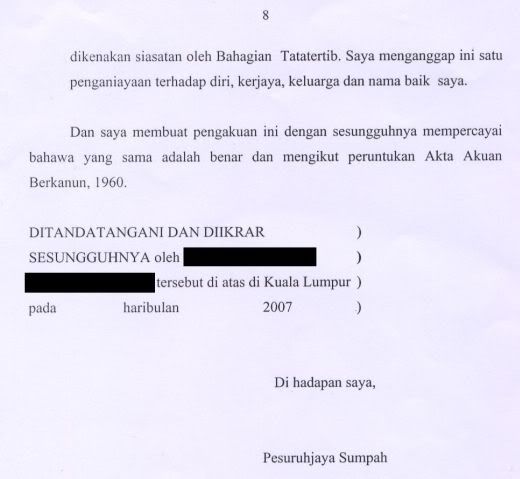
Subscribe to:
Posts (Atom)